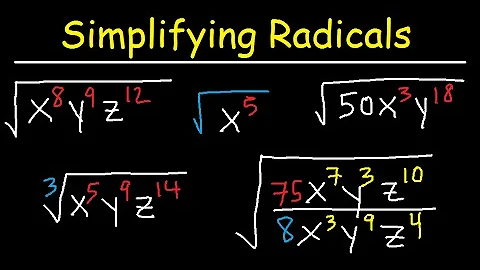
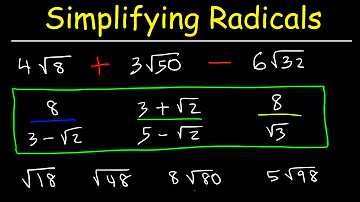
in this video we're going to focus on simplifying square roots we're going to start with some basic examples and then gradually they're going to get harder so consider these four examples how would you simplify it let's start with the first one what is the square root of 49 what two identical numbers when multiplied will give you 49. forty nine is seven times seven so it turns out that the square root of forty nine is seven what about the square root of negative twenty five well this won't give you real number but this will give you an imaginary number what you can do is break it up into 25 times negative one and it's important to understand that the square root of negative 1 is the imaginary number now what is the square root of 25 what two numbers multiplied what two identical numbers when you multiply them will give you twenty-five we know that five times five is twenty-five so the square root of twenty-five is five and the square root of negative one is so this gives us the imaginary number 5i now what about negative square root 81 this time it's little different than the previous example the negative is on the outside so we're not going to get an imaginary number but we're going to get real number and that negative sign will remain on the outside so what is the square root of 89 mean excuse me what is the square root of 81 what number times itself is equal to 81. now we know that 9 times 9 is 81. so the square root of 81 is going to be 9. so the answer that we get in this case is negative 9. now what about negative square root of negative 64. what's the answer there if you have negative sign inside square root it's best to remove it by writing the square root of negative 1 next to it so we can replace this with now the square root of 64 is 8 because 8 times 8 is 64. and so the final answer is going to be negative 8i now sometimes you may have to simplify square roots that don't contain perfect squares for example how can we simplify the square root of and the square root of 75 now you need to understand what are perfect squares one is perfect square because one times one is one four is perfect square two times two is four nine is perfect square because three times three is nine four times 4 is 16 5 times 5 is 25 6 times 6 is 36 7 squared is 49 8 squared is 64. 9 squared is 81. 10 squared is 100. so these are known as perfect squares because if you have the square root if any of these numbers like let's say the square root of 36 it's going to simplify to an integer but now 18 and 75 are not included in this list so how do we simplify the square root of 18 and the square root of 75 what would you do here one thing that you could do is you can break up the number eighteen into two smaller numbers one of which contains perfect square so what perfect square goes into eighteen eighteen is divisible by nine so what would do is write the square root of 18 as being the square root of 9 times the square root of 2 because 9 times 2 is 18. and now at this point we know what the square root of 9 is the square root of nine is three and so the final answer is three square root two and so that's simple way in which you could simplify square roots let's do the same for the square root of so what is the highest perfect square that goes into 75 25 goes into 75 75 divided by 25 is 3 so we can write 75 as being 25 times 3 and the square root of 25 is 5. so the square root of 75 simplifies to 5 square root 3. now let's work on some more similar problems for the sake of practice try these two the square root of 12 and the square root of 48 feel free to pause the video as you work on those two examples so the highest perfect square that goes into 12 is four so we can write 12 as four times three and the square root of four is two so this is going to give us 2 square root 3. now what perfect squares can go into 48 48 is divisible by 4 and it's also divisible by 16. so what do you do in this scenario if you have multiple perfect squares that can go into number pick the highest one in this case 16. 48 divided by 16 is 3 so we can write 48 as being 16 times 3 and the square root of 16 is 4. so the answer is going to be 4 square root 3. try these two problems four square root ninety eight and also seven square root eighty now which perfect square goes into 98 49 goes into 98 and you could write 98 as being 49 multiplied by 2. now what is the square root of 49 we know the square root of 49 is 7 and now we need to multiply 4 by 7 which is 28 so the final answer for that problem is 28 square root 2. now what about for the next one what perfect square goes into 80 80 is divisible by 16. if you take 80 and divide it by 16 you're going to get 5 so you can write 80 as being 16 times 5 and the square root of 16 is 4. so now we have 7 times 4 which is 28 and so this is going to give us 28 square root 5 and so that's it for that problem now what would you do if you have problem that looks like this square root 18 plus times the square root of 72 minus 4 times the square root of 32 how would you simplify this expression now it's important to understand that at this point we cannot add the coefficients of the radicals because right now what's inside the square root are different but if they were the same we could for instance to illustrate that we can't say 3x plus 5y is 8xy that doesn't work however we can add like terms so we could say that 3x plus 5x is 8x so the only way we can add the coefficients is if the radicals are the same for example if had 4 square root 3 plus 5 square root 3 because the radicals are the same can add the coefficients 4 plus 5 adds up to 9. so what need to do in this problem is simplify the square roots in such way that all of these numbers inside the square root that remains will be the same so 18 we can write that as 9 times 2. the perfect square that goes into 72 is 72 is 36 multiplied by 2 and 32 we can write that as 16 times 2. now the square root of 9 is 3 and the square root of 36 is 6 and the square root of 16 is 4. so now can multiply three times three that's going to give me nine five times six is thirty and four times four is sixteen so now at this point can add the coefficients plus 30 that's 39 minus 16 that's going to be 23. so the final answer is 23 square root 2. and so that's how you could simplify problems like this you need to simplify each square root until you get identical square roots and then you can add the coefficients so i'm going to stop it here today that's it for this video hopefully you found it useful if you did feel free to subscribe to this channel thanks again for watching
7:44
Simplifying Square Roots Math with Mr J
Math with Mr. J
404.7K مشاهدة · 4 years ago
3:42
Simplifying Radicals Easy Method
Mario's Math Tutoring
1.5M مشاهدة · 9 years ago
12:01
Math Antic Simplifying Square Roots
mathantics
1M مشاهدة · 6 years ago
43:40
01 Simplify Square Roots with Factor Trees in Algebra Radical Expressions Part 1
Math and Science
816.9K مشاهدة · 7 years ago
11:52
Simplifying Radicals With Variables Exponents Fractions Cube Roots Algebra
The Organic Chemistry Tutor
2.6M مشاهدة · 10 years ago
11:09
Math Antics Exponents and Square Roots
mathantics
2.4M مشاهدة · 7 years ago
9:09
Simplify SQUARE ROOTS 2 EASY Ways
Does Math for Coffee
5.1K مشاهدة · 3 years ago
2:52
How to Simplify the Square Root of a Non Square Number
Brian McLogan
543.5K مشاهدة · 13 years ago
5:37
GCSE Maths What on Earth are Surds And How do You Simplify Them Part 1 3 2026 27 exams
Cognito
1.1M مشاهدة · 5 years ago
13:14
How To Simplify Radicals
The Organic Chemistry Tutor
1.1M مشاهدة · 8 years ago
14:49
How to Simplify Square Roots – Step by Step
Math Queen
22.9K مشاهدة · 1 month ago
4:00
What are Square Roots Math with Mr J
Math with Mr. J
1.4M مشاهدة · 4 years ago
3:40
How to Calculate Square Roots without a Calculator Mental Minute Math

 7:44
7:44
 3:42
3:42
 12:01
12:01
 43:40
43:40
 11:52
11:52
 11:09
11:09
 9:09
9:09
 2:52
2:52
 5:37
5:37
 13:14
13:14
 14:49
14:49
 4:00
4:00
 3:40
3:40
 1:58
1:58


