GCSE KS 3 Biology Plant Reproduction Anatomy Pollination

👁 1 مشاهدة

GCSE KS 3 Biology Plant Reproduction Anatomy Pollination

النص الكامل للفيديو

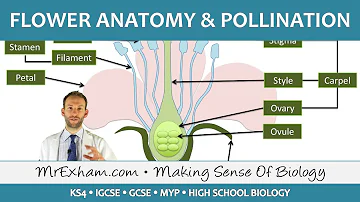
In this video, we're going to learn about plant reproduction. So, we'll cover the male and female reproductive parts of flowering plant, what self-pollination and cross-pollination are, and then also how flowers are adapted for insect and wind pollination. Let's start by covering the male and female reproductive parts of flowering plant. Most flowers have both male reproductive parts, but also female reproductive parts, too. Now, these male and female structures are enclosed within modified leaves called petals, and these are sometimes brightly colored or scented in order to help attract pollinators. Now, when the flower is still in bud, the petals themselves are enclosed by modified green leaves called seepil. And the job of the seepil is to help protect the inner structures of the bud. So that's all the reproductive parts and the petals too. So if we now run through the male parts of typical flower, these consist of two structures, anthers and filaments, which together are called the stamon. The anthers produce pollen and these pollen are tiny grains that contain the male gametes. Filaments are the long stalks that support the amphas. In terms of female reproductive parts, then these include the stigma which sits above style and then just below the style there's an ovary. And if we want to refer to all of these female parts together, we use the term carpel. The stigma is an often sticky structure that receives pollen grains, which remember contain the male gametes. The style though is stalk-like structure that supports the stigma and pollen travels down through it in order to reach the ovary. And finally, the ovary of flowering plants contains ovules and each ovule contains one female gamet and each female gameamt can be called an oam or egg cell. Next up, let's take look at the different types of pollination. Pollination itself can be defined as the transfer of pollen from an anther to stigma which allows fertilization to occur. There are two main types of pollination though. There's self-pollination and crosspollination. If we start with self-pollination, this is the transfer of pollen from an anther to stigma on the same plant. For example, an amph here could produce pollen that then self-pollinates this stigma which is on the same flower. Importantly though, self-pollination can also happen between two flowers from the same plant. So if here produces pollen and that then travels to this stigma on different flower, this would also be self-pollination. Cross pollination then is little bit different and it's defined as the transfer of pollen from an anther to stigma on different plant of the same species. So in cross-pollination the pollen would move from the anther of this plant to the stigma of this other separate plant. And just remember that it's really important that both plants are the same species. If they're not, fertilization won't happen. Now let's take look at how flowers are adapted for insect and wind pollination. Starting with insect pollination. This is when insects like bees, flies, moths, or butterflies called pollinators transfer the pollen from one flower to another. As you might imagine, flowers that do this type of pollination have lots of adaptations to attract insects and ensure that they transfer pollen. One of these adaptations is having nectar. Necttories produce nectar, which is the sugary fluid that some insects eat, tempting them to visit the flower. Necttories are found at the bottom of the flower so that the insects brush against the anthers on their way in, rubbing pollen onto their bodies. The anthers in insectpollinated plants are usually inside the flower. They often produce sticky pollen and that stickiness helps it to attach to pollinators bodies when they move past the anthers into the flower. The stigma of most insect pollinated flowers is also usually inside the flower. Like the pollen, the stigma is also often sticky so that when pollinators visit from another flower to obtain more nectar, the pollen can rub off onto the stigma, pollinating the plant. Finally, then the petals of insectpollinated flowers are often brightly colored. This helps them to stand out in green vegetation and the petals are sometimes scented too, advertising that the flower has nectar. Now, let's move over and compare these to plants that use wind pollination instead. These are going to have adaptations that make it easier for wind to transport pollen between flowers. The first adaptation is that windpollinated flowers usually have long filaments. This is so that the anthers hang outside the flower and pollen can be picked up by wind currents. The second gear adaptation is the anthers produce lot of lightweight pollen. Now they produce lot of pollen because not much of it is likely to land on stigma of the same species. And it's lightweight so that it can easily be carried by the wind. Another adaptation is that the stigma often hangs outside the flower and is usually feathery, too. These two adaptations help the stigma to act like net in order to catch pollen passing in the wind. The petals of windpollinated flowers don't have many adaptations. They're usually small, have no bright colors, are usually green, and also tend to be unscented. This is because they don't need to use lot of energy on adaptations that attract pollinators. Windpollinated flowers also have no nectaries. This is because insects won't be visiting them, so it would be waste of energy to make nectar. If you haven't heard yet, you can find all of our videos on our website, cognito.org. You'll also find questions, flashcards, exam style questions, and pass papers. And we track all of your progress so that you always know what to study next. So sign up for free by clicking here or browse our playlist here on YouTube.
Plant reproduction Flower anatomy and pollination GCSE Biology 9 1 4:13

Plant reproduction Flower anatomy and pollination GCSE Biology 9 1

Mr Exham Biology

280.3K مشاهدة · 7 years ago

Sexual Reproduction in Plants Plants Biology FuseSchool 4:07

Sexual Reproduction in Plants Plants Biology FuseSchool

FuseSchool - Global Education

891.3K مشاهدة · 8 years ago

Angiosperm Flowering Plants Reproduction UPDATED 8:16

Angiosperm Flowering Plants Reproduction UPDATED

Amoeba Sisters

237.9K مشاهدة · 11 months ago

Key Stage 3 Science Biology Reproduction in Plants 8:12

Key Stage 3 Science Biology Reproduction in Plants

The Science Break

18.4K مشاهدة · 4 years ago

Plant Reproduction KS 3 GCSE Biology 6:42

Plant Reproduction KS 3 GCSE Biology

ExamQA

4.1K مشاهدة · 6 years ago

Pollination Explained 5:53

Pollination Explained

Science Sauce

936.1K مشاهدة · 4 years ago

What Is Pollination POLLINATION The Dr Binocs Show Peekaboo Kidz 5:18

What Is Pollination POLLINATION The Dr Binocs Show Peekaboo Kidz

Peekaboo Kidz

2.4M مشاهدة · 4 years ago

Fertilisation and Seed Formation 2:25

Fertilisation and Seed Formation

Science Sauce

739.4K مشاهدة · 4 years ago

IGCSE Biology Sexual reproduction in plants 16 3 7:33

IGCSE Biology Sexual reproduction in plants 16 3

igbiocomplete

17.7K مشاهدة · 2 years ago

Plant Reproduction Introduction and Overview GCSE Biology 9 1 4:51

Plant Reproduction Introduction and Overview GCSE Biology 9 1

Mr Exham Biology

32.4K مشاهدة · 7 years ago

KS 3 Biology Human Reproductive Systems 5:18

KS 3 Biology Human Reproductive Systems

Cognito

5.8K مشاهدة · 3 weeks ago

Key Stage 3 Science Biology Pollination 6:37

Key Stage 3 Science Biology Pollination

The Science Break

3.9K مشاهدة · 4 years ago

Flowers and Pollination 5:18

Flowers and Pollination

Revision Monkey

48.5K مشاهدة · 6 years ago

Flower Dissection Reproduction in flowering plants 4:12

Flower Dissection Reproduction in flowering plants

Science Sauce

1M مشاهدة · 9 years ago

Plant Reproduction Full Guide IGCSE Biology 7:19

Plant Reproduction Full Guide IGCSE Biology

Sci-Sensei

149 مشاهدة · 4 months ago

GCSE Biology Sexual Asexual Reproduction Gametes 2026 27 exams 3:18

GCSE Biology Sexual Asexual Reproduction Gametes 2026 27 exams

Cognito

106.2K مشاهدة · 1 year ago

KS 3 Reproduction BBC Bitesize Biology 1:18

KS 3 Reproduction BBC Bitesize Biology

LearnScienceWithB

13.7K مشاهدة · 3 years ago