النص الكامل للفيديو
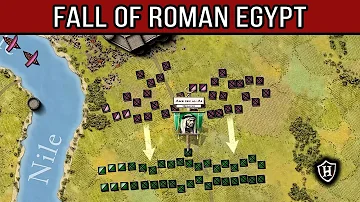
The year was 629 AD. In the aftermath of the ultimate Roman victory over Persia, both empires were devastated and needed time to restore their strength. Among his first decisions, emperor Heraclius began using the greek title “Basileus” to replace latin roman terms such as “Augustus”. As part of the alliance with the Turks, Heraclius’ daughter Epiphania was traveling east to marry the Qaghan Tong Yabghu. When news of his death reached Constantinople, she was recalled to her father’s court. In the wake of Persian withdrawal, Arabs filled the vacuum, launching raids in Palestine. To reassert their authority in the region, Romans and allied Ghassanids clashed with the invaders, defeating them at Mutah. While the imperials were victorious, it was warning of things to come. With the path now cleared, Heraclius entered Jerusalem and restored the True Cross to the Holy Sepulchre. Soon after, the emperor took headquarters in the Syrian city of Hierapolis for much needed administrative supervision. The evacuation of sasanian troops was not an entirely smooth process. In Edessa, the garrison was encouraged to stay by the local jews who started resisting. Heraclius’ brother Theodore responded with brutal massacre. Roman resentment towards this minority was strong after its wartime collaboration with Persia. Thus, the imperials balanced between forgiveness and retaliation. An army was sent in support of Shahrbaraz’ bid for power in the unstable Persia. However, the latter was slain after month of rule, reducing Heraclius’ influence in the region. Roman troops remained in upper Mesopotamia and negotiations with Ctesiphon continued. By 630, no sassanian garrison remained in roman territory and the borders were restored to their pre-war status-quo. After over decade of Persian occupation, restoring Roman administration was not simple. Disputes over property ownership were the norm while the government had to repay loans contracted to the clergy. The finances did not completely recover, mints were closed, cities were in decline and the old praetorian prefectures gradually disappeared. To make up for this, the army saw gradual demobilization, tributes to Arab allies were cut off and an official in charge of the treasury, the Sakellarios, gained in importance. Reuniting with the eastern provinces meant reconciling with population which did not practice the official faith. In this field, patriarch Sergius of Constantinople brought upon the compromise formula of mono-energism. It claimed that Christ has single so-called “energy”. At Hierapolis, Heraclius presented this formula to clerical authorities. After 12 days of debate, he gained the nominal approval of patriarch Athanasius of Antioch and most bishops present. However Athanasius died the next year without signing any written document. For his vigorous promotion of the formula, bishop Cyrus of Phasis was made both prefect of Egypt and patriarch of Alexandria. Later, at Theodosiopolis, the Armenians gave their own feeble acceptance of mono-energism. Eventually, Heraclius allowed himself to return to Constantinople where his grandson received baptism. Looking north, the government was in no position to truly profit from the Avar decline. There were diplomatic actions with pontic and slavic tribes, but not enough to reassert control over Illyricum. Arab raids resumed and intensified around Palestine. Such situation prompted Heraclius to request troop transfer from Africa to Egypt. Then, he established headquarters in Antioch. In Constantinople, monk named Sophronius was made Patriarch of Jerusalem. He was an ardent defender of the chalcedonian creed and had participated in the debates at Hierapolis. His election threatened the fragile compromise built around mono-energism. Unclear to the Romans at the time, the armies they were fighting against claimed loyalty to the newly established Arab caliphate. Its recently deceased prophet, Muhammad, had introduced new religion to the world: Islam. The muslims by now had conquered the Euphrates valley from the Sassanians and at Firaz, they vanquished combined romano-persian force. Sophronius widely promoted opposition to the imperial formula, saying that it betrayed the chalcedonian belief of Christ’s human nature. Sergius, aware of this issue, wrote letter to pope Honorius in which he declared that one should not debate over Christ’s single or multiple energies. Honorius agreed and in addition, wrote about single Christic “will”. Meanwhile, in the same quest for religious unity, Heraclius ordered, to an unclear scale, the forced conversion of jewish communities in the empire. Now, muslim reinforcements from Mesopotamia clashed with imperial Arab allies in Syria. Indeed, despite former emperor Maurice’s hurtful diplomacy towards the Ghassanids and the latest cut of subsidies to many tribes, some Arabs remained Roman allies. Now stronger, the muslims made decisive moves. At Ajnadayn, they defeated sizable Roman army. Theodore, who commanded it, was widely blamed by his brother for such failure. More losses followed with the fall of Damascus and the battle of Pella, allowing the muslims to push all the way to Emesa. From Antioch but now too old to lead the army himself, Heraclius monitored the situation. large force was now ready to launch counter offensive. It was the first ever field army sent against Arabs. Marching south, the imperials forced the muslims to retreat until both armies met near the Yarmuk river. For days, imperial diplomacy and cautious assaults slowly melted down the Arab army. Eventually, the exceptional commander Khalid Ibn Al Walid took decisive actions, encircled and massacred the Roman troops. On the 20th August 636, the only viable army the empire could deploy had been destroyed and the entirety of Syria laid open for the invaders. In November, the Sassanians suffered their own massive defeat at Al-Qadissiya, leaving their heartland of Mesopotamia exposed. Patriarch Sophronius had previously shipped the true Cross and other relics to safety. Soon, the muslims arrived at the walls of Jerusalem. After Yarmuk, Arab momentum in Syria was simply too great. Heraclius evacuated the province, seeking to build new defensive line further north, calling military commanders not to engage the Arabs in pitched battles. scorched earth policy was employed to devastate the region around the Taurus mountains. Redeployment and additional fortifications were meant to maximize Anatolia’s defenses. The siege of Jerusalem lasted half year until Sophronius negotiated and eventually surrendered to the muslim caliph Umar. The holiest christian city had yet again fallen to enemy hands. After more fighting and serious defensive attempt near Antioch, Syria was lost. John Cateas sent tribute for the Arabs not to cross the Euphrates and invade his province. The emperor, fiercely disapproving of this kind of action, exiled the governor. Heraclius arrived in the capital to the unwelcoming news of plot. It included powerful magnates and armenian strongmen, aiming to dethrone the emperor in favor of his illegitimate son John Athalarichos. The main conspirators were mutilated and exiled. The emperor, his life work being undone, saw not only his physical, but also his mental state failing. He solidified the Heraclian dynasty for the succession, putting forward his many children. Most importantly, Heraklonas was made co-emperor. This meant that Heraklonas, son of Martina, now shared the same rank as Heraclius Constantine, son of Eudokia, the emperor’s previous wife. Christological debates continued. Heraclius published Sergius’ final proposal for christian unity the Ekthesis. It declared monothelitism to be the official imperial doctrine. This variant of mono-energism stated that Christ possessed two natures but only single will. Several factors facilitated the acceptance of the Ekthesis. Firstly, the fall of Jerusalem and Antioch followed by Sophronius’ death paralyzed the opposition. Secondly, Cyrus continuously promoted monothelitism from Alexandria. Finally, Pyrrhus, Sergius’ successor in Constantinople, also supported the doctrine. However this time, it was Rome that showed resistance. The newly elected pope, Severinus, refused to sign the Ekthesis and was thus denied imperial recognition. Exarch Isaac had his underpaid troops storm and plunder the Lateran palace in Rome, aiming to enforce papal approval of Sergius’ formula. Parts of the spoils were forwarded to the emperor. This was not an isolated event as several officials in the empire went for such drastic measures to cope with the worsening fiscal crisis. With no more truce to shield it, upper Mesopotamia formed vulnerable bulge between enemy occupied territories. After failed counter attack on Syria by christian arabs, the muslims invaded from east and west, conquering the region. While still resisting, coastal cities were reduced one by one in Palestine, the invasion of Egypt began. Pelusium fell first, opening the way to the Nile. The Romans showed determined resistance in the central delta forming solid lock near Babylon. It was only when the muslims were reinforced that the hard fought contest led to Roman defeat and capture of the city. For his province, Cyrus negotiated terms to the muslims, paying tribute. However, when he sought to have the treaty ratified by Heraclius, the latter angrily refused and sent Thracian troops to continue the fight. If Alexandria fell, Egypt would be completely lost. Meanwhile, continuous muslim attacks on the eastern borders led to first raid in Anatolia. The new pontiff, John, immediately condemned the Ekthesis and its monothelite doctrine as heresy, frustrating any progress made with the previous two popes on the matter. Heraclius passed away in early 641 after 30 year reign of constant upheaval. Few periods of Roman history can be considered as important turning point as the age of Heraclius. Upon becoming emperor, he was propelled into the most devastating war ever fought with the Sassanians. Against the odds, he led the army to victory after which he dedicated his time to reunite all romans. However, as the dust cleared in the Middle East, the Muslims burst out of Arabia and completely reshaped the balance of power. Syria, Palestine, Mesopotamia and Egypt fell to the armies of Islam. Just like his empire, Heraclius lost the strength to resist the new invaders. Thus, he enshrined his name as the emperor who lived too long.

 32:13
32:13
 18:55
18:55
 1:56:45
 21:12
21:12
 0:48
0:48
 8:04
8:04
 13:53
13:53
 25:41
25:41
 1:53:12
 19:06
19:06
 22:19
22:19
 30:48
30:48
 19:36
19:36
 7:47
7:47
 25:07
25:07
 35:15
35:15
 10:34
10:34


