النص الكامل للفيديو
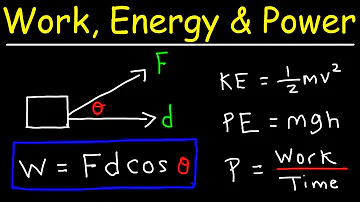
In this video, I'm going to review some of the most common formulas that you're going to encounter in typical physics one class. So, whether if you're studying for physics now or if you're preparing for your final exam, this video is going to be very helpful to you. So, the first formula you want to know has to do with motion with constant speed. And that is is equal to VT. Now, you could read this as displacement is equal to velocity multiplied by the time or the distance is equal to the speed multiplied by the time. Make sure you understand this. The speed is always equal to distance over time. And velocity is equal to the displacement divided by the time. So, remember displacement and velocity, they're vectors. They could be positive or negative. Speed and distance are scalar quantities. They're always positive. Now, whenever you have motion with constant acceleration, these formulas will apply. So, these are the typical formulas that you'll see in kinematics. Final velocity is equal to initial velocity plus the acceleration multiplied by time. So, whenever you see can represent speed or velocity depending on how it's being used. Next, we have final squared is equal to initial squared plus two times the acceleration times the displacement. When you see can represent distance or displacement based on the problem and how you want to use it. Now, going back to this equation, for constant speed, we know that displacement is equal to velocity multiplied by time. Now, when dealing with constant acceleration, the displacement is equal to the average velocity multiplied by the time. Because whenever you have acceleration, the velocity is changing. When you have constant acceleration, the velocity changes at constant rate. Now, the average velocity is basically the sum of the initial and the final velocity divided by two, which we can write it this way. So, you want to make sure you know this equation. The displacement is equal to the average velocity, which is 1/2 initial plus final multiplied by the time based on this equation. Another formula in kinematics that you need to be familiar with is this one. The displacement is equal to the initial velocity multiplied by the time plus 1/2 acceleration times squared. Now, keep in mind, displacement is the change in position. In the direction, if you're dealing with horizontal displacement, is equal to final position minus the initial position. And you can also express this in terms of vertical displacement. So, replacing with final minus initial and moving initial to the other side of the equation, we get this one. final is equal to initial plus initial plus 1/2 AT squared. So, if you have your exam coming up, recommend that you take the time to write these formulas down. In the direction, you can write the equation like this. Keep in mind, the acceleration due to gravity is -9.8 m/s squared, which is about -32.2 ft/s squared. Now, let's move on to projectile motion. So, all the formulas that we've talked about for kinematics, they apply when dealing with projectile motion. So, whenever you have an object that is moving and the only force acting on it is the force of gravity, what you have is projectile. So, let's say we have projectile that launches from the ground and follows this trajectory. We'll call this position and At position projectile is at its highest point. And at that point, vertical velocity is always going to be zero. And let's say this represents the initial velocity at some angle above the horizontal. If we want to calculate the maximum height of this projectile, we could use this formula. It's initial squared times sine squared theta divided by 2g. Now, the range is the horizontal distance that the projectile travels. The range is equal to horizontal velocity multiplied by the time of flight. You can also calculate the range using this equation. It's equal to initial squared times sine of 2 theta divided by the gravitational acceleration. Now, the time it takes to go from point to point it's equal to 2 * Vy, where VY is basically sin theta. And this is initial, by the way. Divided by the gravitational acceleration Now, let's say if you have ball or stone that is thrown from the top of building. Actually, not thrown, but released from rest. So, it's dropped from the top of the building, and you want to calculate the height of the building. You could use this formula. It's equal to 1/2 AT squared. Now, if the ball was thrown downward with an initial velocity, height would be VY initial times plus 1/2 AT squared. Notice that this formula comes from this equation. is equal to initial plus 1/2 AT squared. So, all of the kinematic formulas that you saw earlier, they apply for projectile motion. Now, when dealing with relative velocity, here are the formulas that we need to be familiar with. Now, have video on relative velocity that will explain how to use these formulas by means of example problems. So, for those of you who want to see that, check out the links in the description section below. You can also find on YouTube if you do search, relative velocity organic chemistry tutor, which should show up as well. But, here's what you need to know. The velocity of with respect to is simply velocity of minus the velocity of The velocity of with respect to is VB minus VC. Now, there's more to it than that, but those are the main equations that you need to deal with when dealing with relative velocity. Now, let's talk about vectors. So, let's say you have velocity vector which has an component and component. And here's the angle theta. You need to know that Vy is sin theta. Vx is cos theta. And if you want to calculate you could use the Pythagorean theorem. Or is the square root of Vx squared plus Vy squared. The angle theta is going to be the inverse tangent or the arc tangent of Vy over Vx. Now, these formulas apply for any vectors. So, whether this is velocity vector, acceleration vector, or force vector, you could use those equations. Now, let's talk about forces. Newton's first law. An object in motion will continue in motion unless acted on by force. And an object in rest will usually stay in rest unless acted on by net force. Now, Newton's second law is this, the net force acting on an object is equal to mass times acceleration. In other words, is equal to MA. Now, for Newton's third law, every action force, there is an equal but opposite reaction force. Now, you also need to know this, the weight force is equal to mg. And kinetic friction is equal to mu the coefficient of kinetic friction, times the normal force. Now, some textbooks, they may use capital to represent normal force. You got to be careful not to confuse it with the units of force, which is Newtons, and that's you can capital Static friction, it's an inequality, it's less than or equal to mu times the normal force. Now, I'm going to be putting some videos in the description section below where you can apply these formulas, where you can calculate the static friction, kinetic friction. It'll talk about the forces acting on free body diagrams, inclined planes, pulleys, and other things where you'll be using combinations combination of these equations. So, feel free to check out the links below for more examples on this. Now, let's talk about the formulas associated with uniform circular motion. You might be wondering, what is uniform circular motion? So, let's say we have ball attached to spring, and we move it or we spin it in circle like this. And let's say this is the center of the circle. didn't draw it correctly, but we'll make this work. The length of the rope will be the radius of the circle. Now, in order to keep this object moving in circle, there's something called centripetal acceleration, also known as radial acceleration, and this acceleration vector is always directed towards the center of the circle. To calculate that acceleration, it's equal to the square of the velocity divided by So, this object wants to move this way, but the acceleration is pointed towards the center, so it keeps the object moving in circle. Centripetal force is simply mass times the centripetal acceleration. Now, the velocity of this object can also be calculated using this formula if you know the period of the object. Period is the time it takes for the object to make one full rotation or revolution. And it's measured in seconds. So, if the radius is in meters and the period is in seconds, you're going to get the velocity in meters per second. Now, you can also calculate the centripetal acceleration in terms of and using this formula. If you combine if you replace with 2πr over The centripetal force if you combine these two equations, it's simply mv² over So, those are the main formulas that you're going to be dealing with when you're working on problems associated with uniform circular motion. Let's move on to work, energy, and power. So, let's say if you have block resting on long horizontal frictionless floor, and if you apply force to it causing the object to move by some displacement, the work done on that object is equal to the force multiplied by the displacement. Now, likewise, let's say if you were to pull the object with rope using tension force, and you're pulling the object in this direction, the work is going to be the force times the displacement times cosine of the angle that is between the force vector and the displacement vector. Now, the work is also equal to the dot product of these two vectors. So, that's how you can calculate the work done by force. Now, according to the work-energy theorem, the net work done on an object is equal to the change in the kinetic energy of that object. Now, kinetic energy is equal to 1/2 times the mass times the square of the speed. Now, the work done by conservative forces, such as the electric force or the gravitational force, that's equal to negative change in potential energy. Gravitational potential energy is equal to mass times gravitational acceleration times height. Sometimes you'll see this using the letter for gravitational potential energy instead of PE. And sometimes instead of you might see But in both cases, they represent vertical height or vertical displacement. But technically, this should be vertical height. So, the work done by gravity is going to be negative of the change in potential energy. Now, let's talk about springs. So, let's say we have spring attached to this object. And we wish to apply an active force to stretch the spring beyond its natural length. There's going to be an equal but opposite restoring force. So, the force required to stretch spring is it's to be kx. and the restoring force is negative kx because it's in the opposite direction. is the spring constant and measured in Newtons per meter. So, you can have one spring constant that's 100 Newtons per meter versus another one that could be 500 Newtons per meter. The greater the value of harder it is to stretch or compress that spring. So, value of 500 Newtons per meter tells you that in order to stretch or compress the spring by 1 meter, 500 Newtons of force is required to do that. Whereas for this one, you only have to apply 100 Newtons of force to stretch or compress the spring by 1 meter. Now, the elastic potential energy of spring is equal to 1/2 kx squared where represents the distance from which spring is compressed or stretched from its natural length. So, that is the elastic potential energy of spring. Now, let's talk about power. Power is equal to work divided by time. Work is measured in joules, time is in seconds, and the unit for power is the watt. So, power is basically an energy rate. It is the rate at which energy is being transferred from one object to another. And work has to do with the transfer of energy. So, power tells you how fast that energy is being transferred with respect to time. Now, we know that work is equal to force times displacement, which means force is work divided by displacement. And the work done by conservative forces is equal to negative change in potential energy. And the displacement is basically it could be delta delta delta So, this describes force in relation to potential energy. So, force is basically the gradient of potential energy. The negative gradient of potential energy. Now, power we know is the rate at which energy is being transferred. So, you could describe it as the change in energy divided by the change in time. This energy could be the change in kinetic energy or could be the negative change in potential energy. You could describe it both ways. But, power is also force times velocity. So, just as work is the dot product of the force and the displacement vector, power, instantaneous power, is the dot product of the force and velocity vector. But, average power is work over time or the change in energy for the change in time. Now, let's move on to our next big Let's talk about the formulas associated with momentum and impulse. So, momentum is mass times velocity. Momentum is vector. Mass is scalar and velocity is vector. Impulse is force multiplied by the change in time. Some textbooks will use to represent the impulse. know in other videos I've used to represent impulse. But just know that it's force multiplied by time. Now, when you combine these two together, there's something called the impulse momentum theorem. The change in momentum is equal to the impulse that is imparted to an object. So, delta is equal to force times delta So, this is the impulse momentum theorem. Now, if you divide both sides by delta you get this equation. Force is equal to delta over delta times So, here is delta but instead of the velocity changing, the mass is changing. So, this is basically change in momentum divided by change in time. So, let's say if you want to calculate the force that propels rocket, this form of this equation will be useful. What this tells you is that the force that propels the rocket depends on the mass flow rate, which is the change in mass over the change in time, times the velocity of that rocket. Another way to use that equation is imagine if let's say we have person and they have water hose and out of this they're shooting water. The force that this water will exert on an object is going to be equal to the mass flow rate. That is how much mass of water is coming out of that holes per unit time times the speed at which that water is coming out. So, with that you can calculate the water the force that that water will exert on an object using this equation. So, force is equal to the mass flow rate times velocity. Now, we know that delta represents the change in momentum. The same is true for delta times So, we can replace this with momentum. So, another way to calculate the average force acting on an object is by taking the change momentum and dividing it by the change in time. So, you can think of force as being the rate of change of momentum acting on the object or of an object. Now, let's talk about rotational motion. Perhaps you've seen this equation in trig is equal to theta So, here's the radius of circle. Let's say we have an object that moves from here to this distance. That would be the arc length And this is the angle theta. Theta is the angular displacement. represents the linear displacement. Theta represents angular displacement. Or more technically, delta theta. Because let's say if you define this point to be theta one at 0° and this point to be theta two at let's say 60°. Delta theta would be the angular displacement. The change in angle was 60°. So it's good for us to make distinction between these two and delta theta. So delta theta is the angular displacement. Just as displacement is the change in position, final position minus initial position, angular displacement is well, the change in angular position. Theta two minus theta one or theta final minus theta initial. Omega is the symbol for angular velocity. And it's equal to the angular displacement divided by the angular mean divided by time. Linear velocity, we know it's displacement over time. Linear velocity in the direction is equal to the horizontal displacement, which is the change in divided by the change in Linear velocity in the direction is equal to the the change in position in the direction over the change in time. Or basically, vertical displacement over time. You could see how these equations are similar. So linear velocity tells you how fast an object is moving in straight line and what direction it's going. Angular velocity tells you how fast the object is rotating and the direction in which it it is rotating, whether clockwise or counterclockwise. Alpha is the symbol for angular acceleration. And it's equal to the change in angular velocity divided by the change in time. Much in the same way as acceleration is the change in velocity divided by the change in time. Now, here are some formulas that will help you to see the relationship between angular quantities and linear quantities. Arc length is equal to theta multiplied by And technically, this should be like delta theta, angular displacement. So, here we have angular displacement and linear displacement, but particularly arc length. Linear velocity is equal to angular velocity times the radius of the circle. Linear acceleration is equal to angular acceleration times the radius of the circle. So, on the right side we have the angular quantities. And on the left side we have the linear quantities. And what connects them is the radius of the circle. Now, we know that final velocity is equal to the initial velocity plus the acceleration multiplied by time. Well, if we were to convert that to its rotational form, final angular velocity is equal to initial angular velocity plus the angular acceleration multiplied by time. Now, we also have this equation, final squared is equal to initial squared plus 2 AB. So, we have omega final squared is equal to omega initial squared plus 2 alpha times the angular displacement, delta theta. Now, we know that displacement is equal to initial plus 1/2 AT squared. So, angular displacement is going to be omega initial plus 1/2 alpha squared. Now, displacement is also equal to 1/2 initial plus final times So, angular displacement is 1/2 omega initial plus omega final times So, the formulas that we've learned in linear kinematics apply to rotational kinematics. Now, centripetal acceleration is squared over And we know that is equal to omega times So, if we were to replace with that we get this equation. So, centripetal acceleration is omega squared times So, that's another formula that you want to add to your list. Now, the kinetic energy for an object that is moving in linear fashion, we know it's 1/2 MV squared. Rotational kinetic energy for an object that is spinning is 1/2 times the inertia times omega squared. So, you can think of inertia as being the rotational equivalent of mass. Even though they're not the same. Now, the inertia can vary based on the object you're dealing with. So, if you have long slender rod and it's rotating about its center and is the length of the rod the inertia for this system, for this rod, is 1/2 the mass of the rod times squared. So, inertia is usually in this format. It's some constant times the mass of the object times the radius squared. Where would be the distance from the axis of rotation. Now, let's say if you have long slender rod but instead of rotating about the center, it's rotating at one end of the rod. is still the same. is the length of the rod. The inertia is going to be 1/3 squared. Now, let's say if you have solid cylinder and it's rotating about its center the inertia of the solid cylinder cylinder is 1/2 squared. Where is this distance here. It's the radius of the circle. Now, if you have solid sphere the inertia is simply 2 over 5 squared. So the inertia is going to be dependent on the shape of the object that is either spinning or rotating or revolving. Now let's talk about torque. What is torque? So let's say if we have an object like this and we were to apply force and it can move about this point here. That's like the pivot. This would be the lever arm from where it pivots around and where the force is applied. Torque is like the rotational equivalent of the force. So whenever you apply force, it's going to create torque that will cause this object to rotate. Torque is the product of the force and the lever arm. Now, let's talk about some rotational equivalents. We know that force is equal to mass times acceleration. Torque, you could think of it as rotational force, is inertia times alpha. Alpha being the rotational equivalent of acceleration. And torque is like the rotational equivalent of force. Momentum is mass times Angular momentum is inertia times angular velocity. Power is force times velocity. Rotational power is torque times angular velocity. So, I'm just going to highlight these so you you can see which ones are related to each other. Now, we know that work is equal to force times displacement. Rotational work is torque times angular displacement. So, that's another one that you want to be familiar with. Now, there's lot of P's here. When you see capital that can represent power. Also, capital can represent pressure. Pressure is force over area. If you see row that can represent density mass over velocity. And if you see lower case that can represent Well, that represents momentum which is times Mass times velocity. So you want to be able to distinguish the different types of P's or things that looks like when you're dealing with formulas in physics. Now, let's talk about gravity or the gravitational force. Whenever you have two large objects next to each other let's say like the moon and the Earth. They both exert gravitational forces on each other. And these are forces of attraction. And these forces, they're equal and opposite in direction. But they're toward one another. is the distance between their centers. So the gravitational force between the Earth and the Moon is equal to the gravitational constant times the mass of the Earth times the mass of the Moon divided by squared. The gravitational constant is 6.67 times 10 to the -11 Newtons times square meters over kilogram squared. Now this is number you'll need to know, the mass of the Earth is I've seen two numbers, 5.97, 5.98 times 10 to the 24 kilograms. So using those numbers, you can easily calculate the gravitational force when one of the masses is the Earth. Now if you want to calculate the gravito the gravitational acceleration of the Earth. Let's say capital is the radius of the Earth. You could use this formula. It's times the mass of the Earth divided by squared. Now if you want to calculate the gravitational acceleration of an object that is in outer space at some distance away from the Earth. Well the is going to change. So is going to be the distance between the center of the Earth and one of the masses. So using this formula you can get the gravitational acceleration to be 9.81 m/s ^ 2. If you want to calculate the gravitational potential energy between two objects like the Earth and the Moon, you can use this formula. It's M1 M2 over instead of squared. Because typically we use this formula to calculate gravitational potential energy. But this has to do with relative to the Earth. Let's say if you want to calculate the gravitational potential energy of book 10 above the Earth, you could use that formula. But if you want to calculate the gravitational potential energy between objects that don't involve the Earth, let's say like between the Sun and the planet Mars, Now, let's say we have the Earth and we have satellite orbiting the Earth, and we want to find the speed of that satellite. We could use this formula. It's equal to the square root of the universal gravitational constant times the mass of the Earth divided by where is the distance between the center of the satellite and the center of the Earth. Now, let's move on to SHM, simple harmonic motion. So, let's say we have mass spring system. We have mass attached to spring and it's experiencing it's experiencing oscillation. It's being stretched and compressed over and over again. The frequency of these oscillations is 1 divided by the period. And the period is 1 divided by the frequency. The frequency is the number of cycles divided by the time. In other words, it's the number of cycles that occur per second. And it's measured in hertz or one over seconds or minus one. The period is the reciprocal of that. It's the time divided by the number of cycles. So, in other words, the period is the time it takes to complete one cycle. Because it's the ratio of those two. Omega in this context is little bit different. For rotational motion, omega represents linear mean omega represents angular velocity. For simple harmonic motion, it represents angular frequency. And it's 2π times regular frequency. Omega is also 2π divided by the period. Now, the period for simple harmonic motion when you have mass spring system, it's 2π times the square root of the mass divided by the spring constant. The frequency is the reciprocal of that, so it's 1 over 2π times the square root of over And the acceleration of the mass spring system it's negative over times And it comes from this equation. Recall earlier that we said that the restoring force is negative times Using Newton's second law, equals ma we get this. So, dividing both sides by we get that the acceleration is negative kx over And don't forget that the elastic potential energy of spring is 1/2 kx squared. Now, let's say if we have simple pendulum with massless string, we have the length of the string. The period for the simple pendulum is 2 pi times the square root of over So, the length of the string can be measured, and you can also measure the period, which is the time it takes to complete one cycle. That is after goes here and it returns back to its original position, that's one cycle. Knowing the length of the pendulum and the period, you can calculate the gravitational acceleration of any planet that you're on. Next, we have the physical pendulum. So, this is when mass is important. The period for physical pendulum is 2 pi divided by the inertia over MGD. And I'm going to be posting some links in the description section that shows you how to apply these formulas. So, the simple pendulum and the physical pendulum as well as lot of the other formulas that we've encountered in this video. Now, there's some other topics out there like fluid mechanics, thermodynamics, waves. do have videos on these. So, if you type in waves organic chemistry tutor or let's say the Doppler effect organic chemistry tutor in the YouTube search bar, you'll see these other topics that didn't cover in this video. just want to cover the most common formulas that you'll typically see in first semester of physics. But, there's lot of other formulas that haven't put here, so you can find them in those other videos as well for those of you who are interested. So, that's going to be it for this video. And hopefully you wrote down these formulas. So, thanks again for watching.

 17:20
17:20
 23:16
23:16
 16:50
16:50
 53:37
53:37
 14:20
14:20
 11:43
11:43
 17:06
17:06
 5:59
5:59
 1:01
1:01
 18:52
18:52