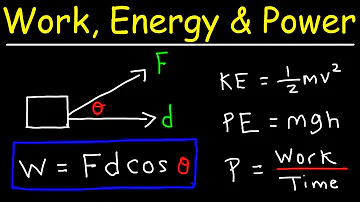
in this video we will go over the concepts of work and energy work is basically force times distance but we only consider it to be work if the force applied is in the direction of displacement so let's say there is box like this we know from equations of motion that there will be normal force and wait let's say there is 200 Newton force that we apply like this now the box will move to the right so the work done is the force multiplied by the distance the Box traveled the weight and normal force don't do any work because the box is only moving in the horizontal direction the formal definition of work is that force will do work on particle only when the particle undergoes the displacement in the direction of the force so because our box isn't moving up or down the weight and normal force don't do any work now let's say there is frictional force like this the friction tries to keep the box from moving to the right so we say does negative work so the 200 Newton force does positive work while friction does negative work now let's say the 200 Newton force is applied at an angle of 30 degrees like this the work done is only done by the component of this force because as before the Box does not move up or down the displacement is in the horizontal direction so we only look at the horizontal components of forces so in this example only the 200 cosine 30 degrees does positive work let's now say that the force we apply is not constant but rather it's variable force like this so this force is dependent on the distance the box travels then how do we calculate the work for that we will integrate let's say the Box move 3 meters so the lower bound starts at 0 meters and the upper bound is 3 meters we then integrate the force and we can figure out the work that's done by the way some books use to represent work while others use the capital letter you to represent work the unit for work is joules or 1 Newton meter another thing to consider about work is when it involves Springs let's continue with our example by adding spring with the stiffness of 2 100 Newton's per meter now let's say our box started like this where the spring is compressed 0.25 meters since it's compressed the spring tries to come back to equilibrium by pushing the box to the right this does positive work and we see the work done by the spring as 1/2 times the stiffness of the spring times the displacement of the spring squared in our case the work is equal to 1/2 times 200 times 0.25 squared if the stiffness of the spring is not constant then as usual we integrated from the initial position to the final position now if our box was actually going like this where was initially moving to the left and the spring is now slowing it down then the work done is negative because it's stopping the block one last thing to consider about work is with weight if the particle is moving up or down then the work done by weight is simply weight multiplied by the distance the particle traveled in the vertical direction we see the work done by weight is positive when the particle moves downwards now that we got work covered we can head into the big equation which is this it's 1 plus Sigma is equal to 2 this is called the principle of work and energy it means very little like this so let's expand on it the first 1 represents the initial kinetic energy of particle the Sigma represents all the work added together and 2 represents the final kinetic energy of particle kinetic energy is 1/2 times the mass times the velocity squared another way of saying this is that the initial kinetic energy of particle plus the work done is equal to the final kinetic energy when we do examples this will make more sense so let's get to it in this question we need to find the distance to create slides in order to attain speed of 6 meters per second we're given the coefficient of kinetic friction so we do need to consider friction in this problem looking at the diagram we have two forces one pushes and one pulls so both of those forces will do positive work but since we're considering friction as well the frictional force will do negative work in simple terms the two forces will move the box to the right while the frictional force will try to slow it down so our first step is to actually figure out what this frictional force is and to do that we will start off by drawing Freebody diagram so we have the two forces the weight the normal force and the frictional force let's write an equation of motion for the vertical direction that will allow us to find the normal force assuming forces upwards to be positive we have the normal force the weight the components of the two forces and that's equal to mass times acceleration but remember the crate is only moving along the horizontal axis not the vertical axis so acceleration in the direction is zero let's solve for the normal force now we can calculate the frictional force which is the normal force multiplied by the coefficient of friction let's think about work and energy so the box moves in the horizontal axis any force that makes the Box move in the horizontal axis selects components of the forces and frictional force will do work whereas forces like weight and the normal force which only has component forces will do no work keeping that in mind we can write the principle of work and energy equation so let's break down what's happening here we got half the mass times initial velocity which is zero since the crate starts from rest then we add up all the work so we got component forces multiplied by the distance the crate moves and the frictional force multiplied by the distance travelled that's equal to half the mass times the final velocity squared which is 6 meters per second we can solve for which is our answer so to gain speed of 6 meters per second the crate slides the distance of one point three five meters let's take look at this example in this example we need to find how far the block must slide before reaching velocity of fifteen meters per second you should notice that unlike the previous question we have variable force the force is dependent on the distance travelled by the block we also have friction so first we will calculate what the frictional force is to do that we need to draw Freebody diagram so we have the weight normal force the variable force and the frictional force let's write an equation of motion for the vertical forces since the variable force has only an come opponent the only force affecting the block in the vertical direction is weight and normal force that's equal to the mass times acceleration but the box is only moving in the horizontal direction so there is no acceleration in the vertical direction let's solve for the normal force now we can find the frictional force by multiplying normal force by the coefficient of kinetic friction let's think about work and energy since this involves variable force we will have to integrate keeping that in mind let's write our equation of work and energy so we have half the mass times the initial velocity then we add all the work that's being done together that means we have the variable force and since it's not constant we will integrate it from starting position of zero meters to is the total distance the block travels we also have the friction which is then multiplied by the distance traveled all of that is equal to half the mass times the final velocity going back to all the work being added together remember only component forces will do any work so forces like weight and the normal force will not do any work for the block because it's not moving in the vertical direction let's simplify and solve the integral now we can solve for and that's our answer let's take look at this question involving police in this question we need to find the speed of cylinder after I've moved two meters from rest so as with pretty much every pulley problem you face the first step is to draw datum we can place it on the top pulley then we draw position coordinates we have SA and SB looking at the diagram it's one single cable so we only need one equation so we have two plus is equal to the total length if we consider change in displacement we can write that displacement using Delta the reason why we do this is because we want to figure out how much cylinder moves when cylinder moves two meters so let's plug in two meters for the change in displacement for cylinder and then we can figure out how much cylinder moved we find the cylinder be moved negative four meters but that just means it moved up four meters we drew our position coordinates downwards meaning any movement down was now the end result we want is to figure out the speed of cylinder which means we definitely need velocity equation so let's take the derivative of our initial equation this equation represents the speeds of cylinders and the next step is to consider work and energy here we think of the movements of cylinder and together because their movements are tied to each other keeping that in mind let's write our equation since it's the addition of both kinetic energies of both cylinders we will add the big Sigma sign in front of the t's let's go through this equation for the initial kinetic energy the system starts from rest so all the velocities are 0 then we have the forces that do work in this case that's only wheat no other force affects the system so when we did the displacement equation we found that when cylinder moves 2 meters down cylinder goes up 4 meters it's important to keep this in mind because while one cylinder does positive work the other does negative work again we assume down to be positive because that's how we do our position coordinates and since cylinder is going up it's going the opposite way meaning the work that's done is negative so we have the mass times the acceleration due to gravity multiplied by the distance traveled on the right side of the equation we have half the mass times the velocity of squared plus half the mass times the velocity of squared now we have two equations with two unknowns we can solve them to figure out the velocity of cylinder and so we get negative value for which again simply means that it's going opposite to the way we chose it to be positive so it's going up at velocity of three point nine six meters per second let's take look at one last example involving Springs in this question we need to find the total distance traveled by the block so there are two ways to approach this problem first we can assume that the block hits spring bounces back but stops before reaching spring or we can assume the block hit spring and slides all the way to spring and then comes back and stops we will assume the first condition and see if it's true if it is thus less work for us otherwise we need to recalculate the distance traveled when it reach you spring and do another equation to see where it stops so let's start off by first figuring out the frictional force for that we can draw Freebody diagram of the block so we have the normal force the weight and the frictional force let's write an equation of motion for the vertical motion solve for the normal force and now we can figure out the frictional force let's get started with our equation of work and energy the block will slide towards spring compress it and stop our first goal is to figure out how much distance the block travels in other words how much does the spring compress because the total distance of the block travels is 0.3 meters plus the distance the spring compresses so first we have half the mass multiplied by the initial velocity then we have the work that's being done we have the frictional force which is doing negative work so the block travels total of 0.3 meters plus the distance it compresses the spring remember even while the spring is being compressed the block experiences friction so the total distance the block travels before it stops is 0.3 plus is the distance the spring compresses then we have the spring which also slows the block down until it stops so it does negative work so that's 1/2 times the stiffness of the spring multiplied by the displacement squared all of that is equal to the final kinetic energy which is 0 because the block is no longer moving again represents the distance the spring compresses before stopping the block now the spring is pushing back the block in the opposite direction so we write another equation for work and energy this time the spring is actually doing positive work while the friction is still doing negative work remember we're trying to figure out where the block will stop now so the initial and final velocities are both 0 so our initial kinetic energy is 0 because the block starts from rest then we have the frictional force doing negative work while the spring is doing positive work for the spring the distance it extends is the same as the distance that was compressed so we have zero point five nine eight meters and for the frictional force remember that in addition to the compressed distance the block travels will go meters on stops so as in this equation is the distance the block travels before stopping then on the other side we have the final kinetic energy which is zero since the block comes to arrest plus solve for so that's the distance the block travels before stopping since thus less than 0.6 meters the block doesn't hit spring so we don't need to do any more calculations let's add up the total distance the block travels from start so we have the initial point three meters then the length of the spring compression then the length of the spring extending and finally the distance traveled before stopping so the block traveled to point zero three six meters before stopping in this question the spring had stiffness that followed Hookes law but if it didn't then you would write the force of the spring as an integral like we did with the variable force example that should cover the types of problems you face in this chapter hope this video helped you gain better understanding of work and energy principles if it did please give thumbs up thanks for watching and best of luck with your studies
1:01:44
Work Energy and Power Basic Introduction
The Organic Chemistry Tutor
2.8M مشاهدة · 5 yr ago
8:56
Principle of Work and Energy Explanation Engineering Dynamics
structurefree
7.8K مشاهدة · 5 yr ago
4:57
Work and Energy
Professor Dave Explains
1.2M مشاهدة · 9 yr ago
13:05
Work and Kinetic Energy Physics
The Organic Chemistry Tutor
391.8K مشاهدة · 2 yr ago
4:11
Vector Dynamics Introduction to Work Energy Principle
CPPMechEngTutorials
2.3K مشاهدة · 11 yr ago
5:48
Work and the work energy principle Physics Khan Academy
khanacademymedicine
458.4K مشاهدة · 12 yr ago
9:43
Rigid Bodies Work and Energy Dynamics Learn to solve any question
Question Solutions
165.3K مشاهدة · 5 yr ago
11:56
Conservation of Energy Learn to solve any problem
Question Solutions
219.6K مشاهدة · 6 yr ago
11:27
Work Energy Principle Engineering Dynamics Notes and Problems
Brianno Coller
11.3K مشاهدة · 13 yr ago
6:55
Energy Work Power 16 of 31 Work Energy Principle An Explanation
Step by Step Science
86.1K مشاهدة · 11 yr ago
10:15
Work Energy Power Formulas and Equations College Physics
The Organic Chemistry Tutor
253.7K مشاهدة · 2 yr ago
13:18
Kinetic Energy and Potential Energy
The Organic Chemistry Tutor
1.8M مشاهدة · 7 yr ago
1:39
Work Energy Principle Introduction
Andreas Physics
214 مشاهدة · 10 yr ago
20:35
phys 2 A ch 6 2 Work Energy Theorem and Kinetic Energy

 1:01:44
 8:56
8:56
 4:57
4:57
 13:05
13:05
 4:11
4:11
 5:48
5:48
 9:43
9:43
 11:56
11:56
 11:27
11:27
 6:55
6:55
 10:15
10:15
 13:18
13:18
 1:39
1:39
 20:35
20:35
 9:12
9:12
 4:18
4:18


