النص الكامل للفيديو
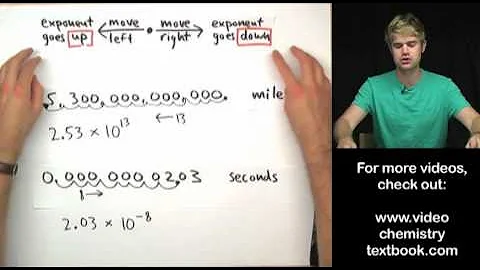
Hi and welcome back to another video of math skills to ACE chemistry for introductory chem. so in this video what we're going to be looking at is what is scientific notation. And if you watched my last video on rounding you might have saw that at the very end that it was different number format. And the whole idea about this is it's an easier way to do lot of mathematical calculations. It helps simplify them and that's something that we'll see in the future. So in this video, what is scientific notation? Well, it helps almost make simpler really really big numbers or really tiny numbers. So that way they're little bit more palatable. They're little easier to plug into your calculator and to solve them and and to use them in different calculations. So, well, what is this? What do you mean by really big numbers? Well, let me tell you. So, what if told you if we had the following number, which is 602 with lot of zeros, probably bigger than any number you've ever seen before. Well, this is Avagadra's number, which is very common number that's used to count how many atoms or molecules. And when you see that, that's in its standard notation. And probably the thing that you see is what's what came to your mind is, my god, is that's that big? That is huge. Do we actually have to use it? Do have to know that for class? Well, that's what scientific notation is for to help make this little easier to handle so that way we can almost minimize what this is. Now what it is is it's counting the number of places that you're moving the decimal. So there's couple little simple little rules that we are going to be doing here. So let's take look at this and try to understand. The whole idea here is that the key is to write numbers as factor of 10. So let's start small and then we'll go back up to that number before. So if have the number 500. Okay. Well 500. How can you write that in let's say factors of 10? So how would you multiply to get to that number? If could do 10 * 10 * 5 would that that would get you to 500. So think about it that way. If take 5 * 10, right? Which would be 50. And if times that by 10 again, well that would be equivalent to 500. That's the same thing. Now do have to write all these numbers out* 10 * 10? No. This is what exponents are for. or powers. So if we want to show that well we can write different powers. So if instead if say 5 * 10 and being there are two of those different 10 we can say 5 * 10 to the 2 power. So we can use exponents to help say how many places we jumped or how much did we move. So another way you can show this is that 10 * 10. Well, what is that? That's 100, right? So, it's the same thing as saying five times 100. So, in the end, what how did we get to here, which is scientific notation? Let's write that down for ourselves. So, that's our scientific notation. Trying to block it with me. Now the whole idea here is that all we did was if kind of like go to that 500 number we'll just write in the middle is if we imagine that we have decimal here right it's not shown but there is position for it which is right over next to the last zero and the whole idea here is that we move that decimal place two times right we went one two jumps which represents how many factors of 10 that you needed here. Right? So what that told you is that when you wrote that down you had your five times 10 to the 2 power. So it helps you see how many spots you are jumping and that's how we write scientific notation. So instead of us doing five we're doing 10^ the 2. So one of the simple rules here when it comes to scientific notation is that when we are writing this down the the first number so we had 5 * 10 to the 2 power. So five in this case is represented by that must be between 1 and 10. So 1 through nine right? So between so that has to be in very simple number right you can count 1 2 3 4 5 6 7 8 9 it's really easy to do and if you multiply let's say 5 * 5 or 4 * 3 like those are things you you have been drilled in your head since like fourth or fifth grade that's something that's always been there. Now the 10 to the part, well that's the power, the exponential part that tells you how big something is or how small, right? So in the in the current time, that's telling you the bigness of something. So we're counting how many factors of 10 or how many jumps are we doing? So if go back up to what had before, we can calculate how many jumps did we have, right? So if go through this and we see that all right, well, we go one 2 3 So 1 2 3 4 5 6 7 8 9 10 11 12 13 14 15 16 17 18 19 20 21 22 23. So when we write this, we want to we only write the significant digits, right? So we have the 6.02 02. That's your sandwich nonzeros, right? The rest are all trailing. There's no decimal. And then we write 10 to the 23. And that's what it shows. So it shows your significant values and it tell and it helps you simplify giant number such as this. And that's the best part is that it shows significant values and it makes it easier to look at. So what this is is this is number that tells you how many molecules or atoms there are in given sample. So if you had like let's say like small glass of water like maybe shot glass and you had half of it filled with water, this would be how many molecules of water there would be in that little shot glass. It was fun example. so that's the idea about it. So let's try to do some like kind of do some different examples. so if kind of go down here and ask you, all right, well, let's do let's try one and put it in scientific notation. So if have 1 million, we'll put 1,4 00. And asked you to put it into scientific notation. Well, how exactly would you do that? Now, the big idea here is that you're moving that hypothetical decimal point to make the first number between 1 and 10. So, if we see that, well, right here would be between 1 and 10. So, the whole idea here is that we're going to continue to move that point. So, it' be 1 2 3. Move it again. Four, five, six. So we're just kind of bunny hopping along the way. 7 8 9. So we move that nine spaces. So this would be 1 point. Now which digits are significant? Well, that's going to go to your last nonzero value, which is our seven there. This would be 7 * 10 to the 9th power. So, not only does it show only your significant values, but it also helps make it little bit easier to look at and to work with. So, if kind of like, let's say expanded on this question and asked you, why don't you round the following to three sigfigs in scientific notation? So, the one that we just did above, let's round it. So, if said round to the three sigfigs, how could you do that? Well, we could count 1 2 3. We're going to look over just like how we did in our rounding video and we can see well to the right of that last zero is four. So we round down. So what this number would turn out to be is 1 0 * 10 the 9th in scientific notation. And if we want to put that back to standard form, we could where we just move that decimal place back nine spaces to help show what the big number originally was. So, as you can see, it gets rounded and you kind of lose some of the digits along the way, but it helps it be in either standard form or scientific notation form as you're going through these. And the key note here is when you're working with these is that that positive number in the exponent. So being that this is positive 9 for example, what that is showing is that that this is very very big number. If look at this example down here, well, we can see we move it 1 2 3 4 5 6. This would be 10^ the 6. That 6 is positive. We had to move that decimal place left. So that's letting you know it's positive exponent. If you have to move it left going to scientific notation form, then it is positive exponent. It's big number. It's very, very large. So keep that in mind. Now, what about small numbers? We talked about big. What about tiny? So lot of times in chemistry, we're talking about tiny amounts, right? We're talking about atoms and molecules and all these little itty bitty things that you can't see. So, if in this case, if you have your decimal number and you're moving the decimal to the right, like how my P's going the wrong way. If you're moving to the right, it's negative exponent. So, if we do couple examples here, so if have 0.001, so once again, our value as we showed it, it has to be between 1 and 10. So, we're going to move that decimal place one, two, three spots. And we can see that we have one. And being that there's only one significant value here, this would be 1 * 10. And being that you moved it to the right, it's going to be negative exponent. So it's going to be 10 to the -3. And that's going to be your final value for that answer. We do the next one where we have 0.0324. Same idea here. We move that over two times to show that okay, it's going to go after your first nonzero number in this case will be 3.24 * 10 to the 2 because we had to move that over two times. And because we had to move it to the right hand side, that shows you that it's tiny number. So it gets that negative exponent here because it's small. So this would be our final value for that answer. now just to kind of what's the final summary when it comes to scientific notation? Well, if we're going from standard form, so seeing really big numbers or really small decimals to scientific notation, you move the decimal until it's between 1 and 10. Key word between, right? It has to be single digit in the front of scientific notation. The new number, let's just call it should always show the correct number of sigfigs. And that's the important thing is we are always showing significant figures. Especially if you're someone that has to do general chemistry 1, two, and maybe you're science major, you're always going to be doing sigfigs throughout your entire career. Even if you're working as health professional, you need to show the correct number of sigfigs when you're giving out medicines and doses and all those kinds of things as well. It's very important. Now, if you write that time 10 the part or the exponent that counts how many places you move the decimal. So, if you moved it left, if you move it left, sorry, then it's positive value. If you moved it right, then it's negative value. Sometimes you'll have to convert it the other way, meaning that you'll be given scientific notation value and you have to convert it to standard form or just regular number. meaning that you this also applies to the backwards direction or the opposite world. So keep in mind that that trend that I've been showing you this whole time about left and right, it's not going to necessarily apply. If you see positive exponent, that means that you're moving that that decimal to the right hand side. If you see negative, you're going to be moving it to the left. So keep in mind of bigness or smallness when you are coming across all these different values. Let's do one example of the backwards. So let's say if had 6.32 * 10 -6. Well, this is negative value. So that tells you the decimal place is going to be moving to the left hand side, right? So it's going to be moving left. So or sorry, I'm still pointing the wrong place. So it's going to be moving left, right? And so as we're moving left, what that tells you is that we're going to be going 1 2 3 and mean there's six here, right? So we see six 4 5 six places. So as we're filling all those numbers, those are all going to be zeros that are going to be added in front of this as that decimal place moves. So we can count that, right? Okay, we have 1 2 3 4 5 zeros that will be out front. So this would be 0.0000 63 2 would be your number here. So it's showing you just to kind of even show you cuz you know, misspoke that said there would be five zeros out front. That's after the decimal. So just to kind of show that right was 1 2 3 4 five six. So did actually miscount? 1 2 3 4 five six. did right. Okay. Yeah sorry miscounted. So it would be six places that that moved. So when we are going through doing these different scientific notation values, it's going to be showing this number sigfigs. There'll be rounding involved when you are looking at all these different values. Okay. hope this video helped you and please stay tuned. There'll be more to come within the soon on YouTube here. Please like and subscribe. Let me know how it all was and let me know if there's anything can do to help you pass chemistry. this has been my math skills to ACE chemistry and look forward to seeing you soon. All right, bye now.

 5:30
5:30
 14:28
14:28
 2:09
2:09
 7:06
7:06
 12:21
12:21
 13:56
13:56
 7:34
7:34
 11:05
11:05
 5:13
5:13
 11:33
11:33
 8:35
8:35
 8:44
8:44
 7:07
7:07
 6:04
6:04
 5:30
5:30
 9:01
9:01
 10:28
10:28
 15:05
15:05


