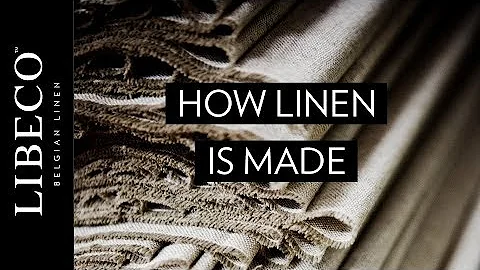
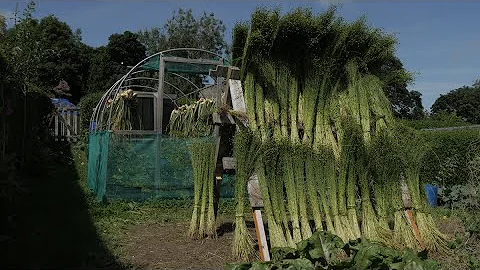
Do you know that linen fabrics are made from the flax plant? Flax is the only natural fiber still being cultivated on large scale in Western Europe. The best flax plants are grown between Kahn in France and Amsterdam in Holland where climatic conditions and soil are ideal. The growing cycle of the flax plant is short with only 100 days between sewing in March and harvesting in July. The plant grows to an ideal height of approximately 4 ft. When close to maturity, the flax plant blooms, dotting the fields with blossoms of violet blue or white. Each flax flower blooms only one day. The flax plant is harvested in July. To preserve the full potential of each plant, flax is never cut, but must be uprooted. As the flax fibers are not only in the stem of the plant, but also in the roots. Harvesting is done by mechanical grubbers who pull and lay the flax plant on the fields. During the rtting process, flax is exposed to moisture to break down the pectins that bind the fibers together in the stem. The flax is spread out on the fields exposed to rain, due, and sunshine for several weeks. At this stage, the fiber is getting its unique natural color by the interaction of the flax with the soil, the rain, and the sun. The flax plant is being turned regularly in order to dry and get an even ratting process. When flax is ratted and dry, it's removed from the fields in large bales. Heat. Heat. scutching and hackling are the following mechanical steps in the production process. Flax fibers are separated from the stem. The raw flax fibers are combed and transformed in several steps into very fine fiber ready to be spun into flax yarns. Short fibers are called toe. Long fibers line. Europe produces close to 120,000 tons of flax grown on 75,000 acres of land. Hallelujah. During the spinning process, the flax fibers are spun into yarns of various weights and thicknesses. The fine yarns are wet spun to get smooth and shiny appearance. The shorter yarns are spun dry or half wet, giving more structured and coarse aspect. Bobbins with flax yarns are being delivered as weft and warp yarns to the linen weavers. Before any weaving occurs, linen yarns are examined for strength, evenness, and color. Once certified, they can be integrated in the weaving process. The first step in the weaving process is the making of the warp beam. Bobbins with warp yarns are placed on rack and are wound onto fully automatic and computerized warping machine. Each warp thread on the warp beam has to be threaded through yarn watcher, through hedle, and through the reed. Each having their own specific function on the weaving loom. The bobbin ends are wound again onto large bobbins in order to be used again so that no valuable flax yarns are wasted in the weaving mill. The warp beams are set up on the weaving looms. Bobbins with weft yarns are placed next to the looms. The weft yarns are crossed with the warp yarns at very high speed. All looms are connected to central computer monitoring system to detect faults and to do constant quality and efficiency control. After weaving, we do thorough quality control of the loomstate fabric. The fabric is controlled meter by meter in full width and weaving faults are repaired by hand to asssure top quality fabric. Linen fabrics can be sold loom state untreated off the loom. Most of the fabrics however get finishing treatment such as dying, bleaching, washing, easy care, fire retardant or water repellent. The unique flax color is obtained naturally. No chemical dyes are used. In the rolling department, we have thorough and final quality control and automatic packaging of the linen fabrics. Finally, the rolls are transported on band into the warehouse where they can be stocked or shipped immediately to the customer. Linen fabrics can be used in so many ways. Interior decoration, upholstery and drapery, household linen and apparel, artist canvas, and technical fabrics. For centuries, Belgian linen has had worldwide reputation based on years of knowledge and expertise, traditional craftsmanship and local production. The Belgian linen quality label is an internationally registered trademark. Belgian linen is known around the world as the finest available. Flax is the most natural fiber in the world. Growing flax requires no irrigation and very little use of chemicals. Since every part of the plant is used, there's no waste. The flax plant is fully recyclable and biodegradable. Impact on the environment is minimal throughout the process. Belgian linen possesses unique combination of very desirable properties. Linen has lasting durability, offers an unrivaled comfort with high absorbency and thermal insulation. Linen is hypoallergenic and lintfree. Belgian linen places as much emphasis on quality and comfort as it does on health and the environment. Flax is the fiber of the future.
2:25
How was it made Linen
Victoria and Albert Museum
284.9K مشاهدة · 8 years ago
8:26
كيف يُصنع الكتان من نبات الكتان إلى القماش
History of Simple Things
16K مشاهدة · 3 months ago
20:21
Flax to linen from sowing to sewing
Rob Stephens
4.9M مشاهدة · 4 years ago
2:06
ما فائدة الكتان إليك كيفية زراعة هذه الزهرة الرائعة ونموها وحصادها
San Diego Seed Company
84.7K مشاهدة · 5 years ago
1:41
السعادة فن صناعة الكتان قرية شبراملس
صاحبة السعادة | Sahibet Al-Saada
29.8K مشاهدة · 10 years ago
1:34
زهرة الكتان نبات شتوي جميل الزراعة والعناية بالنبات
يلا نزرع
6.1K مشاهدة · 3 years ago
1:47
نبات الكوزموس او الكتان نبات من الجنه جمال الشتاء لا يكتمل الا به زراعة ناجحة ١ ٠ ٠٪
يلا نزرع
6.1K مشاهدة · 3 years ago
4:09
How Flax is transformed into Linen Fabric
Arte Italica and Crown Linen Designs
120.7K مشاهدة · 4 years ago
1:14
تعرفوا على قماش الكتان واستخداماته
AlammariTextile العماري للأقمشة
26.2K مشاهدة · 6 years ago
1:42
هل تعلم أن نبتة الكتان تعطي أجمل الأقمشة وأقوى الخيوط
حلل وناقش
43.1K مشاهدة · 3 years ago
4:59
فوائد براعم الكتان و طريقه صنع براعم الكتان
Noor Mohammed
2.6K مشاهدة · 2 years ago
1:24
بذور الكتان و تأثيراته على الصحة الدكتور محمد الكرماني
 2:25
2:25
 8:26
8:26
 20:21
20:21
 2:06
2:06
 1:41
1:41
 1:34
1:34
 1:47
1:47
 4:09
4:09
 1:14
1:14
 1:42
1:42
 4:59
4:59
 1:24
1:24


