Animal Classification for Children Classifying Vertebrates and Invertebrates for Kids FreeSchool
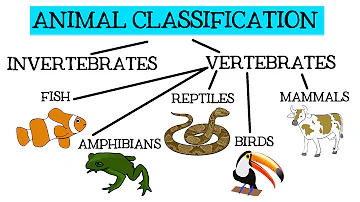
Animal Classification for Children Classifying Vertebrates and Invertebrates for Kids FreeSchool

النص الكامل للفيديو

You're watching FreeSchool! The world is full of many different types of animals. Some swim, some fly. Some breathe air, and some breathe underwater. Some have skeletons, and others don't. To help us understand the differences between the animals in our world, scientists classify, or sort, animals into different groups that share important characteristics. The two largest groups of animals are vertebrates and invertbrates. Vertebrates are animals that have spines, or backbones. Invertebrates are animals that do not have backbones. Most of the animals in the world are invertebrates. Some examples of invertebrates are octopus and squid, insects, arachnids, starfish and sea urchins, jellyfish, crabs and lobsters, clams, and many more creatures. On land most invertebrates are fairly small, but in the water they may grow to much larger sizes, as the water will support them even without skeleton. Vertebrates make up less than five percent of all animal species on earth, but if asked you to think of an animal you would probably choose vertebrate! Vertebrates are divided into different classes, or groups. Several of these classes are specific types of fish, for example: jawless fish, like lampreys and hagfish, and cartilaginous fish, like sharks and rays. For simplicity's sake, these other classes are usually lumped together with bony fish and just called 'fish.' The four remaining classes of vertebrates will all be very familiar: amphibians, reptiles, birds, and mammals. Let's look at the characteristics that make an animal fish. Fish live in the water, and they can breathe underwater. They use gills, not lungs, to get oxygen from the water around them. Fish have scales and fins. They are cold blooded, which means that they cannot control their own body temperature, which changes based on the temperature of the environment around them. Most fish also lay eggs. Amphibians are group of animals that include frogs, toads, newts, salamanders, and more. Amphibians, like fish, are cold-blooded. Unlike fish, amphibians can live on land and in the water, and have smooth, moist skin. Amphibians lay their delicate, jelly-covered eggs in the water. When the eggs hatch, the young may not look much like their parents, because some amphibians must go through metamorphosis - or big change - to become adults. Aside from some fish, amphibians are the only vertebrates that undergo metamorphosis. Reptiles you might know are turtles, snakes, crocodiles, and lizards. Like fish and amphibians, reptiles are cold-blooded. Unlike them, reptiles are air-breathing animals and cannot breathe underwater. Even reptiles that live in the water must come to the surface to breathe! You can tell if an animal is reptile instead of an amphibian if it has dry, scaly skin. Most reptiles lay eggs, but they are very different from the eggs of amphibians or fish. Their eggs are laid out of the water and have protective shell. For the most part, reptile eggs have soft, leathery shells. Birds are easy to recognize. They are the only type of animals in the world to have feathers! Like reptiles, birds can only breathe air. All birds have two legs, and all birds also have wings, but not all birds fly. Unlike fish, amphibians, and reptiles, birds are warm-blooded. That means that they can maintain constant body temperature. Birds lay eggs, but unlike the eggs of reptiles, birds' eggs have hard shells. The last group of animals we are going to talk about is mammals. Mammals are the group of animals that humans belong to! Like birds, mammals are warm-blooded and breathe air. Even mammals that live in water must come to the surface to breathe! All mammals have at least some fur or hair, although some have less than others. Almost all mammals give birth to live young instead of laying eggs, and all mammals feed their babies milk. fun fact about mammals is that mammals are the only animals to have ears that stick out! The animal kingdom is classified into many different groups based on animal characteristics to help us understand the world around us. Saying an animal is an invertebrate, vertebrate, fish, amphibian, reptile, bird, or mammal tells us many things about it that can help us to understand its needs and behavior. hope you enjoyed learning about animal classification today. Goodbye till next time!
Classification of Invertebrates 9:08

Classification of Invertebrates

Sustainable Montessori

1.1K مشاهدة · 3 years ago
Invertebrates The Dr Binocs Show Learn Videos For Kids 3:11

Invertebrates The Dr Binocs Show Learn Videos For Kids

Peekaboo Kidz

2.4M مشاهدة · 9 years ago

Invertebrate Characteristics and Phyla 14:01

Invertebrate Characteristics and Phyla

Southwest Science

33.8K مشاهدة · 2 years ago

The Diversity of Invertebrates 2:58

The Diversity of Invertebrates

MooMooMath and Science

507.1K مشاهدة · 4 years ago

A World of Invertebrates 2:47

A World of Invertebrates

Science Bits

62.1K مشاهدة · 5 years ago

THE ANIMAL KINGDOM VERTEBRATES AND INVERTEBRATES Educational Videos for Kids 6:53

THE ANIMAL KINGDOM VERTEBRATES AND INVERTEBRATES Educational Videos for Kids

Happy Learning English

957.6K مشاهدة · 3 years ago
Vertebrates The Dr Binocs Show Educational Videos For Kids 3:40

Vertebrates The Dr Binocs Show Educational Videos For Kids

Peekaboo Kidz

1.8M مشاهدة · 9 years ago

VERTEBRATE and INVERTEBRATE Animals Educational Videos for Children HappyLearningENG 6:53

VERTEBRATE and INVERTEBRATE Animals Educational Videos for Children HappyLearningENG

Happy Learning English

11K مشاهدة · 6 months ago

Invertebrate animals for kids arthropods worms cnidarians mollusks sponges echinoderms 11:42

Invertebrate animals for kids arthropods worms cnidarians mollusks sponges echinoderms

Smile and Learn - English

3.2M مشاهدة · 7 years ago

Science 6 Quarter 2 Classification of Invertebrates 12:25

Science 6 Quarter 2 Classification of Invertebrates

DELA FUENTE, Eloisa May C.

5.4K مشاهدة · 4 years ago