النص الكامل للفيديو
You’re about to watch golden time capsule: four filmed conversations with Jung, recorded over four days in Switzerland in 1957. The interviewer is Richard Evans, psychology professor from the University of Houston. These films were made for psychology students, and at Jung’s request, were edited into shorter version by the analyst Joseph Henderson. This is that cut, restored and put back in chronological order based on the full transcript. The original sound was often faint or distorted, and some parts remain rough or unintelligible. To make sure meaning isn’t lost, I’ve created accurate subtitles, based on the transcript. At the age of eighty-two, Jung’s presence and expression are full of life. Jung is rooted in empirical evidence yet open to depths that make life mysterious and vigorous. There’s mercurial twinkle in his eye, the look of someone who has seen and realized hidden places in the psyche as few have. His words carry both weight and warmth. You can feel man who has wrestled with ideas until they became tools, and with symbols that serve as living realities. Jung’s influence grows slowly as time passes, far beyond fashion. His work tends to be carried forward not by mainstream establishment, but by individuals who prove it in their own lives and callings. His ideas demand testing in experience. They are instruments to use. You have to meet them in your dreams and conflicts, in love and work, in illness and transformation. Jung influenced far outside psychology, into theology, history, art, physics, among other fields, because he addresses patterns that show up wherever human beings wrestle with symbols and fate. Here’s thread to hold onto while you watch: for Jung, the psyche is real, autonomous, and oriented toward wholeness. It compensates what’s one-sided. We keep our balance, personally and culturally, by listening to the unconscious as it speaks through dreams, intuitions, synchronicities, symptoms, moods, and symbols that press for our attention. They visit everyone, ancient and modern, and deserve careful notice. The unconscious isn’t junk room of repressed thoughts, it’s creative partner, source of new life that acts on its own. In the first session, Jung recounts how, as young psychiatrist, his word-association work led to the discovery of feeling-toned complexes and to the fact that the unconscious can interrupt our speech, memory, and actions. He honors Freud’s breakthrough while widening his frame: the unconscious is not just by-product of repression, it is creative partner that generates new contents, and “libido” is not only sexual drive but the general energy of the psyche, able to flow into hunger, power, curiosity, religious experience, art, and love. With that shift he trades single-cause model for multi-layered field of energies and symbols, placing dreams and myths in their right place, as archetypal expressions of the source of all images, rather than repressed disguises. Jung refuses the notion that the unconscious is merely an epiphenomenon of consciousness, view that is still prevalent today, and shows how it is in fact the autonomous matrix of psychic life. In the second session, Jung names the social mask we all wear - the persona, and distinguishes it from the ego and from the deeper center he calls the Self, the deeper core of the personality. He lays out his map of types. Introversion and extraversion as basic attitudes and four functions for orienting to life. Sensation - what’s there, thinking - what it is, feeling - what it’s worth, and intuition - where it’s headed. Don’t turn types into boxes, he warns. The unconscious inferior side balances the conscious one. He explains anima and animus, the inner feminine and inner masculine images as forces that can seize us or lift us up and that we eventually have to relate to consciously. In the third session, Jung talks about psychic energy by analogy with physics - flow and gradients, and about the psyche’s pull toward balance. Neurosis, he says, is created by the wrong attitude right now, even if it has roots in the past. And so, healing is always possibility - because attitude can change in the present. Jung works with dreams because the unconscious expresses itself in symbols that complete what consciousness leaves out. He discusses Rhine’s experiments and introduces what he calls synchronicity, meaningful coincidences, events outside of causality. He follows evidence and experience and lets facts challenge assumptions. You’ll also hear him talk about psychosomatic illness and his caution about using tranquilizers as shortcuts when the real work is moral and psychological. In the final session, Jung turns to training and culture. Psychology for him can’t just be lab methods and statistics. We need history, myth, religion, language, and the arts because the psyche speaks in age-old images. Marie-Louise von Franz, close collaborator of Jung for several decades, says that Jung wrote and worked with “double bottom”: rigorous observation on one level, and on another living relationship to the symbols themselves. Listen that way, both scientifically and devotionally, and you’ll catch the depth he’s pointing to. What he offers isn’t system of belief, but way of seeing that asks for authentic participation: our dreams, our conflicts, and our courage to face what grips us while we consciously strive toward relationship with the center that can hold and direct us. If something here speaks to you, carry it into practice: in dreamwork, honest relationships, creative work, and service. With that, let’s begin. Now, Dr. Jung, many of us who have read great deal of your work, of course, are aware of the fact that in your early work, you were to some degree at least in association with Dr. Sigmund Freud. And know it would be of great interest to many of us to hear little bit about how you happened to hear of Dr. Freud and how you happened to become involved with some of his work and ideas. Well, as matter of fact, it was in the year 1900 in December. Soon after Freud's book about dream interpretation had come out that was asked by my chief Professor Breuler, to give review of the book. studied the book very attentively and didn't understand many things in it, which weren't clear at all to me. But from other parts got the impression that this man really knew what he was talking about. And thought that this is certainly masterpiece, full of future. had no idea then - of ideas of my own. was just in... it was just when began my career as an assistant in the psychiatric clinic. And then began with experimental psychology or psychopathology. applied the experimental association methods by Wundt and the same that has been applied in the Kraepelin's psychiatric clinic in Munich, and had studied the results, and had the idea one should go once more over it. So made these association tests and found out that the important thing in them has been missed, because it is not interesting to see that there is reaction, certain reaction, to stimulus word. That is more or less uninteresting. But the interesting thing is why people could not react to certain stimulus words or in an entirely inadequate way. And then began to study these places in the experiment: where the attention or the capability apparently of the test person began to waver or to disappear. And found soon out that it is matter of intimate personal affairs (that) people were thinking of, or which were in them even if they momentarily did not think of them. when they were unconscious, in other words, but nevertheless an inhibition came from the unconscious and hindered the expression in speech. And then in examining all these cases And then in examining all these cases as carefully as possible, saw that it was matter of what Freud called repressions. also saw what he meant by symbolization. In other words, from your word association studies some of the things in 'The Interpretation of Dreams' began to fall into place? - Right. - In you own thinking. And then wrote book about the psychology of 'Dementia Praecox', as it was then called- now it is Schizophrenia. And sent the book to Freud and wrote to him about my association experiments and how they confirmed his theory thus far. And that is how my friendship with Freud began. Now one of the, of course, very fundamental ideas in the original psychoanalytic theory was Freud's conception of the 'Libido' as sort of broad psychic sexual energy. Of course, we all know that you began to feel that Dr. Freud might have had perhaps little bit too much stress on sexuality in his theory. Now when did you begin first feeling this? In other words, was this sort of feeling that you had almost from the beginning or as time went by did you begin to feel this way? Well, you see in the beginning had naturally certain prejudice against his conceptions. And after while overcame them. could do that from going to my biological training. And could not deny the importance of the sexual instinct, you know. - Yes. But later on saw that it was very one-sided. Because, you see, man is not only governed by the sex instinct. There are other instincts as well. For instance, in biology you see the nutritional instinct is just as important as the sex instinct. Also in primitive societies sexuality plays role much smaller than food. Food is the all-important interest and desire. Sex? That is something they can have everywhere. They are not shy. But the food is what's difficult to obtain, you see. And so it is the main interest. And then in other societies for instance, mean in civilized societies, the power drive plays much greater role than sex. For instance, there are many big businessmen who are impotent. Because their whole energy is going into money making. Or dictating the laws to everybody else. That's much more interesting than affairs with women. So, in sense, as you began to look over Dr. Freud's emphasis on the sexual drive, you began to think in terms of other cultures and broader ideas and it began to seem to you that this wasn't really an emphasis that was universal or sufficiently universal to be (of primary) importance? Well, you know, couldn't help seeing it becasue had studied Nietzsche. knew the works of Nietzsche very well. He had been proffesor at Basel University, you know, and the air was full of talk about Nietzsche. And so naturally have studied his works, and there saw an entirely different psychology, which was also psychology! perfectly competent psychology, but all built upon the power drive. Do you think it's possible that Dr. Freud was either ignoring Nietzsche, or perhaps not wanted to be influenced by Nietzsche? You mean his personal motivation? Well, of course it was personal prejudice. You see, It happened to be his main point, you know, that certain people are chiefly looking for this side and other people to another side. and other people to another side. So you see, the inferior So you see, the inferior Dr. Adler, the younger, the weaker, naturally had power complex. He wanted to be the successful man. Freud was successful man. He was on top. And so he was interested only in pleasure, in the pleasure principle. while Adler was interested in the power drive. -Yes. -Sure enough. Actually, you feel that it's sort of function of his own personality to some degree? Yea, It is quite natural. You see, it is one of the two ways (of) how to deal with reality. Either you make reality an object with your pleasure, if you are powerful enough already, or you make it an object of your desire to grab it. Or possess it. Some observers have thought that perhaps the patients that Dr. Freud saw in Vienna of this period were often individuals who were repressed sexually. yes, that's right. And perhaps that so many of these patients having been of this type, and that this may have been one thing that sort of reinforced Dr. Freud's ideas. In other words, in sense that the Viennese society was rather—quotes— "repressed" society. Now, would you think that this might have been factor? Well, it is certainly so, that in the end of the Victorian age there was reaction going over the whole world against the taboos, the sex taboos, so-called. One didn't understand anymore, properly, why or why not. And Freud belongs into that time. It was sort of liberation of the mind of such taboos. So the reaction, then, against the sort of tight, inhibited culture he was living in. yes, and you see, Freud in that way, on that side, really belonged to the category of Nietzsche in mind. Nietzsche had liberated Europe from great deal of such prejudices, but only concerning the power drive. And our illusions as to the motivations of our morality. It was time critical of morality. And so then, in sense, Dr. Freud was taking it into another direction? - Yes, yes. - With an equal amount of force. And then, moreover, you know, it is - sex being the main instinct the predominating instinct, in more or less safe society. Where the social conditions are more or less safe, there - sexuality is apt to predominate Because people are taken care of. They have their positions, they have enough food, no question of hunting and seeking food or something like that. Then it is quite probable that the patients you meet have, more or less all, certain sexual complex. So this is, in sense, the drive in that particular society most likely to be inhibited? You see, it is sort of finesse, almost, when you find out that somebody has power drive and their sex only serves the purpose of power. For instance, charming man, you know, women, all women think he's the real hero of all hearts. He is power devil. Like Don Juan, you know? The woman is not his problem. His problem is how to dominate. You see? And so, you see, in the second place after sex comes the power drive. And even that is not the end. Now, in going sort of fundamentaly Now, in going sort of fundamentaly through the development of Freud's theory, which, of course, was sort of significant factor, as you say, in the development of many of your own early ideas. Dr. Freud, of course, talked great deal about the unconscious. The unconscious is something which is really unconscious. So you have no object. You see nothing. You only can make inferences, you know? And so, we have to create model of this possible structure of the unconscious because we can't see it. Now, you see, he (Freud) came to the concept of the unconscious chiefly on the basis of the same experience have made in the association experiment, namely that people reacted; they said things, they did things without knowing that they did it or said it. And this is something you can observe experimentally in the association experiment, where people cannot remember afterwards what they did or what they said in the moment where stimulus word hits the complex. With the reproduction, in the so-called reproduction experiment, you go through the whole list (of words), and you will see that the memory failes where there was complex reaction. And that is the simple fact Freud has based his idea of the unconscious on, because that is what you can see time and again that people, for instance, make mistake in speech or that they say something which they didn't mean to say, that they just make ridiculous mistakes, you know. There are no end of stories, you know, about how people can betray themselves by saying something they didn't mean to say at all. Yet! The unconscious meant meant him to say that thing! Just that thing! For instance, when you want to express your sympathy at funeral, you go to somebody and you say, congratulate you." That's pretty painful, you know, but that happens, and it is true. Now, this is something that goes parallel now with the whole school of the 'Salpetriere' in Paris. There was Pierre Janet, who has worked out that side of the unconscious reactions quite particularly. Now, Freud refers very little to Pierre Janet, but have studied with Pierre Janet in Paris and he has formed my ideas very much. He was first-class observer, though he had no dynamic theory about... no psychological theory, it was sort of physiological theory of the unconscious phenomena, as the so-called 'abaissement du niveau mental' (reduction of mental level) that is, certain depotentiation of the tension of consciousness. It sinks below the level of consciousness and thus becomes unconscious. Now, that is Freud's view too, Only he says, "It sinks down because it is helped, it is repressed from above." Then that was my first point of difference with Freud. said there are cases in my observation where there was no repression from above, but the thing itself withdrew. Those contents that became unconscious have withdrawn all by themselves. They were not repressed, on the contrary. They have certain autonomy. There discovered the concept of autonomy, and that these contents that disappear, have the power to move independently from my will. Either they appear when want to say something definite, they interfere and speak themselves instead of what wanted to say. Or they make me do something which didn't want to do at all. Or they withdraw in the moment where want to use them. They suddenly disappear. And this is independent of any of the, you might say, in sense, of the pressures on consciousness, as Freud suggested? There is, there can be such cases, sure enough. But, beside them, there are also the cases that show that the unconscious contents acquire certain independence. And all mental contents that have certain feeling tone that is emotional, has the value of an emotional affect, have the tendency to become autonomous. So, you see, anybody in an emotion will say and do things which he cannot vouch for. He must excuse himself after: was in state". He was 'Non compos mentis' (of unsound mind). Now, in addition to, of course, the repression, the fact that repressed material is present in the unconscious, of course, as pointed out before, and as you mentioned briefly, Dr. Freud recognized that in sense the individual was born, sort of entirely, sort of victim of what he later called an Id or total sort of unconscious, undeveloped sort of full animal organism. And he, think, it's not very easily seen where all these drives, all these instincts came from as if there's some allusion to the fact that they are the result of phylogenetic Inheritance that they are carried over from previous developments. You see, nobody knows where instincts come from. They are there. You find them. That is story that has been played millions of years ago, you know, then sexuality has been invented, and wasn't there so don't know how it has happened. Feeding has been invented very much longer than even sex, and why and how it has been invented? don't know. haven't been there. So we don't know where that thing comes from. And it's quite ridiculous, you know, to speculate about such an impossibility. So the question is only, where do those cases come from, where instinct does not function? That is something within our reach. Because we can study the cases where instinct does not function. Now, could you give us some rather specific examples, of what you mean, of cases where the instinct does not function? well, you see, instead of instinct which is habitual form of activity, you know, take any other form of habitual activity. And once, suddenly, that thing doesn't function. For instance, take singer, who is absolutely controling his voice, suddenly he can't sing. Or any other, for instance, take man who writes fluently, suddenly he makes ridiculous mistake, There, his habit doesn't function. Or, you see, when you ask me something, I'm supposed to be able to react to you. Suddenly am 'Bouche Beante'. (open-mouthed) For instance, if you succeed to touch one of my complexes, you can see me, that I'm absolutely perplexed. am 'depossede', (dispossessed) and words fail me! Well we haven't seen you very perplexed yet, Dr. Jung. Or look for instance at exam psychology, you know, fellow who knows his stuff quite well. The professor asks him and he cannot say word! - block. - Yes. block. Now, going little further, another part of Dr. Freud's theory, of course, which became very important, as we've already alluded to, is the idea the conscious and out if this, sort of an unconscious, instinctual structure that the individual has, that out of this emerges, as result of these structures, and of course the word "structure" has to be put in quotation marks as you point out it is only model, but as this structure comes to contact with reality of the world, out of it begins to emerge as consciousness, man's conception almost of himself. Now, Freud then, of course, called this structure the ego. - Yes. Now, his ego then was really the product of reality, in sense also perhaps the product of frustration as the individual developed. Now- Don't you speak of the general psychological perception of the ego? Yes. Ah-ha. Now, in your work, of course, you also are interested in this conscious totality, the total of the organism. Now, is your, what about your conception of this conscious totality? Would you agree, for example, with the statement that this is something that emerges out of man's contact (with) reality? Well, that he has an ego at all? That is your question? Yes. Well... You see, that's again such case- hadn't been there when it was invented. Although, you see, you can observe it to certain extent with child. Because child definitely begins in state where there is no ego. And then about the fourth year or before, you know, but about that time, the child develops sense of ego, "myself," and that is in the first place an identity with the body. For instance, when you ask primitives, then they emphasize, always the body. Or when, for instance, you ask- "Now, who has brought this thing here?" He will say, (a grunt) brought it". No accent on the simply "brought it". And then I'll say, "But have you brought it?" He says: "In here, me-me!" "Yes, myself! This here, this thing here!" So the identity, you know, with the body is one of the first things which make an ego. It is the spatial separateness that induces apparently the concept of an ego. And then, of course, lot of other things. Later on, it is mental differences, personal differences of all sorts, etc. You see, the ego is continuously building up. It is not finished product, never. It builds up. You see, no year passes where you do not discover new little aspect in which you are more ego than you thought. Of course, one of the central parts of the so-called cycle section development in the more or less orthodox psychoanalytic theory is the so-called Oedipus complex. believe the term complex was yours originally. Well, you see, that is just what call an archetype. That is the first archetype Freud has discovered. First, and the only one. He thinks that this is the archetype. But of course, there are many such archetypes. You look at Greek mythology and you'll find any amount of them, or look at dreams and you find any amount of them. But incest was so impressive to him that he even has chosen the term "Oedipus complex" because that was one of the outstanding examples of an incest complex. And it is only the masculine form, mind you, because women have an incest complex too. But there it is not an Oedipus, so it is something else. You see, so it is only the term for an archetypal way of behavior, in case of man's relation, say, to his mother. It also means to his daughter, because whatever he was to the mother he will be it to the daughter too. It can be this way or that way. It depends. So, then you will accept, in other words, the Oedipus complex but not as being the only important such influence. You will see this is just one of many... - One of the many, many ways of behavior. Now you see, the Oedipus gives you an excellent example of the behavior of an archetype. Now, you see, the archetype is force! It has an autonomy! it can suddenly seize you! It is like seizure. So for instance, falling in love at first sight, that is such case. You see, you have certain image in yourself without knowing it of the woman. Of the real woman! Now you see that girl, or at least good imitation of your type. And instantly! You get seizure! And you are gone. And afterwards you may discover that it was hell of mistake! (been-there-done-that laugh) Or, you see, man is quite capable, or he is intelligent enough to see that that woman of his "choice", as one says, he got no choice! He has been captured! He sees that she is no good at all, that she is hell of business. And he tells me so! And he says, "For God's sake, doctor! Help me to get rid of that woman!" He can't. He is like clay in her fingers. And that is the archetype. Freud is always inclined to explain these things by external influences. Dr. Jung, we have been discussing some of the factors in the development of the personality of the individual and you have very kindly elaborated for us on some of your fundamental concepts such as the archetype, and the anima, and the animus. Now another concept or idea that seems to be very interesting one in your work is the Persona. wonder if you would mind telling us little bit about how you construe this term Persona? Well this is practical concept we need in elucidating people's relation. noticed with my patients, particularly with people that are in public life, that they have certain way of presenting themselves. For instance, take the doctor. He has certain way, for instance, he has good bedside manners. And he behaves as one expects doctor behaves. He may even identify himself with it and believe that he is what he appears to be. He must appear in certain form, unless - people don't believe that he's doctor. And so when he's professor, he's also supposed to behave in certain way so that it is plausible that he is professor. So the persona is partially the result of the demands society has. And on the other side, it is compromise with what one likes to be, or as one likes to appear. So take, for instance, parson. He also has his particular manner and as corresponding to the general expectation. And he behaves also in another way, combined with his Persona that is forced upon him by society in such way that also is fiction of himself. His idea about himself is more or less portrayed or represented. So the Persona is certain complicated system of behavior which is partially dictated by society and partially dictated by the expectations or the wishes one nurtures oneself. Now, this is not the real personality in spite of the fact that people will assure that it is all quite real and quite honest, yet it is not! Now, such performance or say, yeah, the performance of the Persona is quite all right, as long as you know that you are not identical with the way in which you appear. But if you are unconscious of this fact, then you get into, sometimes, very disagreeable conflicts, namely people will can't help noticing that at home, for instance, you are quite different from what you appear to be in public. And people who don't know it, stumble over it in the end. They deny that they are like that, but they are like that, they are it. And then you don't know, now, which is the real man. Is he the man as he is at home, or in intimate relations or is he the man that appears in public? It is question of Jekyll and Hyde. Occasionally there is such difference that you would always be able to speak of double personality. And the more that is pronounced, the more people are neurotic. They get neurotic because they have two different ways, they contradict themselves all the time, and in as much as they are unconscious of themselves - they don't know it, they think they're all one. Everybody sees that they are two. And some know him only for one side, some others know him only for the other side. And then there are situations that clash because the way you are creates certain situations with people in your relations. And these two situations don't chime in, they are just dishonest. And the more that is the case, the more people are neurotic. Actually, would you say that the individual may even have more than two Personas? We can't afford it very well to play more than two roles. But there are! There are cases, for instance, where people have up to five different personalities, in cases of dissociation of personality. Where, for instance, the one person, say, call it person doesn't know of the existence of the person But knows of Or there may be third personality - that doesn't know of the two others. There are such cases in literature But they are rare. (very rare) The ordinary case is just an ordinary dissociation of personality. One calls that 'systematic dissociation', in contradistinction to the chaotic or unsystematic dissociation you find in Schizophrenia. What is the difference between the term Ego, as you see it, and the term Persona? Well, you see, the ego is supposed to be the representative of the real person. For instance, in the case where knows of but doesn't know of in that case, one would say the ego is more on the side of because the ego has more complete knowledge and is split-off personality. Now, you also use the term Self. Would this have different meaning than, say, ego or persona? Quite true, yes. You see, when say Self, then you must not think of myself" because that is only your empirical self. And that is covered by the term ego. But when it is matter of the Self, then it is matter of personality that is more complete than the ego, because the ego is only... consists of what you are conscious of. What you know to be your self. For instance, in our example, that knows and doesn't know is relatively in the position of the Self. Namely, the Self is on the one side the ego on the other side, the unconscious personality which is in the possesion of everybody. Very often it's just the other way around that the unconscious is in possession of consciousness. Well, that is different case. Now, you see, while am talking, I'm conscious of what say, I'm conscious of myself, yet only to certain extent, quite lot of things happen. For instance, make gestures, I'm not conscious of them. They happen unconsciously, you can see them. may say or use words and can't remember at all having used those words or even at the moment I'm not conscious of them. So, any amount of unconscious things occur in my conscious condition. I'm never fully conscious of myself. While I'm trying, for instance, to elaborate an argument, at the same time, there are unconscious processes that continue - perhaps dream, which had had last night. Or - part of myself, thinks of God knows what! Or of trip I'm going to take or of such and such people have seen or when am, say, writing paper, am continuing writing that paper in my mind without knowing it! You can discover these things, say - in dreams or - if you are clever in immediate observation of an individual, then you see in the gestures or in the expression in the face that there is what one calls 'arriere pensee' something behind conscious. So that you have finally the feeling well that man has something up his sleeve. And you can even ask him now what are you really thinking of? You are thinking all the time, something else, yet he's not conscious of it. Or he may be, there are of course great individual differences, there are individuals who have amazing knowledge of themselves, of the things that go on in themselves. But even those people wouldn't be capable of knowing what is going on in their unconscious. For instance, they are not conscious of the fact that while they live conscious life, all the time myth is played in the unconscious. myth that extends over centuries. Namely, archetypal ideas, stream of archetypal ideas that goes on through one individual through the centuries! and that comes into the daylight in the great movements. Say in political movements or in spiritual movements. For instance, in the time before reformation, people dreamt of the great change. And that's the reason why such great transformations could be predicted. If somebody has been clever enough to see what is going on in people's mind, in the unconscious mind, would be able to predict it. For instance, have predicted the Nazi rising in Germany through the observation of my German patients. They had dreams in which the whole thing was anticipated and with considerable detail. was already absolutely certain in the years before Hitler, before Hitler came in the beginning of... Well, could say the year 1919, was sure that something was threatening in Germany, something very big and very catastrophic. And only knew it through the observation of the unconscious. You see, there is something very particular in the different nations. This is peculiar fact that the archetype of the Anima plays very great role in Western literature, French and Anglo-Saxon, not in Germany. There are exceedingly few examples in German literature where the Anima plays role. You know, that it becomes the fact that not one woman is buried unless she is buried as "alt Kaminfegersgattin" at least. She must have title, otherwise she hasn't existed. And so it is just as if— now mind you, this is bit drastic, but it illustrates my point: in Germany, there are no women. There is Frau Doktor, Frau Professor, Frau"Kommerzienrat", the grandmother, the mother-in-law, the grandfather, father, the son, the daughter, the sister. "la femme ca n'existe pas." Well, it is the idea, you see. Now that is an enormously important fact which shows that in the German mind there is going on particular myth, something very particular. And the psychologists really should look out for these things. But they prefer to think that am prophet. HA! Now this is of course very interesting, remarkable set of statements here. How would you look at Hitler in this light? Would you see him as personification, as symbol of the father? well, no, no. Not at all. No, you see, couldn't possibly explain that very complicated fact that Hitler represents. It is too complicated, you know. He is hero figure. And hero figure is far more important than any fathers that have ever existed. He was hero in the German myth. And mind you, religious hero. He was savior. He was meant to be savior. That is why they put his photo upon the altars, even. Or someone declared on his tombstone that he is happy that his eyes had beheld Hitler, and now he can lie in peace. It is just the hero myth, you know. Now, getting back to the idea of the Self, The self incorporates these unconscious factors. The Self is merely term that designates the whole personality. Because the whole personality of man is indescribable. You see, his consciousness can be described. His unconscious cannot be described. Because the unconscious, as must repeat myself, is always unconscious. And it is really unconscious. One really does not know it, And so we don't know our unconscious personality. We have hints. We have certain ideas. But we don't know it really. Nobody can say where man ends. That is the beauty of it, you know. It's very interesting. The unconscious of man can reach God knows where. They are going to make discoveries. Now, another set of ideas which of course are very, very well known to the world, that of course, you have originated. Center around the terms Introversion and Extroversion. know that you are aware of the fact that these terms have now become so widely known. The man on the street is using these terms constantly describing his wife or his friends and so on and so forth. It has become probably the most used psychological concepts by the layman that we have. Like the word "complex." have invented it too, Yes, from the association experiment. Yes, that's right. Well you see, this is simply practical, because there are certain people who definitely are more influenced by their surroundings than by their own intentions, while other people are more influenced by the subjective factor. Now the subjective factor, and this is very characteristic, was understood by Freud as sort of pathological autoeroticism. Now, this is mistake. The psyche has two important conditions. One is the environmental influence, and the other is the given fact of the psyche as it is born. The psyche is by no means 'tabula rasa'. We are definite mixture and combination of genes, and they are there from the very first moment of our life, and they give definite character even to the little child. And that is the subjective factor, looked at from the outside. Now, if you look at it from the inside, then it is just so as if you would observe the world. When you observe the world, you see people, you see houses you see the sky, you see tangible objects. But when you observe yourself within, you see moving images, world of images, generally known as fantasies. Yet, these fantasies are facts. You see, it is fact that man has such and such fantasy. And it is such tangible fact, for instance, that when man has certain fantasy, another man may lose his life. Or bridge is built These houses were all fantasies. Everything you do here, all of the houses everything was fantasy to begin with. And the fantasy has proper reality. That is not to be forgotten. Fantasy is not nothing! It is, of course, not tangible object, but it is fact nevertheless. It is, see, form of energy. Despite the fact we can't measure it. It is manifestation of something. And that is reality that is just reality as, for instance, the peace treaty of Versailles, or something like that It is nowhere, you can't show it. But it has been fact. And so, the psychical events are facts, are realities, And when you observe the stream of images within you observe an aspect of the world. Of the world within. Because the psyche, you know, if you understand it as phenomenon that takes place in so-called living bodies, then it is quality of matter. As our body consists of matter, we discover that this matter has another aspect, namely psychic aspect. So it is simply the world from within, seen from within. It is just as if we were seeing into another aspect of matter. This is an idea that is not my invention. Old Democritus already said... talked of the 'spiritus insertus atomis', the spirit inserted in atoms. Namely, the spirit that is inserted in atoms. That means - psyche is quality that appears in matter. It doesn't matter whether we understand it or not, but this is the conclusion. we come to if we draw conclusions without prejudices. And so, you see, the man who is going by the external world, by the influences of the external world, say... society or perceptions, sense perceptions, thinks that he is more valid, you know, because this is valid, this is real, and the man who goes by the subjective factor is not valid because subjective factor is nothing. No! that man is just as well based, because he bases himself upon the world from within. And so he is quite right even if he says: it is nothing but my fantasy." You know... And of course that is the introvert, and as the introvert is always afraid of the external world, He will tell you when you ask him he will be apologetic about it. He will say, "Of course, yes, know it's only my fantasies," and he has always resentment. And as the world in general, particularly America, is extraverted like hell, the introvert has no place, Because he doesn't know that he beholds the world from within, and that gives him dignity, and that gives him certainty, because it is nowadays particularly that the world hangs on thin thread, and that is the psyche of man. Assume that certain fellows in Moscow lose their nerve or their common sense for bit, and the world is in fire and flames. Nowadays we are not threatened by elementary catastrophes. There is no such thing as an H-bomb. That is all man's doing! We are the great danger! The psyche is the great danger. What if something goes wrong with the psyche? It is demonstrated to us in our days what the power of the psyche is - of man. How important it is to know something about it. But we know nothing about it. Nobody would give credit to the idea that the psychical processes of the ordinary man that the psychical processes of the ordinary man have any importance whatever. One thinks, he is just what he has in his head. He is all from his surroundings." He is taught such and such thing, and particularly if he is well housed and well fed, then he has no ideas at all. And that's the great mistake, because he is just that as which he is born, and he is not born as 'tabula rasa' but as reality. Now, of course one of the very common, think, misconceptions of your work among some of the writers of America had been that they had sort of characterized your discussions of introversion and extroversion as suggesting that the world is made up of only two kinds of people, introverts on one end and extravets on the other Would you like to comment about that? Bismarck once said... "God may protect me against my friends, with my enemies can deal myself alone!" You know how people are. They catch word and then everything is schematized along that word. There is no such thing as pure extravert or pure introvert. Such man would be in the lunatic asylum. Those are only terms to designate certain penchant certain tendency, for instance, the tendency to be more influenced by environmental influences or more influenced by the subjective factor. That's all. And you see, there are people who are fairly well balanced and are just as much influenced from within as from without, or just as little. And so with all the finer classifications, you know, they are only sort of 'points de repere', points for orientation. My whole scheme of typology is merely sort of orientation. Namely, there is such factor as introversion. there is such factor as extroversion. The classification of individuals means nothing, nothing at all! It is only the instrumentarium! for the practical psychologist to explain, for instance, the husband to wife or vice versa. For instance, it is very often the case, one could almost say, it is almost rule, but don't want to make too many rules. In order not to be schematic, that an introvert marries an extravert for compensation, or another type marries the countertype to complement himself, for instance. Dr. Jung, of course, tied in with your typology and quotation marks for introversion and extroversion, we first know of your concepts of thinking, feeling, sensation, and intuition. And of course, it would be very interesting to hear some expansion of the meaning of these particular terms as related to the introvert-extrovert dichotomy. Well, there is quite simple explanation of these terms, and it shows at the same time how arrived at such typology. Namely, sensation tells you that there is something. Thinking, roughly speaking, tells you what it is. Feeling tells you whether it is agreeable or not to be accepted or not accepted or rejected. And intuition, now there is difficulty. Intuition, now there is difficulty. You don't know ordinarily how intuition works. So when man has hunch, you can't tell exactly how he got at that hunch or where that hunch comes from. It is something funny about intuition. will tell you little story- had two patients. The man was sensation type, had two patients. The man was sensation type, and the woman was an intuitive type. Of course, they felt attraction. And so they took little boat and went out to the lake of Zurich. And there were those birds that dive after fish, you know? And then after certain time, they come up again, and you can't tell where they come up. And so they began to bet, who would be the first to see the bird. Now, you would think that the one who observes reality very carefully the sensation type would of course win out. Not at all! The woman won the bet completely. She was beating him on all points, because by intuition she knew it before. Now, how is that possible? Well, sometimes, you know, you can really find out how it works By finding the intermediate links. You see it is perception by intermediate links, and you only get the result of that whole chain of associations. Sometimes you succeed in finding out, but more often you don't. So my definition is - intuition is perception by ways or means of the unconscious. That is as near as can get. That is very important function. Because when you live under primitive conditions, lot of unpredictable things are likely to happen. And there you need your intuition! because you cannot possibly tell by your... perceptions by your sense perceptions, what is going to happen. For instance, you are traveling in primeval forest. You only see for few steps ahead. You go by the compass, perhaps, and you don't know what there is ahead. It is uncharted country. If you use your intuition, then you have hunches. And when you live under such primitive conditions, you instantly are aware of hunches For instance, there are places that are favorable, there are places that are not favorable. You can't tell for your life what it is! but you better follow these hunches! Because anything can help. Quite unforeseen things. For instance, at the end of long day, you approach river, you don't know that there is river. Yet, when you come to the river, that is quite unexpected. For miles, there is no human habitation. You cannot swim across, it's all full of crocodiles. So what? Now, such an obstacle hasn't been foreseen. But it may be that you have had an hunch, that you remained in the last likely spot, and that you wait for the following day, that you can build raft or something of the sort, or look out for possibilities. For instance, you also can have intuitions in, and it constantly happens, in our jungle called city. You can be... have hunch, something is going wrong. Particularly when you are driving an automobile. For instance, it is day where nurses appear at the street. And they always try to get something interesting, like suicide, you know, to be ran over. That's more marvellous apparently. And then you know, you get peculiar feeling, and really, at the next corner, already is second nurse, that runs in front of the automobile. Duplicity of cases, you know. That is rule, you know, that such chance happens in coming groups. And so you see, we are constantly, And so you see, we are constantly, we have constantly warnings, hints, that consist perhaps in slight feeling of uneasiness, or uncertainty, fear. Now, Under primitive circumstances you will pay attention to these things. They mean something. With us, in our man-made, absolutely, apparently safe conditions, we don't need that function so very much. Yet, we still use it. So you find the intuitive types, for instance, amongt bankers, Wall Street men; they follow hunches, you know, gamblers of all descriptions. You find the type very frequently among doctors, because it helps them in their prognosis. Sometimes case can look quite normal as it were, and you don't foresee any complications. Yet, an inner voice tells you "Now look out here at something... not quite all right, you know." You cannot tell why and how, but we have lot of subliminal perceptions, sense perceptions, and from those, we probably draw good deal of our intuitions, but that is perception by the way of the unconscious. And you can observe that with intuitive types. You see, intuitive types very often do not perceive by their eyes or by their ears. They perceive by intuition. For instance, once it happened, that had woman patient in the morning at nine o'clock. you see, often smoke my pipe so the smell of tobacco in the room or cigar. And so she came and said, "But you begin early." said, "Can you call it early at nine o'clock?" "But no, you must have seen somebody at eight o'clock!" said, "How do you know?" There had been man there that had come at eight o'clock already. Then she said, well had just hunch there must have been gentleman with you this morning." said, "How do you know it was gentleman?" She said, well, just had the impression the atmosphere was just like gentleman here." All the time, the ashtray was under her nose and there was half-smoked cigar. But she wouldn't notice it! So you see the intuitive is the type that doesn't see doesn't see the stumbling block before his feet, but he smells rat for ten miles. You make distinction between an intuitive-extrovert and an intuitive-introvert? For example, more specifically, what would be an example or difference between an intuitive-extrovert and an intuitive-introvert? Well, you know, the... you have chosen... somewhat difficult case, you know, because one of the most difficult types is the intuitive-introvert. Yeah, know. The intuitive extrovert, you find among hunters, bankers, gamblers; That is quite understandable. But the introvert variety But the introvert variety But the introvert variety is more difficult because he has intuitions as to the subjective factor. Namely, the inner world. And of course that is now very difficult to understand. Because what he sees are most uncommon things. And he doesn't like to talk of them if he's not fool. Because he would spoil his whole game by telling what he sees. Because people won't understand it. For instance, once had patient, young woman, about 27 or 28. And her first words, were when had sitted her, she said, "You know, Doctor, come to you because have snake in my abdomen." said "What?" "Yes, snake, black snake, coiled up right in the bottom of my abdomen." And must have made rather bewildered face at her She said, "You know, don't mean it literally!" "But should say it was snake, it was snake!" Now you see, our further conversation little later that was about in the middle of our treatment that only lasted for 10 consultations. She had foretold me, come 10 times and then it's alright. said, "How do you know?" got hunch." You see? And really, about the fifth or sixth hour, she said, "Doctor, must tell you, the snake has risen. "It is now about here." Hunch! And then, on the 10th day, said, "Now, this is our last hour, and do you feel cured?" And she said, "Beaming!" She said, "You know, this morning, it came up, "and came out of my mouth, and the head was golden!" And those were her last words. Now, Now, you see, that same girl, you see, that same girl, when it comes to reality, she came to me because she couldn't hear the step of her feet anymore. Because she walked on air, literally. She couldn't hear it, that frightened her. And then she came to me, asked her for her address, and then she said, pension so and so. Well, it is not called pension but it is sort of pension." had never heard of it. "Now I'm curious," said, have never heard of that place." "Well, it's very nice place", she said. Curiously enough, there are only young girls there, very nice and very lively young girls, and they had merry time. often wish they would invite me to their merry evenings." And say, "But... well... and they amuse themselves all alone?" no, they have plenty of young gentlemen coming in, and they have beautiful time, but they never invite me!" It turned out that it was private brothel. She was perfectly decent girl, you know, of very good family, not from here. She had found that place, don't know how. and she was utterly unaware that they were all prostitutes. And said, "For heaven's sake, you fell into very dark place! You hasty and get out of it." You see, that it was her sensation, you see, she doesn't see reality. But she had hunches like anything, and they came off. Now, you see, such person cannot possibly speak of her experiences, because everybody would think she's absolutely crazy. myself was quite shocked when thought, for heaven's sake, is that case schizophrenia? Because you don't hear that kind of speech, but she assumed that the old man, of course, knows everything, and he even understands such kind of language. So you see, if the introverted intuitive were to speak were to speak of what he really perceives, then practically no one would understand him. He would be misunderstood. And so they learn to keep things to themselves and you hardly ever hear them talking of these things. That is great disadvantage, but it is an enormous advantage in another way. Not to speak of the experiences they gather in that respect but also in human relations. For instance, they come into the presence of somebody they don't know. and suddenly they have inner images, and these inner images give them more or less complete information about the psychology of the partner. You know that it's... but it of course can also happen that they come into the presence of somebody who they don't know at all, not from Adam! And they know an important piece out of the biography of that person and are not aware of it! So the introvert, the intuitive, has in way very difficult life, although one of the most interesting lives! But it is difficult often to get into their confidence, you know Yes, because you say they are afraid people will think they are sick. The things that are interesting to them, or are vital to them, are utterly strange to the ordinary individual. And the psychologist should know of such things. You see? You see! When people make psychology, as psychologist, ought to do, his very first question is, Is he extroverted or is he introverted? They will look at entirely different things. Is he sensation type, is he an intuitive type, is he thinking? is he feeling? Because you see these things are complicated, as they are, they are still more complicated because the introverted thinker, for instance, is compensated by extroverted feeling. by inferior extroverted, archaic extroverted feeling. So an introverted thinker may be very crude in his feeling life, for instance, the introverted philosopher that is always carefully avoiding women will be married by his cook in the end! Now, in other words, then we can take your introverted extrovert categories and in sense go through describing sensation introvert type, sensation extrovert type, thinking introvert type, thinking introvert type and so on. In each case it stems from really not real category but simply as you say an approach, something to sort of help us study model. Well It is just sort of skeleton to which you have to add the flesh or, say, it is like country mapped out by triangulation points. That doesn't mean the country consists of triangulation points, That is only in order to have an idea of the distances and so it is means to an end. It only makes sense, such scheme when you deal with practical cases. Of course familiar with the work of Rhine at Duke University. Yes! Yes! Yes! And of course some of his work in extrasensory perception, clairvoyance, mental telepathy and so on and so forth. Some of the descriptions sounds quite bit like your like intuitive function operating. And in terms of your knowledge of this work would you say that person who has clairvoyance in sense would then be an intuitive type? That's quite probable. Or it can be sensation type, say an extroverted sensation type that is very much influenced by the unconscious, see because he has introverted intuition in his unconscious. You see? There are two groups. The rational group and the irrational group. The rational group is thinking and feeling, because the ideal thinking is rational result. The rational values. That is differentiated feeling. Whereas sensation must need to be irrational, because it may not prejudice facts. You see? It shall not prejudice facts. The real ideal perception is that you have an accurate perception of the things as they are without addition or correction. On the other side, the intuition doesn't look at the things as they are. That is prison. that is anathema to the intuitive. It looks, ever so shortly at the things as they are, and makes off into an unconscious process, at the end of which we have seen something nobody else would have seen. Now, so you see, these people who yield the best results are always those people who are introverted, or where introverted intuition comes in. But you see, that is... side aspect of it. It's not interesting. There's another question, far more interesting. Namely, that the terms they use, Rhine himself uses them precognition, telepathy, etc. They mean nothing at all! They are words! but he thinks he has said something when he says "telepathy." It's nothing. Now, of course, lot of the things that you're describing, think often, scientists will say, well this is due to chance, chance occurrences, chance factors. And Rhine and his own work use statistical methods. We find this happening more often than would be expected by chance. Well, you see, he proves that it is more than chance. It is statistically graspable. And that is the important point. And that hasn't been contradicted. There was such proof sample that happand in England, that man said, Rhine, that's nothing but guesswork. Exactly! That's it, it is guessing, what you call guessing. hunch is guessing. definite guess, you know, is hunch you know. Just that. But that means nothing. You see, the point is that it is more than merely probable. It is beyond chance. And that is the great problem. But you know, people hate such problems. They can't deal with. And so not concrete, and not in front of them? They can't deal with it. Even Rhine doesn't understand our argument in that respect, Because it is relativation Now I'm going to say something which in these sacred rooms is anathema. relativation of time and space through the psyche. That's the fact. and that is what Rhine has made evident. Now swallow that! Well, that's difficult. Well, may go little further? And for some of your recent work, which is indeed very profound, and it is not too well known to many of our students Of course not. Nobody read this things! Only the general public. Because my books are at least sold. I'm referring now to The concept of synchronicity. Which you have discussed. Yeah........ And which would have some relevance at this point in our discussion. Would you care to comment little bit on this concept? That is awfully complicated. One wouldn't know where to begin. Of course it is, this kind of thinking has been started long ago. and when Rhine brought out his results thought now we have at least more or less dependable basis to argue on. But the argument was not understood at all because it is really very very difficult. You know, there are plenty of facts in the observation of the unconscious. Where you come across cases of very peculiar kind. Of parallel events. Namely that, say, have certain thought. Or certain definite subject is occupying my attention. My interest. At the same time, something else quite independently happens That portrays just that thought. Now, this is utter nonsense, you know. Looked at from causal point of view. That it is not nonsense is made evident by the results of Rhine's experiments. There is probability. it is something more than chance that such case occurs. Now, have... never made statistical experiments, except one in the way of Rhine. for another purpose. But have come across quite number of cases where it was most astounding to find that two causal chains happened at the same time, but independent upon each other. So that you could say they have nothing to do with each other. Of course, it's quite clear. For instance, just so speak of red car. And at that moment, red car comes here. Now, hadn't seen it. It was impossible because it was behind the building. In this moment, the red car appears. Now this seems as mere chance. Yet the Rhine experiment proves that these cases are not mere chance. Of course, many of these things are occurrences where we cannot apply such an argument. Otherwise, we would be superstitious. Because, say: "Now this car has appeared because here was..." some remarks had been made about red car. It's not cause and effect. "This is miracle that red car appears!" it is not (a miracle) it is chance. Yeah. Just chance. But these chances happen more often than chance allows. And that shows that there is something behind it. So we see in... Rhine has whole institute with many co-workers and has the means. We have no means here, you know, to make such experiments, otherwise would probably have done them. But... this just was physically impossible. So had to content myself with the observation of facts. The sort of question that is so important as we try to understand the individual. And it centers around the problem of motivation, And it centers around the problem of motivation, why the person does what he does. Now, to great degree you have already talked about this when you talked about archetypes. Now in the work of Dr. Freud, we spoke of libido as an energy, and earlier we spoke of libido and the fact that you felt that it was more than just sexual energy. You thought it could be something much broader. Now you have certain principles about psychic energy which are indeed very provocative. Now one other principle believe you referred to is the principle of entropy. Well you know... only allude to it. The main point is, you know, the standpoint of energetics as applied to psychic phenomena, psychical phenomena. There you have no possibility to measure exactly. So it always remains sort of an analogy. Freud, for instance, uses the term libido in the sense of sexual energy. And that is not quite correct. You see, if it is sexual, then it is power like electricity, or any other form of manifestation of energy. Now energy is concept, energy is concept, by which you try to express the analogies of all power manifestations. Namely, that they have certain quantity, certain intensity, and that there is flow in one direction, namely, to the ultimate suspension of the opposites. For instance, look, high, (there's) lake on mountain, (which) flows down until all the water is down, you know, and then it is finished. And so you see, something similar is the case in psychology, that, you see... from the fact, for instance, we get tired from intellectual work. or from consciously living, and then we must sleep in order to restore our powers. It is just as if in the night the water were pumped from the lower level to higher level so that we can work again the next day. That simile is limping too, so it is only in an analogous way that we use the term "energy". And used it because wanted to express the fact that the power manifestation that the power manifestation of sexuality is not the only power manifestation, because you have another drives! say, the drive to conquer, or drive to aggression, or something of the sort. There are many forms, you see. For instnace, take animals, the way they are building their nests, or the urge of the traveling bird, you know, that migrates. They are driven by sort of energy manifestation, You see, the meaning of the word "sexuality" would be entirely gone if everything is that. So Freud himself saw that this is not applicable everywhere, and later on he corrected himself by assuming that there are also ego drives. You see, now that is something else, that's another manifestation. Now, in order not to presume, or to prejudice things, speak simply of energy. An energy. It is quantity of energy that can manifest via sexuality, or via any other instinct. Any other type of drive. And that is the main feature, not the existence of THE single power, because that is not warrantable. Now, another thing about motivation or the condition which arouse, or direct and sustain the individual. There seems to be two views that we find in much of our psychology in America today. Now, one might be called an historical view, where we try to look in the history and development of the individual for answers as to why he is doing certain thing at the moment. Then we have another view, which was postulated and discussed by Dr. Kurt Lewin, which is sort of field theory. He thinks that the history, the past is not as important in motivation, but all conditions which affect the individual at that moment. We can predict behavior by knowing what are the conditions in that moment and we don' have to go back into the past to understand why person does what he does. Now, do you think that this present field idea of Dr. Lewin has any virtue? That it has merit? Well, obviously, you see, always insist that even chronic neuroses has its true cause in the moment. Now! The neuroses is made every day by the wrong attitude the individual has. But that wrong attitude is an historical fact, and needs to be explained historically by things that have happened in the past. But that is one-sideed too because the... you know, all psychological facts are oriented not only to cause but also to certain goal. not only to cause but also to certain goal. You see, they are, in way, teleological, You see, they are, in way, teleological, You see, they are, in way, teleological, You see, they are, in way, teleological. Namely, they serve certain purpose. And so... the wrong attitude can have originated, in certain way, long ago, but it wouldn't exist today anymore if there were not immediate causes, and immediate purposes that keep it alive today! So neuroses can be finished suddenly on certain day despite of all causes. In the beginning of the war the cases of compulsion neuroses that have lasted for many years Suddenly were cured! Because they got into an entirely new condition. It is like shock, you see that with shock. Even schizophrenia can be vastly improved by powerful shock, Because that's new condition. It is very shocking thing that shocks them out of their habitual attitude, and they are no longer in it, and then the whole thing collapses, the whole system that has been built up for years. So in therapy, in working with patient, you would not say that it's absolutely imperative to have to reformulate all of his past life to have to reformulate all of his past life in order to help him with his present neuroses. You feel that you could deal with them at the moment with this problem as it is at this time, that it's not necessary to go back and probe into things that happened to him during his first, second, and third year of life. You see, there is no system about it in therapy. In therapy, you treat the patient as he is In therapy, you treat the patient as he is in the present moment. Irrespective of causes and such things. That is all more or less theoretical. There are cases who know just as much about their own neuroses as know about it, in way. In such cases, can start right away with posing the problem. For instance, there is case, professor of philosophy, and he imagines that he has cancer. He shows me several dozen x-ray plates that prove that there is no cancer. He says, "Of course have no cancer, but nevertheless am afraid could have one!" "I've consulted so many surgeons and they all assured me there is none, and know there is none, but might have one!" You see? and that's enough. Now... You see, such case can stop from one moment to the other. He simply stops thinking such foolish thing. But that is exactly what he cannot do. And in such case, say, "Well, it's perfectly plain to you that it's nonsense what you believe. But now why are you forced to believe such nonsense? What is the power that makes you think such thing Against your free will? You know it is nonsense, and why should you think it? Or what for should you think it? Well, and what is that power that makes you think such thing? It's like possession, you know, exactly. like demon in him that makes him think like that, in spite of the fact that he doesn't want it. Then you have the problem. That is the problem for an intellectual man. And then say, "Now, you see, you don't know, you have no answer. have no answer. Now, what are we going to do?? Now we must see what you dream! because dream is the manifestation of the unconscious side. Now, he never has heard of the unconscious side, so must explain to him that he has an unconscious and that the dream is manifestation of it, and if we succeed in analyzing the dream we might get an idea about that power that makes him So in such case, one can begin right away with the analysis of dreams. And in all cases that are bit serious, mind you, this is not simple case, it is very serious and difficult case in spite of the simplicity of the phenomenology of the symptomatology. In all cases after the preliminaries, as it were, the history of the family, the whole medical anamnesis, etc., the whole medical anamnesis, etc. We come to that question: What is it in your unconscious that makes you wrong? That hinders you to think normally? And then we are there, where we can begin with the observation of the unconscious, and then day by day one goes on, by the data the unconscious produces. You see, we discuss the dream and that gives new surface to the whole problem. And he will have another dream, and the next dream gives again an answer, because the unconscious is in compensatory relation to consciousness, and after while we get the full picture. And if he has the full picture and has the necessary moral stamina, well, then he can be cured. But in the end it is moral question whether man applies what he has learned or not. So you see then in sense in this situation, the unconscious plays the very important part but as you see it, then what you have found in this dream is not necessarily then an image or symbol of what has happened in the past, in his paricular life? Not at all! It is just the symbol. You see, that is special term. (Symbol) It is the manifestation of the situation of the unconscious, looked at from the unconscious. I'll tell you, for instance, something which is my personal or subjective view. And If ask myself, "Now are you really quite convinced of it?" Well must admit have certain doubts! There are often doubts! not in the moment when tell you, but these doubts are in the unconscious. And then have dream about it these doubts come to the forefront in my dreams. And that is the way the unconscious looks at the thing. it is just as though if the unconscious could say "Yes saw very well what you are stating But! You omit entirely such and such point." Now, if the unconscious acts on its present situation, looking at this in broad motivational terms, looking at this in broad motivational terms, Now, this effect of the unconscious is not something which is the result of repression in the same way the orthodox psychoanalyst looks at it? No, it may be, you know, that what the unconscious has to say is so disagreeable that one prefers not to listen. And in most cases people would be probably less neurotic if they could admit these things. But these things are always bit difficult, or disagreeable, or inconvenient, or something of the sort. So there is always certain amount of repression, but that is not the main thing. The main thing is that they are really unconscious. And, you see, If you are unconscious about certain things that ought to be conscious, then you are dissociated. And then you are man whose left hand never knows what the right is doing and counteracts or interferes with the right hand. Now, such man is hampered all over the place. Would there be great deal of equivalence between the unconscious of particular individual who's been raised in one culture and another individual who was raised in an entirely different culture? Well, you see, that question is also complicated because when we speak of the unconscious we almost should say "which unconscious?" Namely, is it that personal unconsciousness which is characteristic for certain person, for certain individual? Well, so that you have the personal unconscious this is one kin of unconscious. You call that the personal. And when in treatment, for instance, in the treatment of neuroses you have to do with that personal unconscious for quite while, and then only dreams come that show that the collective unconscious is touched upon. As long as... there is material of personal nature you have to deal with the personal unconscious. But when you get to question, to problem, which is no more merely personal but also collective, you get collective dreams. Now, the distinction then between the personal unconscious and the collective unconscious then, is that the personal could be more involved with the immediate life of the individual? yes. For instance, you know, every society has collective problems. Collective convictions, and so on. Now, we are very much influenced by them. For instance, you belong to certain political party, or to certain confession. And that can be serious determinant of your behavior. Now, as long as personal conflict doesn't touch upon it, It's no question. It doesn't appear. But the moment you transcend your personal sphere and come to your unpersonal political question, or any other social question, which really matters to you, then you are confronted with collective problem, and then you have collective dreams. wonder if it will be too presumptuous for me to ask if you could, for the moment, think of an actual case of perhaps patient or friend in which you might show us how the personal and the collective unconscious were acting, say, his neroses or perhaps in problem that he may have had. Well, you see, there is an enormous amount of personal dreams, for instance, with the fact how your relation is to your father or to your mother or to your wife and so on. With all sorts of individual variations. Now, suppose patient comes through, suppose patient comes through, to that in between, to that level or that his conflict begins to become really very serious so that his mind might suffer, so that his mind might suffer, then he can have collective dream in which clearly mythological motifs appear. There are plenty of examples in the literature. wrote book, you know, an introduction "The Psychology of the Unconscious", about such dreams. remember, for instance, case of very learned man, and very rational. And he had of course lot of personal problems and they got so bad that he got into very disagreeable relations to his whole surroundings. He was for instance, member of society and he got into brawl with the people of that society, you know, - Yes. It was very, quite shocking. Now, he started with collective dreams. Suddenly he dreamt of things he had never thought of in his life before! Mythological motifs. And he thought he was crazy! because he couldn't understand it at all, it was just as if the whole world were transformed. Now that is what you see in cases of schizophrenia. in cases of schizophrenia. but this exactly was not case of schizophrenia. As examples you can take any of these collective dreams published. To make it clear should tell long story. Then you see where it applies otherwise it makes no sense than something short. You know, told you that case of that intuitive girl, who suddenly came out with the statement that she had black snake in the belly. Well now... that is collective symbol. That is not an individual fantasy, that is collective fantasy. That is well known in India. For instance, she had nothing to do with India, but we have it too, for we are all similarly human. but it is entirely unknown! So even in the first moment thought perhaps she is crazy? But she was only highly intuitive. It is in India known that it is (the serpent) the basis of whole philosophical system, of Tantrism. It is Kundalini, the Kundalini serpent. - see. You see? And that is something known only to some few specialists, generally it is not known that we have serpent in the abdomen. But that is collective dream or collective fantasy. Now, when day to day living, of the individual, is it possible that things that trouble him and cause tension, that he represses? Now, these things that he represses will become part of the personal unconsious (Oh yes, yes) Yes, you see, he doesn't repress consciously always. These things disappear, simply and Freud explains that by an act of repression. But you can prove that these things never have been conscious before. They simply don't appear, and you don't know why they don't appear. Of course, 'apres le coup' (afterwards) you can say, when it comes up to the surface That is why they didn't appear, becasue they were disagreeable or incompatible with his conscious views, with his conscious attitude." But that is afterwards. You couldn't predict it. And so you see, these things that have an emotional tone, they are partially autonomous, so that they can appear Or! (on) the contrary, not appear! They can disappear at wish. not of the subject, but of their own, or you also can repress them. It is so, the same with projections. For instance, people say: "One makes projections." It's nonsense! One doesn't make them, one finds them! They are already there, it's here (for me) not conscious, but there it is conscious! in my brother. in my brother. see the beam of my own eye as splinter in my brother's eye. And that is right there because I'm unconscious of the beam in my eye. You see, the projections are not made. And so these... disappearances, or so-called repressions, are just like projections. They, instead of being projected into somebody or into something outside, they are introjected. They are already unconscious. - Already unconscious, see. But you are not the one that is doing it, There are cases, sure, but should say the majority of cases are not repressions. That simply... That was my first point of litigation with Freud. saw in the association experiment that certain complexes are quite certainly not repressed. They simply won't appear. Because, you see, the unconscious is real! It is an entity! It works by itself! It is autonomous! So in sense when looking at... the so-called defense mechanisms that the orthodox psychoanalysts speak of, like projection, rationalization, etc., then in sense, where you would differ from the orthodox psychoanalytic view - yes! you would not say that they are repressed type of way of defending manner in which the ego is being defended, but rather you would say that they were already there, they're simply manifestation of patterns that are already present in the unconscious. Yes, and for instance, take that example of that serpent (from part 1 of the interview) that never has been repressed, you know, otherwise it should have been conscious to her, it was exactly unconscious to her. And it only appeared in her fantasy. And it only appeared in her fantasy. It appeared spontaneously. She didn't know how she came to it. She said, Well, just saw it. Some of the orthodox psychoanalysts might have said it was phallic symbol. Yes, of course, but you can say anything! Yes. You know, you can say church spire is phallic symbol, but when you dream of pen*s, what is that? You know what an analyst said? One of the orthodox, the old guard, he said, "In this case the censor has not functioned." Now, you call that scientific explanation? Of course, you brought up many, many very interesting and provocative ideas here, as you have, of course, in your many, many thousands of pages of the writings in your written work. Would you like to comment little bit upon this process of individuation, this process of how all these factors move toward whole, totality? Well, you know, that's something quite simple. Take an acorn, put it in the ground, it grows and becomes an oak. it grows and becomes an oak. You see, that is man. Man develops from an egg, and developes into the whole man, and that is the law that is in him. Well when you spoke with Dr. Einstein, as we were earlier discussion, while he tried out some of his ideas on you. Did you ever ask his opinion about the possibility that relativity might apply to psychic functions? Did you ever discussed that particular point? Well, you see... you know how it is, when man is so concentrated upon his own ideas. And when he is mathematician on top of everything, then you are not welcome. Yes, that's right. What year was it that you were friends with Einstein? Well, wouldn't call myself friend, was simply the host. And have tried to listen and to understand. And so there was little chance to insert some of my own ideas. Was this after he'd already formulated the relativity theory, or just before? It was just when he worked on it, Right in the beginning. It was very interesting, very interesting. It was very interesting, very interesting. In your dealings with Professor Toynbee, have you gotten rather interested in his ideas of history? yes, you see, his ideas about the life of civilizations, that is ruled by archetypal forms. that is ruled by archetypal forms. And Toynbee has seen what mean by the historical what mean by the historical function of archetypal developments. See, that is mighty important determinant of human behavior. That lasts for centuries or for thousands of years And expresses itself in symbols, And expresses itself in symbols, sometimes simple symbols you would think nothing at all. For instance, you know that Russia, the Soviet republics, had that symbol of the Red Star. Now, It's five-rayed red star. America has the five-rayed white star. They are enemies. They can't come together. Now, you see, in the Middle Ages, for about at least two thousand years the red and the white is the couple. (In Alchemy) That is ultimately destined to marry each other. And so, America is sort of matriarchy, as much as most of the money is in the hands of women. And Russia is the land of the little father, You see, that's patriarchy. So it is father and mother, you know? The white woman, in the Middle Ages they've called her the white woman, the "Femina Candida", and the "Servus Rubeus". The red slave! What seems to be very fundamental part of your writing and ideas and it's encased in the term "Mandala". Ya. Ya. Now, this seems to be sort of an ultimate realization, direction. And would certainly be most interested in hearing your observations on this idea. Well, mandela is just one typical archetypal form. It is what they called in alchemy the 'Quadratura Circuli', or the circle in the square. And It is an age-old symbol, that goes right back into prehistory of man. And it's all over the world. And it either expresses the Deity, or the Self. And these two terms are psychologically very much related, which doesn't mean that believe that God is the Self, or that the Self is God. make that statement, that there is psychological relation. And that can... There are plenty of evidence for it. And it is very important archetype It's the archetype of an inner order, it is always used in that sense, either to make the arrangement of the many, many aspects of the universe, world scheme, or (to make) scheme of our psyche. or (to make) scheme of our psyche. And it expresses the fact that there is center and periphery, and it tries to embrace the whole. It's symbol of wholeness. In moment where, say, during treatment when there is great disorder and chaos in man's mind, then this symbol can appear as in the form of mandala in dream, or in an imaginary, fantastical drawings, or something of the sort. Then it spontaneously appears (the mandala) as compensatory archetype, bringing order, showing the possibility of order. Centredness. And it is center which is not coincident with the ego, but with the wholeness with it's wholness. The wholeness which I've called the Self. This is the term of wholeness. And am not whole in my ego. My ego is fragment of my personality. So you see, the center of mandala is not the ego, it is the whole personality, (the whole Self) the center of the whole personality. And it plays very great role in the East, And it plays very great role in the East, for instance. But in the Middle Ages equally. And then it has been lost, and was thought of as mere allegorical, decorative motif. But in matter of fact it is highly important and highly autonomous symbol that appears in dreams and so on, or in folklore. We could easily say that it's the main archetype. In speaking of this totality, which you say it's very unified with the Self, and of course, as you suggested, the image of the mandala, it is very important archetype symbolizing this balance, believe. Yes. Of course, sometimes we try in psychology to start from whatever totality does exist in the individual and try to further look into underlying motivation, and we have recently used great deal of the type of testing we call projective tests, and as you've already suggested and we all know, of course, very well, that you played major role in developing this point of view with your word association method. What are the ingredients of the word association test? What is involved in the use of it? You mean the practical use? Yes! the medical use of it, yes. well, you see, in the beginning when was young man, of course, was completely disoriented with patients. didn't know where to begin or what to say, and the association experiment has given me chance to offer access to their unconscious. learnt about the things that they did not tell me, And I've got deep insight into the things they did not know. and discovered many things. Now, would you say that from responses that as you say, complexes or sort of emotional blocks. Of course, this word "complex", know, you're the originator and it's used very widely now. You know, the 'Gefuhlsbetonter Komplex', that is one of my terms. Now, do you hope some of these complexes, or emotional blocks that you uncover, as you administer this test to get at materials of the personal unconscious or the racial unconscious or all of these factors? You now, in the beginning there was no question of collective unconscious or anything like that. It was chiefly the ordinary personal complexes. see, see. You weren't expecting to get into such depths. Among hundreds of complex associations there might appear an archetypal element, but that wouldn't show particularly. You know it is like Rorschach (test), superficial orientation. You knew Hermann Rorschach, believe, did you not? No, he circumvented me as much as possible. Yes. But did you get to know him personally? - No. - No, you did not. No, never saw him. In his terms "introtensive" and "extrotensive" ideas, of course, he talks great deal about your introversion and extroversion idea, was anathema because had first said it, and that is unforgiveable. never should have done that. So you really didn't have any personal contacts with Rorschach? No personal relation at all. see. Are you familiar with his test? Yes, yes, sure. know it. But never applied it. Because later on, of course, didn't apply the association test any more because it wasn't necessary. learned what had to learn, from the exact examination of psychic reactions. think it was very excellent means. Would you say, for example, that the practising psychiatrist, the clinical psychologist, or the practicing psychiatrist, could use the projective tests like the Rorschach test? You see, for the education of psychologists. For the practical psychologists. Who is meant to do active work with people, think it was one of the best means to make them see how the unconscious works. Is that right, the projective test? It is exceedingly didactic. There you can demonstrate repression or amnestic phenomena, And so, the way in which people cover their emotions, and so on. It is like an ordinary conversation, but seen and measured in its principles. That makes it so interesting. You observe all the things you observe in conversation. For instance, you ask people something, you discuss certain things, and you observe little hesitationists mistakes in speech, certain gestures. All that comes into the foreground, And measure, you know. in the experiment. think don't overrate the didactic value of it, think very highly of it. And we still use it in the education of young alienists. Or, if have case that doesn't want to talk, can make such an experiment and find out lot of things through the experiment. have, for instance, discovered murder! Is that right? yes. Would you like to tell us how this is done? You see, you have that lie detector in the United States. Well, that is the association test. had worked out with the psychogalvanic phenomenon. And we have done lot of work also with the pneumograph, to show the decrease of the volume of breathing under the influence of complex. That is one of the reasons of tuberculosis, that arises from such condition. Some people have very shallow breathing, don't ventilate the apices of their lungs any more, and get tuberculosis. Half of the tubercular cases are psychic. Of course, this matter of psychic tubercular cases, and so on, gets us into particularly interesting special case of motivation that we're talking lot about in the United States today (1957), and I'm sure that it is of interest to you also, as this is the whole area of psychosomatic medicine. have seen quite lot of astounding cures of tuberculosis, chronic tuberculosis, where people learnt to breathe again. But it wouldn't have helped them if they had learned to breath normally, that wouldn't have helped. but understanding what their complex was, that has helped them. When did you first become interested in the psychic factors of tuberculosis? was an alienist to begin with, was always interested. Naturally. Because understood so little of it, or noticed that they understood so little! This is very much the heart of lot of our thinking today, an area that we call psychosomatic medicine. Yes, yes. Where we are now, right now, becoming more and more interested in the very thing you're saying, how these emotional, how these unconscious personality factors can actually have effect on the body. And of course, the classic examples in the United States in the past and today, for example, the peptic ulcer. Yes. But they believe this is case of where these emotional factors have actually created the pathology in the body. Yes, yes, yes. And of course, we've extended these ideas into many other areas. We, for example, feel that where there already is pathology that these emotional factors could intensify it. Not only can it create it, but it can intensify existing pathology. Or sometimes there may be actually the symptoms of pathology without the pattern. Now, for example, many of our physicians, or as you say, alienists in America, say that 60 or 70% of their patients are not individuals who have anything that really physically is wrong with them, but they have disorders that are of psychosomatic origin. Yes, well, that's well know fact that is known since more than fifty years. But the question is how to cure them. Now, what is the... in speaking of these psychosomatic disturbances, and, as you say, tuberculosis would be one example, we are now, of course, very interested in further research in this matter in the United States, and for that matter other parts of the world. Do you have any ideas as to why the patient selects this type of symptom? He doesn't select them, they happen to him. You could ask just as well, when you are eaten by crocodile, how do you happened to select that crocodile. He has selected You! Of course it means that, in sense, unconsciously why you're selected. No, not even unconsciously! In other words, you don't believe there is any way of tracing any, (in the) personality of the individual, reason why. You see, that is an extraordinary exaggeration of the importance of the subject. As if he were choosing such things. Now, in the whole matter of psychosomatic medicine, they have now, for example, very recently hinted that cancer may have psychosomatic involvement. yes, yes. And this doesn't surprise you? Not at all. We know these things since long, you know. We knew that 50 years ago (1907), we already had these cases, you know. Ulcer of the stomach, Tuberculosis, Chronic Arthritis, skin diseases. All are psychogenic under certain conditions. And even cancer, the fact that cancer may have... Well, you see, couldn't swear. but have seen cases where thought, now, could wonder whether there was not psychogenic reason for that particular ailment. It came too conveniently. Too conveniently? - Ya-ya-ya (ya? yaa!) And so some of the studies that, for example, in the United States show that, for example, Jewish women practically never get cancer in the vaginal region. Yes. Where more often they get cancer, say in the breast, as one example. Yes. Well... many things can be found out about cancer, I'm sure. You see, to us, it was always question of how to treat these things, and anything is possible. Every disease has psychological accompaniment, and It all depends, perhaps, lives depend upon it, whether you treat such patient psychologically in the proper way or not. That can help tremendously, even if you cannot prove in the least that the disease itself is psychogenic. Or you can have an infectious disease in certain moment of psychical ailment, or predicament, because you're... you are particularly accessible to an infection. For example angina, you see, is such typical psychological disease, yet it is not psychological in its physical causation. It's just an infection. But why then? Well, it was psychological moment. And you see, when it is established and there is high fever and an abscess, you cannot cure it by psychology. Yet it is quite possible that you can avoid it by proper psychological attitude. So all this interest in psychosomatic medicine is pretty old stuff to you? These things, they are known here long ago. And so you're not at all surprised by the new developments? Take for instance, there is the toxic aspect of schizophrenia. had published it fifty years ago! Just fifty years ago! And now everyone discovers it. You see, you are far ahead in America with technological things, but in psychological matters and such things but in psychological matters and such things you are fifty years back! They simply don't understand it. It is fact. I'm sorry, you see, don't want to offend you. That's general collective statement, you know, you are simply not yet aware of what there is. There are plenty more things even than people have an idea of! told you the case of that theologian who didn't even know what 'Hieros Gamos' was and thought it was an apparition. You see, everyone who says that am mystic, you know... is just... an idiot! He doesn't understand the first word of psychology. (a reference to Martin Buber) When you study human psychology you can't help noticing that man psychology doesn't only consists These are not the only determinants, there are many others, and the study of man from his biological aspect only is by far insufficient. To understand human psychology it is absolutely necessary that you study man also in his social and general environments. Because either, for instance, the fact that there are different kinds of society different kinds of nations different traditions and to that purpose it is absolutely necessary that one treats the problem of the human psyche from many standpoints. Which is most considerable task, naturally. Thus, after my association experiments, when realized that there is obviously an unconscious, the question arose, "Now what is this unconscious?' "Does it consist merely of remnants of conscious activities? of remnants of conscious activities? or, are there things that are practically forever unconscious?" In other words, is the unconscious factor in itself? And soon came to the conclusion that the unconscious must be factor in itself because observed time and again that, for instance, the people's dreams or schizophrenic patients' delusions and fantasies contain motifs which they couldn't possibly have acquired in our surroundings. This depends upon the fact that... child is not born 'Tabola Rasa' (clean slate) but is definite mixture of... or combination of genes, and although the genes seem to contain chiefly and although the genes seem to contain chiefly dynamic factors, 'Arrangeurs' of certain behavior, dynamic factors, 'Arrangeurs' of certain behavior, 'Arrangeurs' of certain behavior, they (also) have tremendous importance also for the arrangement of the psyche. in as much as it appears, naturally. Before its appearance you cannot study it, but in as much as it appears it has certain qualities, it has certain character, and that must depend upon the elements born in the child. So, factors determining human behavior So, factors determining human behavior are born with the child and determine his further development. Now that is one side of the picture. The other side of the picture is - the individual lives in connection with others in certain definite surroundings that will influence the given combination of qualities. And that is, now, also very complicated factor, because the environmental influences are not merely personal. There are any amount of objective factors. The general social conditions, laws, convictions, ways of looking at things, of dealing with things, now these things are not of an arbitrary character. They are historical. They are historical. There are historical reasons why things are as they are. And as there are historical reasons for the qualities of the psyche that has formed, there is such thing as the history of man's evolution in past aeons, and that shows that real understanding of the psyche must consist in the elucidation of the history of the human race. The history of the mind, for instance, as of the biological data, simply the biological data. So, when wrote my first book concerning the psychology of the unconscious, already had formed certain idea of the nature of the unconscious. of the nature of the unconscious. To me it was then living remnant of the original history of man living in his surroundings. very complicated picture. When wrote my first book concerning the psychology of the unconscious already had formed certain idea of the nature of the unconscious. To me it was then living remnant of the original history of man living in his surroundings very complicated picture. My material then, my empirical material, was formed chiefly by lunatics, by cases of schizophrenia, and there had observed that there are, chiefly in the beginning of disease, invasions of fantasies into conscious life, fantasies of an entirely unexpected sort, most bewildering to the patient, he gets quite confused by these ideas, and he gets into sort of panic because he never before has thought such things; they are quite strange to him, and equally strange to his physician. You see the alienist is equally dumfounded by the peculiar character of those fantasies. And therefore one says: "That man is crazy!" "Crazy to think such things!" "Nobody thinks such things!" And the patient agrees with him, and all the more he gets into panic. So, as an alienist thought it to be really the task of psychiatry to elucidate that thing that broke into consciousness. These voices, these delusions. In those days, that is, mind you, more than forty years ago or over fifty years ago, had no hope to be able to treat these cases or to be able to help them, but had very great scientific curiosity, and wanted to know what these things really were. Because, thought that these things had system, that they were not merely chaotic, decayed material. Because there was too much sense in those fantasies. So, what did then was that studied cases of psychogenic diseases, like Hysteria, Hysterical Somnambulism, and such things, where the contents that came from the unconscious were in readable condition, an understandable condition. And, and then saw that, in contradistinction to the schizophrenics, the mental contents of hysterics were of humanly understandable character, they were, even, elaborate, dramatic, suggestive, insinuating, so one could make out second personality. Now, that is not the case in schizophrenia. There the fantasies, on the contrary, are unsystematic, chaotic, and you cannot make out proper second personality, apart from rare cases of complicated nature. knew of psychopathic cases, just in the balance between Schizophrenia, and Hysteria, where ideas came up, delusions that were not exactly hysterical because, they were singularly difficult to understand, it was sort of strange eruptions, and thought that these cases and thought that these cases could give me better understanding. So, took the opportunity when Professor Flournoy, the old professor of psychology and philosophy at the university of Geneva, when he published case of an American girl who had bestowed upon him series of half poetic and romantic fantasies. He published these materials without commenting on them. He gave it as an example of creative imagination. Now, when read those fantasies, saw - this is exactly the material. And was always bit afraid when tell of my personal experiences with patients, that they would say: this is merely suggestion!", You know. took that case because, surely had no hand in it. It was old Professor Flournoy, an authority, he was friend of William James. knew him personally very well, fine old man. And he certainly wouldn't be accused in having influence the patient. And that is the reason why analyzed these fantasies. And that became then that case became the subject of whole book called "The Psychology of the Unconscious". It is called now: "Symbolism of Transformation". And have revised it after forty years. It needed it. Because it was the first attempt. And, and there tried to show that, there is sort of unconscious, then simply called it "the unconscious" that clearly produces things which are historical and not personal! It was mythological material, of the nature of which wasn't understood neither by Professor Flournoy nor by the patient. And there tried for the first time to produce picture of the functioning of the unconscious. functioning which allowed certain conclusions as to the nature of the unconscious. Then, Then, after had written that book that cost me my friendship with Freud, because he couldn't accept it. To him the unconscious was product of consciousness. And it simply contained the remnants. And it was sort of store-room where all the discarded things of consciousness were heaped-up and left. But to me, the unconscious then was already matrix, sort of basis of consciousness of creative nature. Namely, capable of autonomous acts, autonomous intrusions into consciousness. In other words, took the existence of the unconscious for real fact, or for real autonomous factor capable of independent action. And, now that was problem, psychological problem of the very first order. And that made me think furiously, because the whole of philosophy in our days has not yet recognized this fact: that we have counter-actor in our unconscious. That in our psyche there are two consciousness; there's one factor, and there's another factor, equally important, that is the unconscious. That can... interfere with consciousness at any time it pleases. And of course, said to myself, now, "This is very uncomfortable, because, think am the only master in my house." But - must admit that there is another somebody in that house that can play tricks. And had to deal with the unfortunate victims of that interference, every day in my patients. So the next thing wrote was in 1918, namely, disquisition about the relations between the ego and the unconscious. There tried to formulate the experiences that are more or less regularly observable in cases where consciousness is exposed to unconscious data, to interferences or intrusions, where the unconscious is considered as an autonomous factor that has to be taken seriously. Where one doesn't say anymore, or, undervalue the unconscious by assuming it is nothing but discarded remnant of consciousness. It is factor in its own dignity! And very important factor! Because it can create the most horrible disturbances. Now, that was the pamphlet wrote, it was published in French, and nobody understood it. saw that the reason why nobody undersands it is that, well, nobody had similar experience, because the question hasn't been pursued to such an end. Namely, that one has taken the unconscious seriously and considered it as real factor that can determine it's human behavior to very considerable degree. began an examination of the human attitudes. Namely, how our consciousness functions. couldn't help seeing for instance, the difference between Freud and Adler. typical difference. The one assumes that things evolve along the line of the sex instinct, the other assumes that things evolve along the line of the power drive. And there was, was in between the two, well, could see the justification of Freud's view, and also to see the same for Adler. And knew that there are plenty of other ways in which things could be envisaged. And so considered my scientific duty And so considered my scientific duty And so considered my scientific duty to examine first the condition of the human consciousness! That is the originator of ways of envisaging. It is the factor that produces attitudes, conscious attitudes towards certain phenomena. So when you know, for instance, that there are people who see the difference between red and green, you can take it for fact that everybody sees that difference. Not at all! There are cases of trichromatism, And so on, you know... The one sees this, the other sees that, and tried to find out what the principal differences were. And that is the book about the types. saw first the introverted and extraverted attitudes, then the functional aspects, namely, which of the four functions is predominant. Now mind you, these four functions were not scheme had invented and applied to psychology. On the contrary! It took me quite long time to discover that there is another type than the thinking type, you see, thought it's my type. It's of course, that is human. It is not! (The thinking type is not the only type) There are other people who decide the same problems had to decide, in entirely different way. They look at things in an entirely different way. They have entirely different values. There are, for instance, feeling types. And so after while, discovered that there are intuitive types. They gave me much trouble. It took me over year to become somewhat clear about the existence of intuitive types. And the last and the most unexpected was the sensation type. And only later saw that these are naturally the four aspects of conscious orientation. You can increase the number of principles, but found the most simple way is the way told you. As the division by four, is simple and natural division of circle. didn't know the symbolism of this particular classification. Only when studied the archetypes, became aware that this is very important archetypal pattern that plays an enormous role. also found in the study of types that it gives us certain lead as to the personal nature of the unconscious, the personal quality of the unconscious in given case. For instance, take an extrovert. Well, his unconscious has then an introverted quality, because all the extraverted qualities are played in consciousness and the introverted are left in the unconscious therefore it has introverted qualities, and so on with the (other) functions, the same. That gave me lead of the diagnostic value. It... It helped me to understand my patients. So professor Jung, so, you began to see, in sense, your typology lead to sort of theory psychology of opposites, that the conscious would reveal one side of the type and the unconscious would be the other side. Ya. This would be very important way, then, of helping you to analyze and understand the individual. From practical point of view, it is quite important. Well, the point wanted to elucidate is... you know in, in analyzing patient you make typical experiences. Namely, there is sort of typical way in which the integration of consciousness takes place. Namely, the avarage way is that through the analysis of dreams, for instance, you become acquainted with the contents of the unconscious. already told you this. To begin with, all personal material: subjective questions, questions of the individual's difficulties in adapting to environmental conditions, difficulties in adapting to environmental conditions, and so on. Now, it is regular observation that when you talk to an individual and this individual gives you insight into its inner preoccupations, interests, emotions, with other words, hands-over his personal complexes then you get slowly into the situation of sort of authority. You become point of reference. You know, you are in possession of all the important items in person's development. remember, for instance, analyzed very well-known American politician, and he told me, any amount of the secrets of his trade, and suddenly he jumped up and said, "My God! What have done! You know! You could get million dollars! for what have told you now!" said, "Well, I'm not interested. You can sleep in peace, shall not betray you. I'll forget it within fortnight." Now you see, that shows that the things people hand-out are not merely indifferent things. When it comes to something important, emotionally important, then they hand out themselves, they hand-out big emotional value, as if they were handing over large sum, as if they were trusting you with the administration of their estate. And they are entirely in your hands. Often, you hear, you know, hear, things, well, that could ruin those people, utterly and permanently ruin (them). Or it would give me, if should have any blackmailing tendencies, unlimited power to the blackmailing. Now, you see, that creates an emotional relationship to the analyst. And that is what Freud called the 'Transference', which is central problem of analytical psychology. And it's just so, as if these people had handed-out their whole existence. had handed out their whole existence. had handed out their whole existence. That can have very peculiar effects upon the individual. Either they hate you for it, or they love you for it. But you are not indifferent to them. And there is then sort of emotional relation between the patient and the doctor. You know, when you hand-out such materials, these contents are associated with all the important persons in the life of patient. Now, the most important persons are usually father and mother. That comes up from childhood. The first troubles are with them, as rule. So, in handing-over your infantile memories about the father, or about the mother, you hand-over, also, the image of father and mother. Then it is just as if the doctor had taken the place of the father, even of the mother. have had quite number of male patients that called me "Mother Jung", because they handed over the mother to me, curiously enough. But, you see, that's quite irrespective of the personality of the analyst. It is simply disregarded. He functions as if he were the mother, or he functions as he were the father, the central authority. Now, that is what one calls transference, typical case of projection. Now, Freud doesn't exactly call it projection, he calls it transference. That is an allusion to the old and superstitious idea of handing over disease, transferring the disease upon an animal, or handing-over the sin upon scapegoat, and the scapegoat takes it out into the desert and makes it disappear. So, they hand over themselves in the hope that can swallow that stuff and digest it for them. And so, am in 'Loco Parentis' and have high authority. Naturally am also persecuted by the corresponding resistances, by all the manifold emotional reactions they have had against their parents. Now, that is the structure you have to work through first in analyzing the situation, because the patient in such condition is not free, he is slave. He is utterly dependent upon the doctor, like patient with an open abdomen on the operating table. He is in the hands of the surgeon, for better or worse, and so the thing must be finished. and so we have to work through that condition in the hope that we arive in situation where the patient is able to see that am not the father, or not the mother, that am an ordinary human being. Now, everybody naturally should assume that such thing would be possible, for instance, that the patient could arrive at such an insight when he is not complete idiot, that am just doctor and not that emotional figure of their fantasies. But that is very often not the case. had case that was an intelligent young woman. She was student of philosophy. Very good mind, where what you could expect, easily, that she would see that am not parental authority. But she was utterly unable to get out of this delusion. And, in such case, one always has recourse to the dreams. It's just as if one would ask the unconscious, "Now what do you say to such condition?" You see, she says, with her consciousness, of course know you are not my father! But! just feel like that, it is like that! depend upon you! And say, now we'll see what the unconscious says. Now the unconscious produce dreams in which really assume the very cure as rule. You know, she was the little infant, she was sitting on my knees, held her in my arms, was very tender father to the little girl, you know. And the last dream of that series was, cannot tell you all the dreams, was that was out in nature, stood in field of wheat, an enormous field of wheat that was ripe for harvest. And was giant. And held her in my arms like baby. And the wind was blowing over that field of wheat. Now, you know, when the wind is blowing over wheat fields, these waves in the wheat fields. And with these waves swayed like that, putting her as if it were to sleep, you know. And she felt as being in the arms of the Godhead. And then thought, now the harvest is ripe, and must tell her. And told her, "You see, what you want, and what you project into me, because you are not conscious of it, is you have the idea of Deity you don't possess, therefore you see it in me. That clicked. Because, you know, she had rather intense, religious education. Of course, it all vanished later on. And something disappeared from her world. Her world became merely personal and that religious perception of the world was non-existent, apparently. And so, she suddenly became aware of an entirely image that comes fresh from the archetype. She had not the idea of Christian God or of an old Testament Yahweh. It was Heathenish (natural) God. You see, God of nature, of vegetation. He was the wheat himself, the spirit of the wheat, the spirit of the wind. And she was in the arms of that Numen. That is the living experience of an archetype. Now that made tremendous impression upon that girl. And instantly it clicked! She saw what she really was missing, that missing value that was in the form of projection in myself and made myself indispensable to her! And that is Numinous experience, you see. And that is the thing that people are looking for. An archetypal experience that gives them an incorruptible value. You see, they depend upon other conditions. They depend upon their desires, their ambitions. Depend upon other people. Because they have no value in themselves. They have nothing in themselves. They are only rational. And they are not in the possession of treasure that would make them independent. But when that girl can hold that experience, then she doesn't depend anymore. She cannot depend anymore! Because that value is in herself and that is sort of liberation. And that is, of course, makes her complete, you know. In as much as she can realize such Numinous experience, she is able to continue Her Path! Her Way! Her Individuation! The acorn can become an oak! and... not donkey! Nature will take her course. She will become that which she is from the beginning. Now, having seen such cases, quite number of such cases, that, of course, has given me motive for me to study the archetypes because began to see that the structure of what then called the collective unconscious is really sort of accumulation of such typical images, of which it has numinous quality, you know. The archetypes are at the same time dynamic. They are instinctual images, that are not intellectually, even! They are always there, and they produce certain processes in the unconscious. One could best compare with inner myths. That's the origin of mythology. Mythology is pronouncing of series of images that formulate the life of archetypes. And so, the statements of every religion, and of many poets, and so on, are statements about the inner mythological process, which is necessity because man is not complete if he is not conscious of that aspect of things. And so, you see, man is not complete when he lives in world of the statistical truth. He must live in world of his biological truth, that is his biological (reality), that is not merely statistics. It is the expression of what he really is, as what he feels in himself. So, you see, somebody without the mythology is merely an effect of statistics, as it were, an average phenomenon. And while the truth is (that) the carriers of life are individuals! not average numbers! Yet, our natural science makes everything into an average, reduces everything to an average, And of course, all the individual qualities are wiped out. And that, of course, is most unbecoming. It is unhygienic. It deprives people of their specific values, where they are individuals. It deprives them of the most important experiences of their life, where they experience their own value. Namely, the creative background of their personality. You see, the trouble is that nobody understands these things, apparently. Do you think that the humanities, are important, for the individual who wants to study the individual? One doesn't see what an education without the humanities is doing to man. He loses the connection with his family, as it were, that means - with the whole family, the tribe, the connection with the past, that he lives in. That in which man always has lived. Man has always lived in the myth! And we think we are able to be born today and to live in no myth, without history. That is disease! That's absolutely abnormal! Because man is not born every day. He is once born in specific historical setting, with specific historical qualities, and therefore he is only complete when he has relation to these things. As If you were born without eyes and ears. When you are growing up with no connection with the past. From the standpoint of natural science you need no connection with the past, you can wipe it out! and that is mutilation of the human being. Now saw, from practical experience, that... this... kind of percieving (our need for myth) had most extraordinary therapeutical effect. can tell you such case. There was young Jewish girl. Her father was banker, and she had received an entirely worldly education. She had no idea of any tradition, or so. And then went further into her history and found out that her grandfather had been Tzadik in Galicia, and when knew that knew the whole story. That girl suffered from phobia, terrific phobia, and had been in psychoanalytic treatment already with no effect. And she was really badly plagued by that phobia, anxiety states of all sorts. And then saw that the girl had lost the connection with her past, had lost, for instance, the fact that her grandfather was Tzadik, that he lived in the myth. And her father had fallen out of it too. So simply told her, "It's either you will stand up to your fear. You know what you have lost? She didn't, of course not. said, "Your fear is the fear of Yahweh." You know, the effect was that within week she was cured from so many years of bad anxiety states, because, you see, that went like lightning through her. But only could say it because knew that she was absolutely lost. She thought she was in the middle of things, but she was lost, gone. (Her life) made no sense, for what is our existence, you know, when we are just "average numbers"? you know. The more you make people (in)to average numbers the more you destroy our society. (If you are looking for) the "ideal state", (If you are looking for) the "slave state", then you can go to Russia. There it is wonderful, There you can be number. But... one pays it very dearly, then our whole life goes to blazes. And so with me, had plenty of cases of similar kind, and that has, naturally, lead me on to profound study of the archetype. got more and more respectful of archetypes, and now, by Jove, that thing should be taken into account! That is an enormous factor! Very important! for our current development, for our well-being! It was, of course, bit difficult to know where to begin because it is such an enormously extended field. And the next question asked myself was; "Now where in the world has anybody been busy with that problem?" And found nobody, except peculiar spiritual movement that went together with the beginnings of Christianity, namely the Gnostics. And that was the first thing saw that the Gnostics were concerned with the problem of archetypes. And made peculiar philosophy of it, as everybody makes peculiar philosophy of it when he comes across it naively and doesn't know that those are structural elements of the unconscious psyche. Now, they have lived in the first, second, and third centuries. And what was in between? (then and now) Nothing! And now, today, we suddenly fall into that hole and are confronted by the problems of the collective unconscious which were then the same, two thousand years ago, and we are not prepared to meet that problem. was always looking for for something in between, you know, something that linked that remote past with the present moment. And found to my amazement it is alchemy! That is understood to be the history of chemistry. It is, one could almost say, nothing less than that! It is peculiar spiritual movement. or philosophical movement. The called themselves philosophers, like in Gnosticism. And then read the whole accessible literature, Latin and Greek. studied it because it was enormously interesting. It is the mental work of one thousand seven hundred years, in which there is stored up all they could make out about the nature of the archetypes, in peculiar way, that's true, it is not simple. And, most of the texts are not published in between. No one published since the Middle Ages. The last editions are in the middle or end of the 17th century, all in Latin. And some texts are in Greek, and not few very important ones. That has given me no end of work! But the result was most satisfactory. Because it showed me the development of our unconscious relations to the collective unconscious. And to the variations our consciousness has undergone. Why the unconscious is concerned with these mythological images? For instance, such phenomena as in Hitler, or so. You know, That is psychical phenomena, and we've got to understand these things! You see, It is just as so as if terrific epidemic of typhoid fever were breaking out, and you said, "Now, this is typhoid fever, isn't that marvellous disease?" It can take on enormous dimensions and nobody knows anything about it! Nobody takes care of the water supply, nobody thinks of examining the meat or something like that. One simply states that this is phenomenon. Yes. But one doesn't understand it. And to me, of course, it was an enormous problem because it is factor that has determined the fate of millions of European people and of Americans. Nobody can deny that he has been influenced by the war. That is all Hitler's doing, and that's all psychology, our foolish psychology. But you only come to an understanding of these things when you understand the background from which it springs. And so, of course cannot tell you in detail about alchemy. It is the basis of our modern way of perceiving things. And therefore, it is as if it were right under the threshold of consciousness. It gives them wonderful picture of how the development of archetypes, that means - the movement of archetypes, looks, when you look upon them as if from above. Namely, from today you look back into the past, and you see how the present moment has evolved out of the past. It is just as if, the (term) 'alchemistic philosophy', sounds very curious. We should give it an entirely different name. It had different name, it was called Hermetic philosophy, of course that conveys just as little as the term alchemy. It is the parallel development, as Gnosticism was, to the conscious development, say, of Christianity, of our Christian philosophy of the whole psychology of the Middle Ages. And so, you see, in our days we have such and such view of the world, such and such philosophy, but in the unconscious we have different one. And that, as we can see, through the example of the alchemistic philosophy, that behaves towards the medieval consciousness exactly like the unconscious behaves to ourselves. And we can construct, or even predict, the unconscious of our day - when we know what it has been yesterday. Now that is, in few words, the development of my ideas, without going into details. couldn't in this sort of way. For you've gone into great detail elsewhere in much of your writing, of course. Well, yes. People have to read the books, by golly, in spite of the fact that they are thick! am sorry!

 3:02:44
 19:30
19:30
 2:56:11
 33:41
33:41
 2:31:57
 3:02:34
 2:30:39
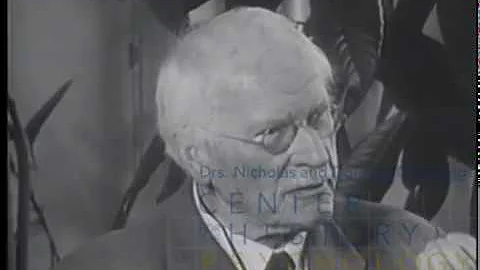 36:08
36:08
 38:05
38:05
 1:13:45
 1:53
1:53
 25:20
25:20
 7:34
7:34
 23:32
23:32


