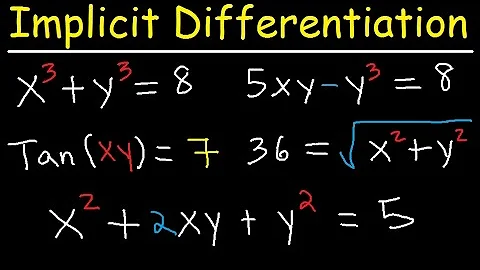
in this video we're going to talk about how to do implicit differentiation so let's say if you have this function Cub plus let's say Cub is equal to 8 and you want to find dydx at let's say you want to just find dydx so what we need to do is differentiate both sides with respect to so that's over DX the derivative of 3r is 3x^2 and the derivative of 3 is 3 y^2 * dydx for these kinds of problems anytime you differentiate value add dydx to it the derivative of constant like is zero so now we got to put dydx we got to get it by itself so if we move the 3x to the other side here's what we now have all we got to do now is divide both sides by 3 y^2 and so in this particular case dydx is therefore equal to the 3es cancel it's- x^2 over y^2 so that's how you can do it but now let's try another example so let's say if we have this function x^2 + 2x + y^2 = 5 and we want to find dydx so let's go ahead and jump right into it let's differentiate x^2 to derivative of X2 is 2x now for this part right here we have and combined and whenever you see that you need to use the product rule so let's separate this function into two parts 2X and time so to use the product rule the gist of it is like this you differentiate one part and then keep the other part the same so we're going to differentiate the 2x part which is going to become two we're going to keep the same plus we need to keep the first part the same now and then differentiate the second part the derivative of is one and anytime you differentiate variable in relation to implicit differentiation add dydx to it so here we have y^ 2 next and the derivative of y^2 is 2 * dydx and the derivative of any constant is always zero so now our goal right now is to isolate dydx so any variable that or any term that doesn't have dydx we're going to move it to the right side so what we now have on the left is 2x Dy DX plus 2 dydx is equal to -2X - 2 there's lot of twos here you know what let's divide everything by two so this will disappear that and that all of them will disappear our next step we're going to factor out dydx so we're left with + is equal tox minus which we're going to factor out negative 1 and that's + so now we're going to divide both sides by + so notice that the plus cancel so for this particular problem dydx is just equal to1 let's try another problem for the sake of practice so let's say if you have 5xy minus 3r is equal to 8 now feel free to pause the video give this problem shot and find dydx so let's use the product rule here so the first part it's going to be 5x the second part is the derivative of 5x is simply five and then times the second part and we're going to now we're going to keep the first part the same 5x and then we're going to differentiate which is 1 * Dy DX the derivative of 3 is 3 y^2 dydx and the derivative of constant is zero so any term that doesn't have dydx let's move it to the other side so that's the 5y we're going to move it over here so now we have 5x dydx - 3 y^2 dydx is equal to - 5 whenever you move term from one side to another it changes from positive to negative or vice versa our next step is to factor out the GCF well not really the GCF but just dydx we need to isolate it so we have dydx time 5x - 3 y^ 2 = -5 so our last step is to get dydx by itself by dividing both sides by 5x - 3 y^2 and so now we have our answer dydx is equal to -5 over 5x - 3 y^2 so that's it for that problem but there's more to talk about so let's say if you have this problem let's say tangent XY is equal to 7 go ahead and find dydx for this problem the derivative of tangent is secant squar and we got to keep the inside the same the angle for tangent was XY so therefore the angle for secant squ has to be XY but now we got to differentiate the inside part according to the rules of the chain rule so let's use the product rule the derivative of is one keep the second part the same the derivative of is 1 * dydx but we got to keep the first part the same which is the and the derivative of constant is zero now for this problem to get dydx by itself the first thing we need to do is distribute this term secant squ to and to dydx so secant squ * is simply secant XY and for the next term this time see is just dydx time see 2 XY so now what we're going to do is we're going to take this term which doesn't have dydx and we're going to move it to this side so dydx secant squ XY is equal to y^ 2 XY you know realized this probably was an easy way of doing this which I'm going to show you after this part let's divide both sides by secant squ notice that the secant squar is cancel and in the end dydx is basically negative overx so but let me show you the other way we can have done this so we had see 2 XY time believe it was + dydx is equal to Zer what we could have done at this point is just at this right here divide both sides by secant Square so these cancel and you get + dydx is equal to0 0 divided by anything is zero and yeah it's going to be much easier solving it like this so now let's move to the other side and then let's divide both sides by so therefore dydx is equal to- y/x so there's more than one way of solving problem let's try another one let's say if 36 is equal to theun of x^2 + y^2 how would you find the answer for this one now you can go ahead and take the derivative at this point but personally believe it's much easier if you simplify it or adjust it let's Square both sides we really don't need to find out what 36 squ is we're just going to write it as 36 squ because when we take the derivative it's still going to be constant and it's going to become zero however this part is very useful when you square square root the radical disappears and it makes it lot easier to find the derivative so now let's differentiate both sides with respect to the derivative of 36 SAR which we already said was constant is zero the derivative of x^2 is 2X and for y^2 it's 2 * dy/ DX so let's move the 2 to this side it's going to become -2X and then let's divide both sides by so the twos cancel so therefore dy over DX is thus equal tox over at least for this particular example and let's say though we have to find the second derivative so we have this equation dydx is equal tox whenever you want to find second derivative and since we have fraction we need to use the quotient rule which is Prime minus UV Prime over ^2 is basically the top part which ISX Prime actually let me change the color so ISX Prime is the derivative of Negative which is1 is the bottom part which is and Prime is the derivative of which is 1 * dydx so let's use the formula so ^2 over dx^ 2 the second derivative is equal to which is time Prime which is -1 minus which ISX time Prime which is just dy over DX okay so and v^2 is simply y^2 notice that we have dydx here what we need to do is take this term and plug it in for dydx so we have- + * over time y^2 now what we're going to do is multiply top and bottom by just to get rid of this mini fraction so- * see if can fit that here y^ 2 and the Y's cancel here so we get x^2 over whatever you do to the top you have to do to the bottom so you got to multiply top and bottom by so over Cub that's the second derivative for this function that's how you could find it so that's it for this video hopefully this gave you more or better Insight on how to find the derivative us an implicit differentiation
11:45
Implicit Differentiation
Professor Dave Explains
1.5M مشاهدة · 8 years ago
15:34
Implicit differentiation whats going on here Chapter 6 Essence of calculus
3Blue1Brown
2.3M مشاهدة · 9 years ago
14:17
How to Do Implicit Differentiation NancyPi
NancyPi
1.1M مشاهدة · 7 years ago
14:34
Implicit Differentiation
The Organic Chemistry Tutor
1.8M مشاهدة · 8 years ago
4:34
Implicit Differentiation
Prime Newtons
5.9K مشاهدة · 5 years ago
2:32
Learn the basics to implicit differentiation
Brian McLogan
15.1K مشاهدة · 8 years ago
8:02
Implicit differentiation Advanced derivatives AP Calculus AB Khan Academy
Khan Academy
1.2M مشاهدة · 13 years ago
1:08:11
Calculus 1 Lecture 2 7 Implicit Differentiation
Professor Leonard
601.3K مشاهدة · 12 years ago
10:21
10 DERIVATIVES OF IMPLICIT FUNCTIONS A LEVEL MATH
Rowa E-learning Platform
18.2K مشاهدة · 6 years ago
13:28
Calculus Implicit Differentiation
Ms Havrot's Canadian University Math Prerequisites
6K مشاهدة · 6 years ago
9:34
Implicit Differentiation Method
Excellence Academy
234.8K مشاهدة · 4 years ago
11:11
Implicit Differentiation With Partial Derivatives Using The Implicit Function Theorem Calculus 3
The Organic Chemistry Tutor
426.4K مشاهدة · 6 years ago
33:00
Calculus 1 Implicit Differentiation Video Math with Professor V
Math with Professor V
18.6K مشاهدة · 5 years ago
17:21
Implicit Function Implicit Differentiation Numericals Maths 1
Gautam Varde
88.1K مشاهدة · 3 years ago
11:37
Implicit Differentiation
Eddie Woo
80.7K مشاهدة · 13 years ago
10:42
Implicit differentiation
Starfish Maths
83.9K مشاهدة · 6 years ago
28:54
Implicit Differentiation Second Derivative Trig Functions Examples Calculus
The Organic Chemistry Tutor
433.7K مشاهدة · 9 years ago
15:57
Implicit Differentiation
Khan Academy
1.1M مشاهدة · 18 years ago
12:16
Implicit Differentiation Find The First Second Derivatives
 11:45
11:45
 15:34
15:34
 14:17
14:17
 14:34
14:34
 4:34
4:34
 2:32
2:32
 8:02
8:02
 1:08:11
 10:21
10:21
 13:28
13:28
 9:34
9:34
 11:11
11:11
 33:00
33:00
 17:21
17:21
 11:37
11:37
 10:42
10:42
 28:54
28:54
 15:57
15:57
 12:16
12:16