النص الكامل للفيديو
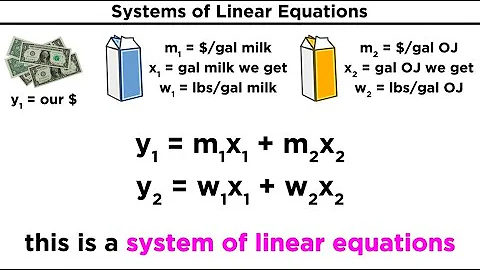
It’s Professor Dave, want to teach you linear algebra. Now that we are past calculus, it’s time to begin to tackle some more advanced concepts in mathematics, and the subject that is typically studied in an undergraduate math curriculum after several semesters of calculus, is linear algebra. This may sound unintimidating, because we already know lot about lines, and we wrapped up our study of algebra quite bit earlier in the series. Indeed, in certain sense, linear algebra is based on very simple concepts, but over the next few tutorials, we will expand upon these concepts to arrive at some incredible fundamental truths about mathematics that we weren’t ready to understand before. But first things first, let’s start with the basics. At its core, linear algebra is all about linear equations. Linear equations have lot of real-world applications, since so many things have linear relationships, whether in science, engineering, or even economics. Linear equations are very basic kind of equation, which take the form equals MX plus We learned many things about linear equations when we studied algebra, and we will assume that this information is already known, so if at any point you feel you need refresher, go back to that portion of the series. To put things into larger context, we may wonder, why is it that linear equations are so omnipresent, with so many applications? The reason is that linear equations embody happy medium of simplicity and complexity. If we go simpler, looking at the simplest possible function, of equals some constant this is line at equals having constant value no matter what the input. This is unlikely to solve too many problems in the real world. On the other side, we can look at quadratic function, of equals AX squared plus BX plus As we remember from algebra, solving these can be little bit tricky, and if we look at cubic or quartic functions, or functions of higher degree still, things get quite bit trickier. Linear equations are right in the middle. Not too simple, not too complicated, which actually end up modeling lot of real-world relationships. To see how much structure we can get from linear equations, consider the following example. Say we need to buy some milk, and we have dollars. Milk costs dollars per gallon, so how many gallons of milk can we get? That’s easy, we just set up the equation equals MX. dollars per gallon, times the gallons we can afford, will equal the money we have. If is two dollars per gallon, and is ten dollars, since we have ten dollars, ten divided by two is five, and equals five. We can get five gallons of milk with our ten dollars. Now let’s step things up little. Perhaps we also need to get some orange juice. Let’s say that one is the cost of milk per gallon, and one is the number of gallons of milk we get. two is the cost of orange juice per gallon, and two is the number of gallons of orange juice we get. one is the amount of money we have, and so one will equal one one plus two two. All of sudden there are infinitely many options for what to do, as there are infinite combinations of one and two that will satisfy this equation. We could buy no orange juice and lots of milk, or we could buy no milk and lots of orange juice. Or, more likely, we could buy some combination of milk and orange juice, but we can choose any value for one of these and then calculate the other. Now let’s throw another parameter in there. Let’s say we can only carry two pounds of stuff home with us. Milk weighs one pounds per gallon, and orange juice weighs two pounds per gallon. That means that two equals one one plus two two. Now, we need values for one and two that satisfy both equations simultaneously. So things are starting to get little more complicated, but let’s note that each of these is still linear equation. This means that everywhere we see it is not being raised to any exponent. But since there is more than one equation, we can call this system of linear equations. As you can probably guess, we will be looking at all kinds of different systems of linear equations as we study linear algebra. For this reason, let’s get some basic definitions and terminology out of the way regarding linear equations. From now on, we will consider linear equation to be any equation in the form one one, plus two two, plus three three, all the way to ANXN, equals So as we can see from the ellipses, there can be any number of terms of this type, depending on the value of and their sum will equal some constant. The terms are coefficients of any type, and the terms are not all they are actually all different variables. They could be and so forth, or more commonly, and if there are just three. The main thing that must be true is that none of the variables are raised to any exponent, otherwise it would no longer be linear equation, it would be quadratic, or cubic, or something else. Also, there are no roots, no trigonometric functions; none of the other more complicated functions we have learned are going to be involved here. In addition, none of the variables are involved in products or quotients with each other. There is just series of individual terms involving coefficient times variable. So in that sense, systems of linear equations are very simple. They get complex in other ways, namely due to the fact that if we have three equations involving three variables, as is shown here, we will have to use certain techniques to solve this system. solution to system of linear equations will have as many values in it as there are variables in the system. In other words, we need value for each variable that will make all of the equations true at the same time. And there is no limit to the number of variables or equations in system, so that is the sense in which systems of linear equations can get very complicated, despite the fact that each individual equation is extremely simple. But at first, we will look at very simple systems, some that are as simple as two equations with two unknowns, which we learned how to solve when we studied algebra. Take something like three one minus two equals negative six, and negative two one minus two equals zero. We can take one and two to be the same thing as and so we can just solve these for and graph the lines. We will get equals three plus six, and equals negative two If one line is all the points that satisfy one equation, and the other line is all the points that satisfy the other equation, then the point at which they intersect is the solution for the linear system, as the coordinates of that point give us the one and two values that satisfy both equations in the system. If we go through the algebra, we would arrive at negative six fifths for one and twelve fifths for two, and that’s the unique solution to the system. If we had two lines that were parallel, there would be zero solutions to the system, and if the two equations were different ways of expressing the same line, there would be infinitely many solutions to the system, as we recall from algebra. When system has at least one solution, we say the system is consistent, and when system has no solution, we say that the system is inconsistent. But we don’t have to stop with two dimensions, corresponding to two variables. We will frequently see three variables, and if we have equations each with an one term, two term, and three term, which can correspond to and these could each correspond with plane, such as with this system of three equations. We can draw the three planes and see where they intersect, in this case at singular point, and the coordinates of this point represent the solution to the system. We could also have an entire line be solution to this kind of system, or whole plane, if all three equations describe the same plane, both of which would yield infinite solutions. Or we could have three parallel planes, and therefore zero solutions. It doesn’t stop there, we could have four equations and four variables, and that transcends our ability to represent things geometrically, so we will have to figure out other ways to conceive of such system. At this point it is clear that big part of linear algebra will involve learning certain tools and techniques that will allow us to solve systems of linear equations, which can help us solve real-world problems that are much more alluring than how much milk and orange juice we can get at the store. One tool that we will be using constantly in order solve these problems is something called matrix notation, so let’s move forward and learn about matrices now.
 7:35
7:35
 6:56
6:56
 32:05
32:05
 13:24
13:24
 1:58
1:58
 20:50
20:50
 39:49
39:49
 14:50
14:50
 26:18
26:18
 8:17
8:17
 27:16
27:16
 15:01
15:01
 17:32
17:32
 17:28
17:28
 7:28
7:28
 2:15
2:15
 8:35
8:35
 8:59
8:59