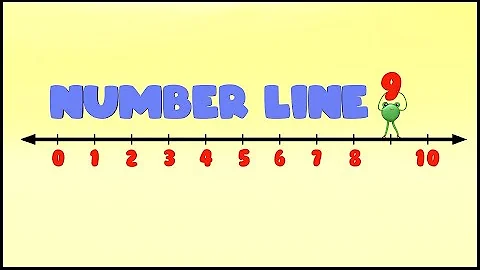
hi i'm rob welcome to math antics in this video we're going to learn about an important tool for visualizing how different numbers relate to each other that tool is called the number line in the place value videos you learned that our base 10 number system uses 10 different digits to express any number but we didn't just use those digits randomly we use them in specific order for counting we started with 0 which represents the idea of having nothing and then the next digit we used was 1 which represented single apple in our example then if we got another apple we used the digit two then another three then four five six seven eight and finally nine which is the last of our ten digits do you see how this pattern formed by the apples increases as it goes from left to right like going upstairs and decreases as it goes from right to left like going downstairs well that's how the number line works it consists of long horizontal line with an arrow at the end which i'll explain in minute for each digit there's tiny vertical mark showing where that amount belongs on the line this particular version of the number line shows how the digits 0 through 9 relate to each other it's set up so that as you go from left to right each new number is bigger or greater than the number just before it and as you go from right to left each number is smaller or less than the number just before it and do you notice that all the marks are the same distance apart that's because each of these numbers differs from its immediate neighbors by the same amount they're all one apart starting from zero moving right to the first mark is an increase of one likewise moving from one to the next mark two is also an increase of 1. in other words you just add 1 to get to the next number and even though our current number line stops at 9 we could continue the process of adding 1 to make it longer if we wanted to for example 9 plus 1 equals ten ten plus one equals eleven eleven plus one equals twelve and so on in fact technically the number line goes on forever because there is no biggest number whatever number you decide to stop at you could always just add one more to make the line longer and that's what the arrow on the right side is for it tells you that the numbers keep on going forever even though we could never write them all down you'll probably see many different versions of the number line as you learn math some may stop at different numbers and some might not even start at 0 like this one that starts at 7 and stops at 15. one way to think about these different number lines is that they're all snapshots of the ultimate ideal number line that has every number on it it's kind of like trying to take picture of something really big like an elephant if you're too close you'll only be able to fit small part of it in each snapshot of course if you back up far enough you could fit the whole elephant in the shot but the number line is infinitely big no matter how far you zoom out you can never fit it all in single image or drawing so you only draw the part of it that you need for whatever problem you're working on for example instead of number line that stops at 10 maybe we need one that goes all the way to 20. that wouldn't be too hard to draw but what if we needed to go all the way to hundred would we need to draw number line that shows all the numbers from zero to hundred fortunately no we actually have two different options that are much easier the first option would work for situations where we only need to use portion of the number line that's near 100. in that case instead of starting our number line at zero we could have it start at bigger number like 95 and increase by one until we get to 105 or so all the marks are still one apart like the other number lines we've seen we're just starting and stopping at different values notice that we have arrows on both sides now to show that the line keeps on going in either direction the second option would work for situations where we need to use the entire range from zero to hundred in that case we could simply leave out most of the digit marks on the number line and just show mark for each multiple of 10 like 10 20 30 40 and so on let's compare that number line to the one we previously saw that went from zero to ten even though these two number lines look the same size on the screen the bottom one is actually ten times longer if we resize them so that they use the same scale lining up the zeros and the tens you can see that most of the number line going from zero to ten fits in between the first two marks on the longer number line and that helps you realize very important idea just because number line has marks showing specific numbers doesn't mean that there's nothing in between them there's actually lot in between them as you'll see in minute in this example the space between the 0 and the 10 on the longer number line still contains all the counting numbers 1 through 9 but for simplicity we left them out but it's important to remember that they're still there in case you need to use those in-between values like if someone asks you to put point on the number line where 65 is located you would put it halfway between the 60 and the 70. that's where 65 is even though its mark isn't shown okay but let's zoom back in on the number line that goes from 0 to 10. you may be wondering are there any numbers in between these basic whole numbers there sure are in the video about decimal place value we learned that special numbers called fractions are used to represent amounts that are less than one like one-half of an apple or one-tenth of an apple well we can divide up the sections of the number line that are between the whole numbers to show exactly where those fractions would go for example what if we put an extra mark exactly halfway between each of the marks that we already have what would these new marks represent well the first one is pretty easy it's halfway between 0 and 1 so it represents the number one half which happens to be the same amount as the decimal 0.5 the next one is little trickier since that mark is halfway between one and two that means that it's one half more than one and one half less than two in other words it's the number one and one-half which has the decimal value 1.5 the next in-between mark would be two and one-half or 2.5 and then would be three and one-half or 3.5 get the idea but there's an even more useful way to subdivide the space between each of the whole numbers if we divide up the space between the 0 and 1 into 10 equal parts you'll see that this works perfectly with our decimal number places each one of these new marks is the fraction one-tenth apart so after zero this first mark is one-tenth and the second mark is two-tenths the third is three-tenths and so on and remember we have decimal number place immediately to the right of the decimal point that's specifically used for counting tenths using that decimal number place also this first mark has decimal value 0.0 because it represents zero ones and zero tenths and zero everything for that matter the next is 0.1 because we have zero ones and one tenth the next is 0.2 because we have zero ones and two tenths and the pattern continues on like that until we get to the number one which can be shown as the number one in the ones place and zero in the tenths place because it's whole number it doesn't need any decimal digits but we can put zero in them if we'd like as you might expect we can keep going down the number line like that the next mark is one-tenth more than the one so it's 1.1 the next is 1.2 and the next is 1.3 we could go on but if we wrote all of the tenths in the numbers between the whole numbers our number line would get very cluttered again the point is just to realize that the tenths are in between the ones on the number line see how amazing the number line is but we don't have to stop there because there are numbers in between the tenths too if we zoom in further and divide the space in between this first tenth into ten equal parts each of those new smaller fractions is called hundredth because it's the amount you'd get if you divided one into 100 equal parts again remember that we have number place for counting hundreds immediately to the right of the tenths place so this first mark would be zero point zero one because it's one hundredth and this next would be zero point zero two because it's two hundredths but why stop at hundredths if we divide the spaces between each hundredth into ten equal parts we'll get thousands which are even smaller fractions can you see where we're going with this yep to infinity just like there's no biggest number because you can always keep adding one more there's no smallest number either because you can always keep dividing whatever small fraction you have into even smaller and smaller fractions it's kind of mind-blowing if you think about it not only are there an infinite amount of numbers on the number line even if you just stick with the whole numbers and count them forever which you can't actually do but there's also an infinite amount of numbers in between each pair of whole numbers if you keep subdividing forever which you can't actually do either so what can you do well you can use the number line to understand how numbers relate to each other it's helpful because it's visual representation that shows the range of values that get bigger as you move to the right and smaller as you move to the left and that's the main thing you need to know about the number line it's tool to help you see how numbers work it kind of helps you with the big picture of math lot of the time you won't need it but it's always there when you do alright that's it for this lesson there aren't many practice problems for this video because the main goal is for you to just understand how the number line works but don't worry there'll be plenty of opportunities to practice math and future lessons as always thanks for watching math antics and i'll see you next time learn more at mathantics.com
2:24
Addition Using a Number Line Get Set and Hop
Tutoring Hour
575.9K مشاهدة · 5 years ago
2:58
Number Lines Song Adding and Subtracting on a Number Line
Math Songs by NUMBEROCK
1.4M مشاهدة · 5 years ago
3:53
sing and count with a number line
Hey, Mrs. Hays!
6.4K مشاهدة · 1 year ago
1:53
Number Line Basics Song – Learn Numbers – Learning Upgrade App
Upgradors
767.1K مشاهدة · 10 years ago
1:43
Movin on the Number Line A song to help teach number line math Miss Molly Sing Along Songs
Miss Molly
589.4K مشاهدة · 1 year ago
4:20
Simple addition using number line number line for kids Kindergarten and First Grade Math Lesson
Little Bloom Kids
113.2K مشاهدة · 5 years ago
3:27
2 nd Grade Math Number Lines Topic Video
Education Galaxy
107.6K مشاهدة · 4 years ago
0:38
Number Line Math for kids
Miami Skye
8.2K مشاهدة · 1 year ago
1:03
Learn Subtraction Using Number Line Mathematics Book B Periwinkle
Periwinkle
899K مشاهدة · 9 years ago
12:11
4 Top Tips to Teach Students how to use a Number Line Number Line Activities for K 2
Susan Jones Teaching
27.9K مشاهدة · 3 years ago
3:20
How to Add Numbers On The Number Line For Kids
The Online Teacher
731 مشاهدة · 4 years ago
1:03
Learn Addition Using Number Line Mathematics Book B Periwinkle
Periwinkle
1.4M مشاهدة · 9 years ago
1:43
Movin on the Number Line A song to help teach number line math Miss Molly Sing Along Songs
Miss Molly
156.9K مشاهدة · 1 year ago
2:39
Number Line Addition Song for Kids Math Strategies with Movement Visuals
StudyBuddyLearning
6.2K مشاهدة · 5 months ago
1:42
Number Line Song Learning Videos for Kids Smarty Bugs
Smarty Bugs
9K مشاهدة · 1 year ago
3:05
Grade 1 Number Line Addition Made Easy
Elemental
206.9K مشاهدة · 6 years ago
11:15
Number Line Adding and Subtracting using Number line Counting 1 10 on the Number Line
Neel Nation
195.5K مشاهدة · 4 years ago
2:59
Counting Song For Kids NumberLine Counting Count Up and Down 123 Song
Toons For Kids 🌟
8.5K مشاهدة · 1 year ago
3:21
Fractions on a Number Line Song 3 rd Grade 4 th Grade

 2:24
2:24
 2:58
2:58
 3:53
3:53
 1:53
1:53
 1:43
1:43
 4:20
4:20
 3:27
3:27
 0:38
0:38
 1:03
1:03
 12:11
12:11
 3:20
3:20
 1:03
1:03
 1:43
1:43
 2:39
2:39
 1:42
1:42
 3:05
3:05
 11:15
11:15
 2:59
2:59
 3:21
3:21


