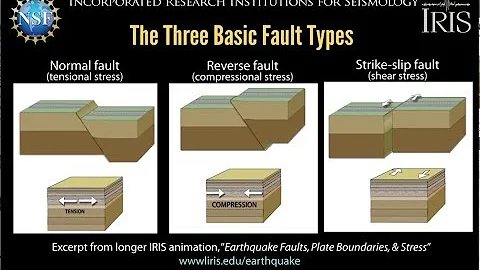
so in this video i'm going to explain to you how earthquakes affect the surface of the earth so you want to get your notes in your notebook and and always say you should have your notes open on one window and then have this video open in the other window so that you can easily go back and forth otherwise it makes it difficult so we know that earthquakes are caused by the movement of the crust but that movement builds up over period of hundreds or even thousands of years so what happens is this is the crust right here there are places where the earth has snapped before so we call that fault the fault is like boundary but there's lots of little faults around plate boundaries it's places where the earth kind of cracks right so if there's no pressure enough no movement that's called an unstrained crust nothing going on there but over period of time there might be some movement you know this crust is just getting pushed little bit nothing's going to move dramatically but over period of time it might start bending the crust this crust is under great strain and so it caught we could say that's it's their strain at the fault there's pressure that's building up there's still no earthquake but there's but there's lot of pressure that's building at some point right so if you take your two hands and you push them together really hard and then you try to slide them try to slide them by each other it doesn't work at some point it just jolts like that because the pressure the friction that was stopping the movement was overcome by the pressure build up and so what happens in this picture we have more and more pressure building up when it's greater than friction that piece just snaps and you have that movement and that's the earthquake so maybe that pressure's been building up for 100 years and then finally something snaps and so that that sudden movement that release of pressure is an earthquake sometimes that happens you know in north carolina we're not even on plate boundary but that kind of buckles you know in in the middle so where you have faults you have different kinds of faults depending on the kind of movement of the crust so if the crust is moving away from each other like here we call that what kind of boundary it's right it's divergent boundary right we call that normal fault don't know why they call that normal but they consider that's what they call it normal fault and you can see that this is kind of gent it's sort of it's like cliff but it's not straight up and down right so that's going to happen you know at divergent boundaries where the faults are divergent anyway this one look what's happened here they're not moving away from each other and they're not moving towards each other just sliding they're just sliding by one another sliding by one another we haven't even talked about that kind of boundary that's called transform boundary but the the fault you call strike slip fault and that happens at transform boundaries those are not convergent they're not divergent they're just sliding by one another so you know no mountains are made no volcanoes are made there's no subduction or anything so they're kind of boring but but there's lot of those so if you see things like rivers or fences that are sort of you know pushed to the side like this that's called strike slip and then we have the opposite of divergent would be convergent and so you call this reverse fault like said don't know why they name them these way it's the reverse of normal fault and you can see here it's it's more than 90 degrees it's not even straight up and down it's more than straight up and down as opposed to this one and so that happens at convergent boundaries where the plates where crust is moving towards itself so those are the three kinds of faults normal looks like this strike slip looks like this and reverse looks like that whoa we skipped ahead no no we didn't so now we get to explain tsunamis and so if you look here this should know these are kind of crazy looking drawings but drew them myself i'm so proud of myself but we have subduction going on so this is one plate moving down underneath another one so like to do it like this so this is what's what's happening this plate is is moving down underneath this one but it's but it's not so smooth okay i'm going to show you what happens here okay so first this is going to happen over you know underneath the water because tsunami is huge wave right so what's going to happen that's the water level is and you should do this with your hands one of these plates is moving down like this but there's an incredible amount of friction right here so what happens is it gets stuck and you can see what happens to that one plate it kind of bends this plate here sort of under with under pressure kind of gets bent and we're talking about solid rock right so we're going to draw that and see how i'd read that on here so over time friction between the blades prevents the movement one plate bends down just like that know it's not very good drawing but we're just showing that plate you know this plate right here know this plate right here is kind of is is bending down all right bending down so that pressure's going to grow mean imagine you're bending you know hundreds of miles of rock that's lot of pressure what's going to happen at some point right there's all this pressure building up behind it well that's going to just it when when that pressure is more than friction before it's going to snap back imagine that right it's just it's going down it's going down and then it just it's going like this and then just snaps back snaps back if that snaps back what's going to happen to this water above here that water above there right when that plate springs back that water above the plate is going to move up right it's going to move up just as much if that if it's if that plate snapped up 20 feet now you have 20 foot wave 20 feet of water because you can't compress water so now that wave is going to move in both directions and that is tsunami and i'm going to show you picture of tsunami so water travels in both wave travels in both directions and travels pretty quickly so here's short little movie about tsunami get out of here so when tsunami approaches the water actually recedes so the water is kind of taken up with that wave and so if you're ever at the beach and the water goes way back like that way further than it ever would at low tide you know there's tsunami and you have to go to high ground pretty quickly that's that's that's no joke so here comes here comes maybe 20 or you know 10 or 20 foot wave there's nothing more destructive than moving water now this video doesn't show it but but all those houses i'm sure are gone and there's going to be more than one wave usually there's several of these tsunami waves and there you have it so there is what happens we're going to do hotspots later
2:35
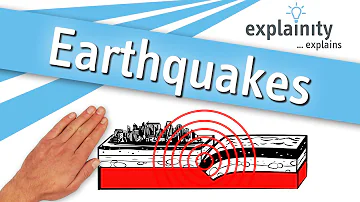
Earthquakes explained explainity® explainer video
explainitychannel
382.8K مشاهدة · 3 years ago
12:04
How does Earthquake happen Earthquake explained using D Simulator Physics Simulator Letstute
Let'stute
1.6M مشاهدة · 6 years ago
2:07
Tectonic Plates and Earthquakes Motion Graphics Pixeldust Studios
Pixeldust Studios
584.5K مشاهدة · 8 years ago
6:14
Earthquakes for Kids STEM Learn why earthquakes happen and how to measure them
Learn Bright
1M مشاهدة · 3 years ago
2:02
Earthquakes Volcanoes the Story of Earth as a Violent Place Down to Earth
Da Vinci Kids
316.8K مشاهدة · 9 years ago
3:43
What Is An Earthquake The Dr Binocs Show Educational Videos For Kids
Peekaboo Kidz
10.2M مشاهدة · 10 years ago
11:30
Earthquakes and Seismology in Earths Interior
Professor Dave Explains
147.5K مشاهدة · 3 years ago
3:21
the Earth change quickly volcano floods landslide and earthquakes
TECHNO-LOGIC
51.1K مشاهدة · 5 years ago
4:30
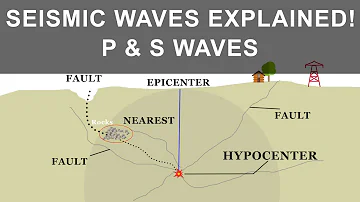
How Earthquake occurs and what causes it Seismic Waves P and S Waves
Amit Sengupta
1.6M مشاهدة · 9 years ago
6:34
Forces that Affects Changes on the Earths Surface Earthquake
Centralian Channel
2.8K مشاهدة · 4 years ago
3:27
अर्थक्वेक भूकंप कैसे आता है Earthquake In Hindi Dr Binocs Show Educational Videos For Kids
Binocs Ki Duniya
698.7K مشاهدة · 4 years ago
3:15
Understanding earthquakes The science behind what makes the earth shake CBC Kids News

 2:35
2:35
 12:04
12:04
 2:07
2:07
 6:14
6:14
 2:02
2:02
 3:43
3:43
 11:30
11:30
 3:21
3:21
 4:30
4:30
 6:34
6:34
 3:27
3:27
 3:15
3:15
 4:31
4:31
 8:02
8:02
 6:49
6:49
 0:52
0:52


