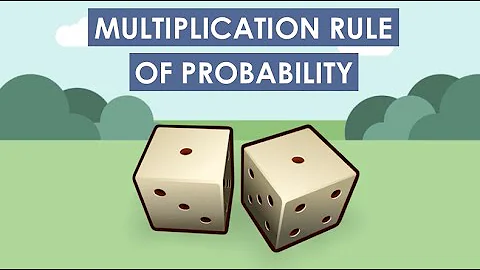
Today we're diving into the multiplication rule for probability. powerful tool that helps us calculate the probability of two or more events occurring either together or in sequence. The key to using this rule is determining whether the events are dependent or independent. Let's break it down, see when to use it, and work through few clear examples. Dependent events are events where the outcome of one event affects the outcome of the other. While independent events are events where the outcome of one event does not influence the outcome of the other. Let's first look at two examples where events and are dependent on each other. Ben is on his way to work. The probability that it rains on any given morning is 0.3. If it rains, the probability that Ben is late for work is 0.6. What is the probability that it rains and Ben is late for work? We can let event be it rains and event Ben is late. Based on the context, it's clear that Ben being late for work is influenced by the rain. Hence event is dependent on event We are asked to find the probability that the two events both happen. So we apply the multiplication rule of probability which states the probability of and happening is equal to the probability of times the probability of given that event already occurred. The probability of which is the probability that it rains is 0.3. The probability of given which is the probability that Ben is late given that it rains is 0.6. Hence the probability that Ben is late and it rains is 0.18 or 18%. Here is another example of dependent events. jar contains five red sweets, three green sweets, and two blue sweets. Maria picks two sweets at random, one after the other, without replacement. What is the probability of picking green suite followed by blue suite? Let's define the two events. Let event be the first suite picked is green and let be the event that the second picked is blue. There are 10 sweets in the jar when picking the first suite. Since it wasn't replaced, there are now nine sweets when the second suite is picked, which means that the outcome of event is affected by the outcome of event Hence, and are dependent events. To find the probability of both events happening, that is picking green suite and then blue suite. We'll use the multiplication rule of probability shown here. Let's calculate the probability of picking green suite on the first try. There are three green suites out of total of 10. So the probability of is 3/10. Now assuming the first suite was green and we didn't put it back, there are only nine suites left and still two blue suites. So the probability of picking blue suite given that the first pick was green is 2 9ths. Multiply and we get the probability of picking green and then blue suite which is 6 over 90 or 115th when simplified. Now let's look at few problems where the events are independent. Meaning the outcome of one event does not affect the outcome of the other. If we take the most recent example and change the situation to with replacement, meaning the first suite was put back into the jar before the second suite was drawn. This would now mean events and are independent. Since regardless of the outcome of the first pick, the outcome of the second pick is not affected since we will still have the same 10 suites in the jar. To find the probability of both events happening, that is picking green sweet and then blue suite, we'll use the multiplication rule of probability shown here. The probability of which represents the probability that the first pick was green sweet is 3/10. Now the first suite is put back into the jar. So the probability of which is the probability of picking blue sweet on the second draw is 2/10 since there are still 10 sweets in the jar. multiply and we get the probability of picking green and then blue suite with replacement which is 6 hundreds or 6%. By the way, note that the probability of given that happened is the same as just the probability of since whatever the outcome of event was event is not affected in these independent cases. Let's look at another experiment where the events are independent. For example, coin is flipped and die tossed together. What is the probability that the coin shows head and the die shows three. Let's call heads and call three What the coin shows has nothing to do with the value shown on the die. Hence, the events are independent. So we use the multiplication law which states that if events and are independent then the probability of and is equal to the probability of times the probability of The probability which is same as probability the coin showing heads is half while the probability of which is the same as the die showing three is 16th. So the probability of the intersection or the probability of getting both events together is 12 * 16 which is 112th. Alternately we can use table to visually represent the experiment. At the top of the columns we have the possible outcomes on the dice. The numbers 1 to six. To lead the rows we have the possible outcomes of the coin toss. That's head or tail. We compare head to all the dice outcomes and then do the same with tail. This will give us all the possible combinations in the experiment. Notice there's total of 12 possible combinations. Only one has head and three occurring together. So the probability of head and three showing together is 1112th. So we get the same answer that the formula gave us. The multiplication and addition rules of probability can also be combined to solve problems. For example, what's the probability of getting sum of 11 when two dice are tossed? There are only two possible ways to get sum of 11. Either die one shows five and die two shows six or die one shows six. and die two shows five. So the probability that the sum is 11 is the probability of the dice showing five and six or the probability of the dice showing six and five. The probability that dice shows five or any number is 16th as explained in the rules. Replace and with multiplication and replace or with addition. So the probability of 5 and 6 is 16 * 16. We also do the exact same with 6 and 5. So the probability that the sum is 11 is 1 18th. Alternately, we could do visual representation by creating table showing the sample space which is the set of all possible combinations on the two dice. Notice that there is total of 6 * 6. That's 36 possible combinations with only two combinations having sum of 11. That's 2 out of 36 which is 1 18th. Join us in the next video when we will be covering conditional probability and tree diagrams. If you found this helpful, don't forget to like, subscribe, and share with your fellow math lovers. See you soon.
10:02
Multiplication Addition Rule Probability Mutually Exclusive Independent Events
The Organic Chemistry Tutor
3.3M مشاهدة · 7 years ago
3:12
The Multiplication Rule of Probability Explained
Jeremy Blitz-Jones
234.8K مشاهدة · 7 years ago
6:44
Probability of Independent and Dependent Events 6 2
Simple Learning Pro
634.1K مشاهدة · 6 years ago
4:37
What Are The Multiplication Rules For Probability Dependent And Independent Events in Statistics
Whats Up Dude
11K مشاهدة · 6 years ago
26:31
Multiplication rules and Conditional Probability
Oktay Koç
620 مشاهدة · 5 years ago
3:43
The multiplication rule for independent event probabilities
The Moening Group
195 مشاهدة · 5 years ago
20:04
Probability Rules Independent vs Dependent Events and the Multiplication Rule
Andrew Bulawa
203 مشاهدة · 4 years ago
5:50
Probability Using the Multiplication Rule for Independent Events
Asma Alayeb
633 مشاهدة · 5 years ago
3:42
Lesson on Multiplication Rules of Probability Advanced Multiplication
eHowEducation
229.1K مشاهدة · 13 years ago
10:11
Probability Independent and Dependent Events
The Organic Chemistry Tutor
894.4K مشاهدة · 7 years ago
6:10
Independent and Dependent Events and Multiplication Rule of Probability
Sir Vicz
111 مشاهدة · 1 year ago
13:10
Independent events probability Dependent events Multiplication law Tips tricks and shortcuts
Chempulli School Of Mathematics C4Math
310 مشاهدة · 5 years ago
10:25
Probability of Independent Events Multiplication Rule
Tom Teaches Math
2.1K مشاهدة · 6 years ago
17:08
Multiplication Rule of Probability with Dependent Events Conditional Probability
MATH MADE EASY WITH LAUREL
559 مشاهدة · 3 years ago
9:39
2 5 Multiplication Rule Independent Events
Professor Horwitz
330 مشاهدة · 4 years ago
10:04
Multiplication rule for independent event probabilities
VC math
67 مشاهدة · 5 years ago
7:50
Probability of A and B Multiplication Rule for Probabilities of Independent Events
Radford Mathematics
3.4K مشاهدة · 5 years ago
4:38
5 6 Multiplication Rule for Independent Events
JWMHS Adams
959 مشاهدة · 3 years ago
2:39
General multiplication rule example dependent events Probability combinatorics

 10:02
10:02
 3:12
3:12
 6:44
6:44
 4:37
4:37
 26:31
26:31
 3:43
3:43
 20:04
20:04
 5:50
5:50
 3:42
3:42
 10:11
10:11
 6:10
6:10
 13:10
13:10
 10:25
10:25
 17:08
17:08
 9:39
9:39
 10:04
10:04
 7:50
7:50
 4:38
4:38
 2:39
2:39


