The Magic and Mystery of Mirrors

النص الكامل للفيديو
- Thank you to Brilliant for supporting PBS. Hey, smart people, Joe here. You know, when you think about it, it is incredible just how symmetric the human body is. mean, our left and right side are basically mirror images. mean, sure, we've all got some minor differences, but my right side is basically the same as, sorry, held on my left hand when said right. What was trying to say was that my right side is basically the same as, (chuckles) it's really weird. seem to be confused today. Just let me, just hold on. Right, okay. This old trick should work. Left, right, left. You know, there's only one possible explanation for what's going on here. This must be different universe. (whimsical music) mirror universe. (whimsical music) If you hold clock up to mirror, you see that instead of the numbers going clockwise, they go the other way, counterclockwise. Mirrors seem to flip the whole world so that everything that we're used to seeing on the right is on the left. Why do mirrors do this? What's really weird is that not everything looks reversed in mirror. mean, this chair just looks like normal chair, and well, take this cup. It looks like normal cup, except that the writing on the cup is reversed. So maybe mirrors only do their reversal magic on words, and numbers, and not furniture. That doesn't make any sense. (glass shatters) (cat yowls) mean, the left and right side of this mirror are the same as the top and bottom. They're smooth, they're shiny, why are only the left and right flipped? Why isn't my head on the bottom of my feet on top? Like they are in this mirror. And why does this mirror not reverse left and right? My left hand is the left hand of my reflection and right points to his right. Mirrors are weird. And it's about time you learn how they really work. To really understand the magic of mirror, it might help to leave our three-dimensional world behind for sec and enter Flatland. world inhabited only by flat two-dimensional characters. It's pretty plain existence. (Joe chuckles) (crickets chirping) Let's move on. Meet Mister Triangle and Miss Square. When they look in the mirror, each of them just sees line. But from our three-dimensional point of view, we can see their whole reflection. If we imagine sliding Miss Square into the mirror, she can cover or superpose her reflection point for point without turning her around. In other words, she's symmetric. But if we imagine sliding Mister Triangle into the mirror, there's no way he can cover his mirror image without us rotating him in higher dimension. Which would be very strange experience for him. Mister Triangle is asymmetric. He can't be superposed on his reflection. In Flatland, heart is asymmetric if it approaches the mirror like this, but it's symmetric if it looks in the mirror like this. it has an axis of symmetry running up and down. line that divides it in half. And if you put the edge of mirror along this axis, you get the original shape. Different shapes in Flatland have different numbers of axis of symmetry. circle actually has infinite axis of symmetry, except poor Mister Parallelogram, no access for you. You're just as asymmetric as they come. So we've been playing around in this imaginary two-dimensional land to hopefully give you hint about what it is that mirrors really do. So just like 2D shapes can have 1D line of symmetry, 3D shapes can have 2D plane of symmetry. Take this cone. It actually has infinite planes of symmetry rotating around its center here. And if we slice along one of those, we get two half cones. Each of them completes the other. It's as if we slid it into the mirror and it overlaps with itself. This happens because the mirror is parallel with the plane of symmetry. But what if we point the cones so that the mirror is now at right angle to the plane of symmetry? Suddenly, what we see in the mirror doesn't really line up anymore. It's been reversed. Now, we could imagine rotating this cone into the mirror so that its point was facing out. But what about these? There's no way to rotate hand around so that it neatly totally lines up with its reflection. Shapes like these that are the mirror image of each other, but they can't be superposed on each other, they're called enantiomorphs, which is cool word. Left and right shoes are enantiomorphs. So are your ears, or helix, or spring that curls right and another that curls left. Same but different. And this is why mirrors seem to reverse left and right, because they actually don't reverse left and right. They reverse forward and back. You are looking at your in enantiomorphic self. To make this forward/backward reversal more clear, take look at this pencil. When face the pencil to the left, well, the mirror pencil is also pointing to the left. If point it up, then the antipencil is also pointing up. But if point the pencil into the mirror, well, then the mirror pencil is pointing the opposite direction. Back at me. watch this. The tip of that pencil is maybe three centimeters away from the mirror, and the eraser end is maybe 20 centimeters away. The mirror has simply reversed these coordinates along this axis, so that the anti tip is minus three centimeters and the anti eraser is minus 20. Or let's say that this side of the mirror is east and this side is west. When point west, mirror me points west too. But if say, this is north and this is south, when point north, mirror me points south. But if mirrors flip back to front, then why does text look reversed left to right? Because it's us that's doing the reversing. Mirrors are just showing us what we show them. See, mirrors don't reverse text at all. You just gotta know how to speak their language. Now that you know how mirrors really work, we can have some fun with them. Now, normally, mirrors make text look reversed because we reverse it. Just as we'd expect. But happen to have here doohickie. And this prevents this mirror from reversing how it normally would. Of course, that's trick. actually showed it to the mirror upside down. Each letter in this word is symmetric along horizontal axis. So when present it to the mirror, flipped along that axis, we can read the reflection normally. While this word, because flipped it along vertical axis, is reversed. You can even play trick on your friends by writing out words like these, and then telling them that your magic mirror doesn't reverse red text. or that your magic mirror can turn pi into pi. You know, that mirror from earlier that didn't reverse images? That's actually two mirrors. They're carefully aligned edge to edge at right angle. The image is actually reflected back to you twice, reversing the reversal to unreverse it. And yes, in mirror like this, you see yourself as others actually see you. So why do people say that mirrors reverse left and right when they clearly don't? think we just lack the right language to describe what we're seeing because we rarely put concepts like these into words. don't know, maybe for four-dimensional people, this is very easy, but for us lowly 3D humans, we imagine it's actually us inside the mirror looking back. And since we know what our right and left are, well, we know what their right and left are. So mirror can teach us interesting lessons about geometry and physics, but they might also be able to teach us something about ourselves. An evolutionary psychologist named Gordon Gallup did famous experiment where he put mirror in front of some chimpanzees. At first, they attacked the reflection that they saw as if it was stranger, but pretty quickly, they started to use the mirror the way that we do. To look at themselves, cleaning their teeth, grooming their bodies, but did they know that that was them? Well, the chimps were put to sleep temporarily and red mark was dabbed on their face. When they woke up, they looked at the mirror and they touched their fingers to the paint on their faces, not to their reflections. Along with bonobos, orangutans, and few other species, there's only handful of animals that recognize that what they see in the mirror is themselves. And any species that can recognize itself in mirror, not only has mind of its own, but also has the potential to recognize that other creatures have their own minds. And to express empathy and complex emotions like that. But humans are special among this group, because we not only realize that what we see in the mirror is us, but also, that it's not exactly us. Plus, I'd like to see chimpanzee make this video. Stay curious. And thank you to Brilliant for supporting PBS. Brilliant is an online learning platform for STEM with hands-on interactive lessons. This platform is for curious learners, both young and old, professional, and inexperienced. You'll get to see science in new way through visual examples. For example, for those who wanna strengthen their physics knowledge, you can begin Brilliant's Scientific Thinking course, where you can explore the laws of physics, and the principles of engineering, and the rules that make them work while solving puzzles. To learn more about Brilliant, go to brilliant.org/BeSmart. hey guys, it's me, Mirror Joe. Now that that other guy's gone, just wanna say thank you to everybody who supports the show on Patreon. We could not make videos like this without you in this dimension or any other one. If you'd like to know how you can support the show, we'd really appreciate it, if you click the link down in description. And, well, that other guy will see you in the next video. probably won't be there. One more thing before you go. Our friends over on "It's Lit!" have launched podcast. It is hosted by the amazing Princess Weekes. "Its Lit! Unabridged," features all of your favorite literature topics, and thoughtful, funny conversations from amazing authors. It's basically like joining the best book club ever but you don't have to read anything. Sounds like win-win. You can check out the "Its Lit!" podcast in the link in the description below. (Joe gulping) I'm so thirsty when shoot. (man laughing) hi. Hold on. Don't you judge what do in my free time. find it calming. Okay.
 3:37
3:37
Law of Reflection
Science Sauce
144.8K مشاهدة · 6 years ago
 10:33
10:33
How do Mirrors Work more videos
It's AumSum Time
2.2M مشاهدة · 4 years ago
 23:22
23:22
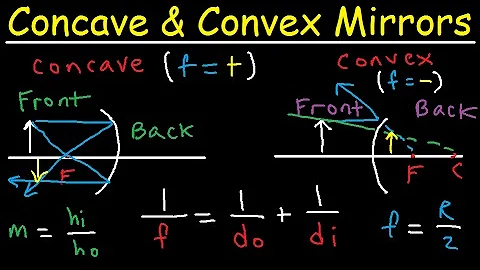
Concave Mirrors and Convex Mirrors Ray Diagram Equations Formulas Practice Problems
The Organic Chemistry Tutor
1.3M مشاهدة · 9 years ago
صفحات ذات صلة

شرح درس التشبيه بأسهل طريقة ـ الصف العاشر ـ مع أحمد الكسواني

دروس عين تابع استخدام الطاقة الكهربائية – الفيزياء 3 – مقررات ثالث ثانوي طبيعي

هكذا أحب النبي ﷺ زوجاته دروس في الحب والرحمة د الهنوف الحقيل

محبة النبي صلى الله عليه وسلم درس مؤثر للدكتور فريد الأنصاري رحمه الله

كيف نتعلم حب النبي صلى الله عليه وسلم الخير الحلقة الثانية

تعليم ظرف المكان للأطفال في على تحت

تعليم ظرف المكان للاطفال مع اختبار نهاية الفيديو

درس تعليمي عن مفهوم الزمن والوقت والساعة للأطفال