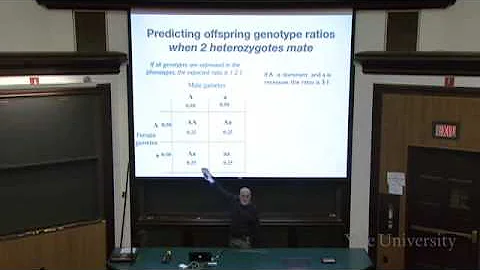
okay I'm gonna start with an example and that great shot of the baby mean the web is so great you can download pictures from the web that just looks fantastic so want to start by posing you problem Jill and John are gonna have baby and Jill's got blue eyes and John's got brown eyes okay all of the other men whom Jill knows have blue eyes the baby has blue eyes should John be worried John's got brown eyes baby's got blue eyes should John be worried well we can assume that brown eyes are dominant to blue which roughly speaking is correct the actual situations bit more complex in fact if you want to write paper on the evolution of eye color and the genetics of eye color there's lot out there but this is approximately correct and John comes from an island where one of the 1% of the people have blue eyes so that just how the face of it would indicate that maybe John ought to be worried but in fact just exactly how worried should he be just based on genetics not based on behavior or rumors or anything like that well we'll come back to that do that at the beginning just to point out that there are interesting issues here and that they are things that touch our daily lives so now I'm going to run through as much as can of genetics in the next 40 minutes and please speed me up or slow me down and as you wish and don't hesitate to interrupt some of this may already be very familiar to you so the genetic material is deoxyribose nucleic acid we have known that since 1945 and we've known its structure since 1953 and this is an actually an extremely important point in genes are solid particles that are transmitted from parent to offspring they are not fluid there actually material stuff okay and we know exactly what it is they encode information as winces of nucleotides and in the DNA its adenine thymine guanine and cytosine so you can think of those as four letters they string into linear chain to form molecule and these there are two strands that are twisted around each other to form double helix so it looks like that the sugar phosphate strands form the backbone and then the nucleotides are glued onto the backbone and they form pairs so adenine pairs with thymine and guanine pairs with cytosine the sugar phosphate backbone is the same in every DNA molecule on the planet and the information in the molecule is in the sequence of nucleotides you can think of that as letters forming words so these are big molecules if you were to put all the chromosomes in your nuclei together and just for one cell and string them together one half would copy is exactly one meter long so when they say it is macro molecule it is serious macro molecule it is big thing so just chop this piece of measuring tape up into 26 pieces and you get about the size that you've got in each of your chromosomes okay yeah when first isolated DNA from sugarcane and condensed it in ethanol it came out in the ethanol mixture as bunch of white stringy strands and could wrap it around glass rod this is big stuff so we're not talking about tiny weeny little molecules DNA is biggie it's very stable now how does this relate to organisms well that's the issue of genotypes and phenotypes and that's question of information and matter so there's general principle here it's quite intriguing and it has to do with how you turn information into matter the genotype is basically the info in the and every cell in your body has got all the information in it that is needed to build whole organism that by the way is an interesting statement because if we can overcome some of the genetic programming of the side of the egg we could in principle simply put cotton swab into your cheek and take one cell off of your cheek and then do fancy reproductive medicine and colonial off of just the DNA in cheek cell now it turns out that the developmental machinery and the egg is really critical it's hard to do that but just from the point of view of the information any cell in your body could be used to make another you on you pull out hair cell take cell off of the root of the hair do the same thing the phenotype basically you should think of that is you okay that's the material organism it's built according to genotypic instructions so the genotype contains information the phenotype contains matter and the transformation from information in matter is done by developmental biology decoding that transformation is one of the major research agendas for the 21st century in biology it's called the construction of the genotype phenotype map that's kind of modern jargon for developmental biology so where's the DNA actually sit in the cell well here's some more vocabulary I'm building vocabulary for those of you who haven't been in biology recently I'm going to say few words here in the eukaryotes the things that have real nucleus includes us and all other multicellular organisms such whole bunch of single-celled ones they have cells that have nucleus and the DNA in the nucleus is contained in chromosomes and these chromosomes are long structure that has kind of central scaffold it's got central mirror that's labeled two here on the slide and the DNA itself is actually wrapped around proteins in the chromosome in the prokaryotes which are the things that lived on this for about the first two billion years of life that is bacteria and archaea they are single-celled organisms and their DNA is basically not in separate chromosomes but all in one circular loop so it's circular chromosome it's attached to the cell wall so there's big difference in the way that you carry oats and prokaryotes are organized and in fact the eukaryotic nucleus is very probably the evolutionary residue of prokaryote that's where that organelle probably came from anybody know what the other organelles are that used to be independent organisms mitochondrion is one chloroplast is another not lysosomes well maybe lysosomes there's little bit better evidence though for another one spindle apparatus this mental apparatus that pulls the chromosomes apart has little circular genome associated with it okay bit more on chromosomes the number of chromosomes is usually constant within species although there is some variation you get 23 from your mom and 23 from your dad so you've got 46 sitting in every cell of your body except your red blood cells which don't have nucleus that dual set one from mom and one from dad together it's called the diploid condition okay so di 2 from Greek diploid and in contrast to that your eggs and your sperm are haploid so the gametes are haploid they have one set haploid means one set of chromosomes so the haploid number in humans is 23 the diploid number is 46 world record for eukaryotic minimum chromosome number is one the nematode that lives in the gut of dog has one chromosome world record for maximum number of chromosomes actually probably also in ascaris but in somatic condition that one chromosome falls into about thousand pieces when it develops so chromosome number varies widely they've got genes and other things in them you can think of chromosome as being about thousand genes and you can think of gene as having several thousand nucleotides in it and you can think of gene as being segment of DNA that tells cell to make particular protein particular structural RNA and through splicing and other things there are various other classes of RNA that are now important regulatory RNAs you're made out of proteins and materials whose construction is basically governed by the actions of proteins and so the DNA in your genome is set of instructions on how to make what kinds of proteins at certain places and times to control the construction of the organism and determine the uniqueness of the species this you know and few words describe something which is incredibly complicated and beautiful and if you think about how complicated your eyes are your brains or your livers or whatever else is and you think about that for all of the 10 to 100 million species of organisms on earth the amount of information stored in the genomes of the organisms on earth is just absolutely astounding and by the way when one goes extinct it's kind of like burning the library at Alexandria we lose all of that information okay genes are in specific locations and they come in different forms so again this is vocabulary building we call the place that this gene is found on chromosome it's locus this is in classical genetics and genes can be found in different versions we call those different versions alleles so for example the gene for eye color is either blue or brown those would be the allele for blue or the allele for brown if you are carrying two different versions of the gene you got one from your mom and you got one from their dad and they're different then you're heterozygote and we call that condition the heterozygous condition if you got the same one from both parents then you're homozygote and we call that the homozygous condition what does gene look like well there's lot now that's known about this and as matter of fact encourage you to do things like go on the web and just type gene structure and have look at all the diagrams that pop up normally gene has got codon that is three nucleic acids that say this is where you're going to start reading me off and then it's got another one down at the end it's stop codon it says that's where you stop and then in between that you've got long string of DNA this is in eukaryotes not in prokaryotes long string of DNA and some of it is going to end up coding for protein and some of it is not so the part that will code for protein we call the exons the part that is going to be cut out and spliced and put into messenger RNA to go out and make protein and the part that is not we call introns so not all of the DNA is going to go out and become protein the central dogma of molecular biology basically is that DNA makes RNA makes protein and transcription is copying the DNA into messenger RNA and that's done with complementary pairing and the process the thymine is replaced by uracil in the messenger RNA the introns are cut out and discarded the exons are spliced together and the mRNA then translated into protein in the ribosome there's lot of activity here for RNA RNA is doing lot of stuff and in fact it's because of the amount of engagement of RNA in this very very basic process of life that we think that RNA was probably the original genetic molecule and the DNA evolved after RNA and then all of this process developed after that the reason for that is that RNA has very high mutation rate DNA has low mutation rate but RNA can be an enzyme and DNA is not so RNA was both an information storage molecule and an enzyme at the beginning close to the beginning of life and then DNA came along later so this is the picture of the structure of genes and the process that goes on when the DNA is transcribed into RNA the RNA is spliced and assembled into molecule that is then going to code for polypeptide or big polypeptide as protein and that will then go through ribosome to make protein so the messenger RNA and by the way when was sitting in this room in 1965 was taught about messenger RNA and the faculty would laugh and they'd say it would say nobody has ever seen one that was 40 years ago now they are the basis of hi-tech gene chips and people work with them all the time but that's you know this kind of ghost in the machine from 40 years ago became very concrete about by about 25 years ago transfer RNA is much smaller molecule transfer RNA if you think of messenger RNA is being that big transfer RNA is about that big and it is the molecule that matches the genetic code that's sitting there in the messenger RNA to particular amino acid so you can think of say if this is the messenger RNA sitting here the transfer RNA is coming along and sitting down on the messenger RNA and matching the code on it and then out of at its other end it's carrying like right here where I'm wiggling my finger it's carrying an amino acid and this whole process will get fed through ribosome and how did this end of it the amino acids will get joined together so the RNA will go out one end of the ribosome and out of the other end of it will come the growing chain of the protein so the transfer RNA is actually the translation device it is what implements the genetic code which comes in units called codons so it takes three nucleotides to specify one amino acid and you can think of it like this the DNA is codon sequence it gets translated into an RNA and then in units of three okay so in chunks of three nucleotides the RNA gets translated into protein just to repeat this message RNA is playing big role in this whole process and there's good reason to suspect that it was the original genetic macromolecule there's an interesting implication in this and will not shy away from telling stories like this during the course information is flowing out from the genotype into the phenotype doesn't go in the other direction that's very important that it doesn't go in the other direction okay this is restatement of something that August vice Monde said in the 19th century he said that there's distinction between the genotype the soma and the germ line which is the genotype and the soma which we now call the phenotype and vice Minh basically said in the 1880s that information flows from the genes out into the organism and not back in the other direction now the implication of that is the evolution of acquired characteristics won't work in other words if during my lifespan acquire healthy tan my child will not inherit it because the information on tanning isn't going to go back into my genome and get transmitted to my kids if develop calluses on my feet they will not be transmitted if giraffe stretches its neck on the savanna to try to get to the top of the tree and thereby actually does physically lengthen its neck by couple of centimeters that will not get transmitted to the next generation so that would be evolution of acquired characteristics characteristics acquired during the lifetime of the parent and it doesn't work that's not how evolution works you're probably sitting there wondering well how does it work hey that's what this course is about you're gonna find out don't worry now there was guy named Ephraim Cinco who was demagogue and corrupt guy pretty evil man he claimed that evolution by acquired characteristics would work and it would work very rapidly this would allow crop selection to go on in period of one generation rather than ten or hundred generations and that therefore in Russia Stalin would be able to move people into Siberia and into areas where crops were not currently grown and why senko said and we can guarantee you scientifically that these crops will work the science was wrong and millions of people died because they starved to death Communist China was influenced by Stalin and in fact Mao bought this stuff for while and carried out some similar policies during the Great Leap Forward in the 1950s and millions of people starve to death in China as well the Chinese found it little bit easier to get rid of this incorrect this bad science because after all it was Russian import right so you could throw it out bit more easily than the Russians could why Cinco in fact persisted for quite while in Russia and when he was denounced by geneticists who told him we're trying to tell Stalin that it was bad science think arrange to have them killed and they were killed they were executed Davila died in the gulag in 1943 one of the greatest evolutionary geneticist of the 20th century so the point of this is that there's some important stuff about genetics and it's not just abstract it's effective science policy it's affected international relationships and it's affected the ability of agricultural practices to support human populations ideas have very important consequences and this is just one of the first that you're going to run into in this course okay back to genetics when the cells divide the DNA replicates and each daughter cell gets complete copy this is how inheritance works okay this is why you look like your parents during replication the ends of the DNA strand are loosened and opened up so that in the knotch between the two strands nucleotides can be inserted and all of this is done with complex enzymatic machinery and it's done extremely precisely only one mistake in about billion nucleotides occurs in DNA it's almost impossible for humans to construct system that has that degree of reliability obviously this precision has been in extremely important thing natural selection has worked very hard to get those enzymes that precise when an end when mistake does occur that is one source of mutation and in fact the more frequently DNA is copied the higher the mutation rate so that's one place where mutations come from when this is going on this copying is going on in the process of the development of multicellular eukaryotes or when it's going on in an asexual eukaryote basically what happens is the chromosomes go through the process of mitosis and in mitosis what what's going on is that the chromosomes will be duplicated they will line up at plate at the center of the cell spindles will form so these are our proteins these are actin fibrils here and they aren't anchored to an organizing center which is at the poles of the cell and they attach to the centromeres of the chromosomes and they pull one copy into each cell and then the cell splits so that's physically how the copying occurs at the DNA level and then at the chromosomal level in the cell and the picture basically is stained mitosis caught in an onion root tip cell which is sort of the classical place to observe this the information result of this is that if you've got two genes big and little that are alleles at the same locus the two versions of the gene at the same place on the chromosome mitosis basically consists of doubling first doubling of the chromosome so you have enough copies to end up with they line up at the middle of the cell and then the spindle apparatus pulls one copy of the big and one copy of the little in this slide they're on different chromosomes into each of the daughter cells what about meiosis meiosis is the process that produces gametes so it takes the diploid parent down into haploid gamete so it's reduction division the process is more complicated and in fact it is like sticking to mitosis together in the sequence but with bit of additional machinery so the first thing that happens is that the chromosomes are duplicated and they are then actually duplicated again then out of the out of the original chromosome there are two they're out of the original cell you're going to go through process first of duplication another duplication then you're going to reduce them each twice by going through two mitosis and so in in sequence and as result of that each haploid gamete is getting one original chromosome or the other but not both that's cartoon of meiosis meiosis is actually much more complicated than that and it's much more precise than I'm able to indicate with these kinds of stick diagrams but for today's purposes the main thing to remember about it is that meiosis takes diploid parent and from that diploid parent generates haploid gametes and each haploid gamete is getting one original chromosome or the other but it doesn't get both there's great paper that was written back in 1907 by geneticist on this issue does the behavior of chromosomes explain Mendel's laws and it does so Mendel's first law is that if you have two alleles two members of gene pair when they segregate into the gametes one goes into each gamete that's Mendel's law of segregation so half of the gametes from heterozygotes big little will carry the allele and half of them will have little allele so this is the law that allows us to predict what the genotype ratio should be in the offspring and that allows us to notice any deviations from that genotype ratio so I'm jumping ahead little bit here to punnett diagrams just make note in your head that this fact of segregation is the basis for our being able to predict what the offspring will be like if we know what the parents are like at least it's part of it so if you have two heterozygotes who are meeting with each other so the male gametes have either big or little and the female gametes have either big or little leg it is Mendel's law of segregation which tells us that we can expect those gametes to be equally likely the probability is 50% in each case when they then come together to make zygote that's going to grow up to be the offspring then these we just multiply these probabilities together so 0.5 times 0.5 gives us 0.25 and each of these kinds of zygotes is equally likely 25% however there was reason that we wrote big and little if big is dominant that is safe brown eyes and little is recessive say it's blue eyes and remember our baby with issues then the ratio here is three to one that's only true because it's 3 to 1 because in these three cases we have big egg and in this one case we don't so the ratio is 3:1 it was this observation of three to one ratios in the offspring of heterozygote crosses that caused Mendel to postulate the idea that hey some genes are dominant and some genes are recessive if gene is dominant you can see that fact in the phenotype you can see that the allele is present in the phenotype if it's recessive you can't see the presence of the gene in the heterozygote its presence is covered up by the dominant one Mendel's second law what happens when there are we're looking at two genes and they're on different chromosomes well Mendel's second law basically says that the events that occur at the different chromosomes are independent of each other so genes that are sitting on one chromosome are going to be assorting independently two genes that are sitting on other chromosomes so in in this picture you can see it if we have big little and this would be big little heterozygote this is big little heterozygote they are depicted as already having been copied okay so the they've been duplicated so that they can start going through the process of meiosis and what's going to happen is that we're going to pull them apart we're going to make four gametes out of each of the chromosomes this combination where you get big big little little is just as likely is this combination where you get big little and little big okay so that's tracking what happens when you have genes on two different chromosomes that are forming gametes that's Mendel's second law so meiosis is capable of producing genotypes that are different from the parental genotype I'll pause for moment there I'm not just going to keep running through this slide because want to tell you that this is the essence of sexual reproduction the fact that the offspring genotypes are different from the parental genotypes is the essential evolutionary fact about sex it can be achieved in lot of different ways but it means that sex produces offspring that are not copies of the parent they are all different from the parent and there are two genetic mechanisms that do it just showed you the first one if you've got the genes on different chromosomes they assort independently if they're on the same gene chromosome you can have crossing over okay so crossing over means that chromosome parts are exchanged during meiosis and it produces new combinations like this it's easiest to show you just with the diagram rather than with words so when we've made the copies of the chromosomes and they are lined up think this isn't prophase one if I've got my phases right in my in meiosis it is possible that there will be break and then rejoining at certain spot and this will be done where the DNA sequences are very similar so the chromosomes can break and be rejoined and the product of that is gametes that are different these are recombinant gametes generated by crossing over these combinations this kind of genetic variation is something that's going on in every generation the estimates for the human genome is that actually in order to go through meiosis there must be crossing over event and it is thought that every human chromosome experiences one crossing over event every generation roughly probably true for most organisms so these things are continually being shuffled and the point of that is that there are two mechanisms of recombination remember this okay when we say that the genes recombine they do it both because the chromosomes get shuffled and because there is crossing over the crossing over generates new combinations within chromosomes and the chromosome assortment generates new combinations within the genome both things are going on now mutations are also going on in every generation and they produce changes in DNA sequences some of them make genes that are functional some mutated genes have improved many don't many have worse function lot of them are neutral and it's mutations that occur in the germline that is in the cells that will form eggs and sperm that get transmitted to offspring they have evolutionary significance so they change the information that's transmitted over evolutionary time mutations that occur in somatic cells are the things that lead to cancer cancer is mutational process and every cancer is little evolutionary process that occurs just within the lifetime of the person who has it ultimately if you go back through the history of life mutations are where all genetic variation came from so it's important to understand basically what's going on here we refer on the one hand to point mutations that's where you just change one nucleotide and there's category there are categories of point mutations you can have substitutions you could have deletions and you can have deletion of an entire codon will not cause change in the downstream amino acids so if you take out three nucleotides at once there won't be any change in the coding for the remaining amino acids but if you take out one or two you're shifting the reading frame so if you have deletion of one nucleotide or two nucleotides it changes everything downstream from that point so one or two deletions can have really big effects on the information content of the whole genome we call those frameshift mutations mutations also occur at higher levels you can have chromosomal mutations where you delete an entire gene so if say we delete want you to think now that we're taking out maybe 3,000 nucleotides the whole gene disappears everything from the start codon to the stop codon we can duplicate gene so we get two copies or we can invert them these are very important evolutionary processes if you duplicate gene you can use the old copy to keep things working why you innovate with the new copy so gene duplications are really important your genome has been completely duplicated twice we can see that in the Hox genes you'll see that in few lectures but in the course of vertebrate evolution once back about with the hagfish is in the AG NAFA and then once between the Agnetha and the higher fishes the entire genome was duplicated and it is thought that this duplication of information may very well have been associated with the fact that there was radiation and generation of lot of morphological complexity because we had duplicated the entire library you could keep one of them going to to keep everything running and you could use the other one for innovation so duplications are important now to get back to John Jill and the baby with issues remember said that John came from an island where the population had 1% gene frequency well we need to think about the whole population then now want you to think about an out crossing sexual diploid population that produces haploid gametes could be the population of Connecticut could be the population of New Haven population of Pitcairn Island and focus on one gene that occurs as two alleles okay we'll call them big and little we've got Mendel's laws going on so we have random ferrous or assortment of alleles in the gametes we have random fusion of gametes and design goats and we can put that into Punnett diagram so this is would be for heterozygotes big little mating with big little if we look at it as population diagram then the frequencies can be anything doesn't have to be heterozygote frequencies we can just say if there's random mating of individuals in this population some of them are homozygotes some of them are heterozygotes we have population of eggs and population of sperm and the frequency of big we will call and the frequency of little will call and it's important to remember and this is place where people just getting into it often to get fouled up and can be anything between zero and one they're not 50% okay they can be anything between zero and one these genes can occur at arbitrary different frequencies in the general case well plus is got to equal one because we only have two possibilities and that's just the definition of frequencies the frequencies of the kinds of psy goats they will form our squared 2pq and squared and those frequencies also add up to one the assumptions behind those statements are that meiosis is fair so that's just like flipping coin it's 50% probability whether you will get one or the other allele in any particular mating the mating is random that there are large populations and if there's no selection and there's no migration so this is kind of an ideal gas law for biology and such laws are very useful in physics and chemistry and this one is particularly useful in evolution it tells us that if these assumptions hold then in every generation you can expect those proportions of genotypes no mutation well what does it mean it means that if you start in one generation with frequencies and and you go through that kind of mating you get zygotes with these frequencies and in the next generation you get the same gamete frequencies nothing changes it's kind of funny that you would place lot of emphasis on law that says that nothing changes but in fact it's extremely important because it means that at the level of population genetic information doesn't disappear the gene frequencies stay the same and that means that the population gets replicated the whole population gets replicated that allows information to accumulate if this were not true then the information that had been accumulated would get eroded by just the basic process of genetics it turns out that genetics and random mating and the whole structure of the hardy-weinberg assumptions is set up in such way that information is preserved at the level of the population that makes evolution possible if we didn't have that retention of information and you couldn't tweak it it would get eroded by processes other than natural selection so it's kind of an inheritance mechanism at the whole population level and by the way it minimizes conflicts among genes about who gets into the next generation and genetic conflict will be something that we examine in more detail later on particularly interesting in the context of evolutionary medicine and reproductive biology okay let's go back to our problem Jill and John have this baby and the baby is that issue so Jill's got Jill is I'm now gonna use the words to drive them home Jill is recessive homozygous she's got two copies of little John could be either dominant homozygote or he could be heterozygote he's got brown eyes baby's got blue eyes it's recessive homozygote should John be worried well here's the hint this is the one new piece of information I'm going to give you we're going to assume that John's genotype is random sample of those on the island and therefore that squared that's the frequency of little little little little is 0.01 so if squared is 0.01 what is point 1 right 10 percent probability what's the probability that John is heterozygote this requires having picked up information very rapidly it's 2 okay those are the heterozygotes the probability that John is dominant homozygote is squared is 0.9 squared is 0.8 1 81 percent probability that John is homozygote should John be worried mean just on genetic grounds the only way that that baby could be John's child as if he is heterozygote 2pq is 18% squared is 81 percent okay so did that just to give you problem that has little bit of human content to it that is answered by genetics and by the concepts that we were playing with today well if he in fact is homozygote there is no way that that child is his unless he no there is way he could have had mutation in the gene that turned it from brown into blue gene and that could have found its way into the sperm that fathered the child and the probability of that happening is about 10 to the minus ninth okay see if you could explain that take print this list out sit down at lunch with colleague from class and see what you can't explain take that term into section and get it explained okay next time adaptive evolution
15:02
Mega Genetics Review Mendelian and non Mendelian Genetics
Amoeba Sisters
1.1M مشاهدة · 4 years ago
7:29
Introduction to Genetics DNA RNA Genes Nucleosides Nucleotides Transcription Translation
Medicosis Perfectionalis
332.2K مشاهدة · 3 years ago
45:58
12 Genetics 1 – Cell Division Segregating Genetic Material
MIT OpenCourseWare
116.3K مشاهدة · 6 years ago
49:01
13 Genetics 2 – Rules of Inheritance
MIT OpenCourseWare
48.6K مشاهدة · 6 years ago
23:20
Principles of Genetics Genetics 1 of 8
DaVinci Academy
3.7K مشاهدة · 2 years ago
59:39
Lecture 1 Introduction to Genetics
Thomas Mennella
178.7K مشاهدة · 7 years ago
15:57
Genetics for beginners Genes Alleles Loci on Chromosomes
Biology Lectures
360.9K مشاهدة · 5 years ago
1:29:03
Gregg Braden – The Controversial Genome 2 Chromosome HCR 2
Gregg Braden Official
263.8K مشاهدة · 2 years ago
17:11
EASY TO UNDERSTAND INTRO TO GENETICS
Miss Angler
768.9K مشاهدة · 4 years ago
12:34
Genetics and The Modern Synthesis Crash Course History of Science
CrashCourse
174.4K مشاهدة · 7 years ago
8:32
Dihybrid and Two Trait Crosses
Amoeba Sisters
3.6M مشاهدة · 11 years ago
54:41
BIOL 2416 Chapter 1 Introduction to Genetics
Dr. D Explains Stuff
96.1K مشاهدة · 5 years ago
8:18
DNA Chromosomes Genes and Traits An Intro to Heredity
Amoeba Sisters
6.5M مشاهدة · 8 years ago
1:30:01
Lecture 2 Introduction to Biology and Genomic Measurement
MIT OpenCourseWare
1.2K مشاهدة · 3 years ago
1:27:14
Science at Cal Lecture – Uncovering the Past Using Genetic Data to Understand Human History
Science at Cal
17.3K مشاهدة · 3 years ago
2:21:38
Genetics Full Course 13 High Yield Chapters
MedicoMedics
6.6K مشاهدة · 10 months ago
5:10
An Introduction to Mendelian Genetics Biomolecules MCAT Khan Academy
khanacademymedicine
674.9K مشاهدة · 11 years ago
12:51
Lecture 4 2 Inheritance and Genetics Allele Segregation
 15:02
15:02
 7:29
7:29
 45:58
45:58
 49:01
49:01
 23:20
23:20
 59:39
59:39
 15:57
15:57
 1:29:03
 17:11
17:11
 12:34
12:34
 8:32
8:32
 54:41
54:41
 8:18
8:18
 1:30:01
 1:27:14
 2:21:38
 5:10
5:10
 12:51
12:51
 10:18
10:18


