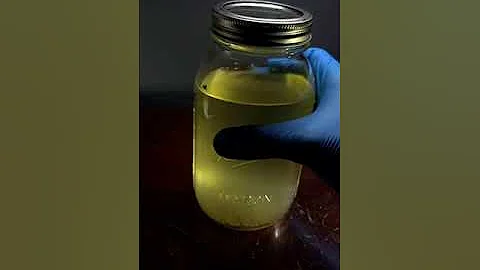
in this video I'm going to show you the effects of distilled water on red blood cells under microscope I've placed drop of distilled water on glass slide along with normal saline solution on another to show what blood cells should look like normally normal saline is mostly sterile water with concentration of 9% sodium chloride or more commonly known as salt I'll be using Lancet to obtain small amount of blood from my finger which is just tiny spring-loaded needle that only breaks the first layer of skin now that we have our samples we can take look at the difference under the microscope I've added the magnification and which sample I'm using at the top right of the screen for reference looking at the saline sample first you can see that red blood cells normally look like these small biconcave discs that are packed with hemoglobin which is protein responsible for gas exchange giving blood its red color and many other functions there are some deformed red blood cells but for the most part they look normal and haven't liced or lost any of their hemoglobin switch ing over to the slide with distilled water you can see that most of the cells have this swollen disfigured appearance and this is due to distilled water being hyponic which causes water to rush into cells and eventually burst from process called hemo liis when the cells burst or lice they also release all of their hemoglobin into the sample which is why there is slight tint of orange throughout the screen you may also notice outlines of circular cells that are barely visible all over the slide which are known as ghost cells the empty hus of red blood cells that have lost most if not all of their hemoglobin even though the cell contents are empty now it still maintains similar shape due to structural proteins like spectrin and actin which form cytoskeletal mesh that provides support to the membrane think of it as high-tech tent with bendable and resilient poles that represent the network of proteins since the poles are bendable it allows the tent or cell membrane to temporarily deform then return back to its original shape as needed it's not not an exact match but hopefully it gives you sense of how blood cells maintain their structure while maneuvering through the body going back over to the slide with saline we can see that the cells still look similar to how they did when we initially looked at them the reason why red blood cells stay alive slightly longer inside the saline solution versus the distilled water is because the saline is isotonic meaning it has very similar osmotic pressure to that of our blood which prevents excessive water movement into or out of our cells just to show visual of how cells act in distilled water versus the normal saline put drop of blood in vial of distilled water in vial of the normal saline solution then time-elapsed it this is around 3 hours of footage scrunched into 15-second clip but you could see difference almost instantly in real time the vial of distilled water has lot more of uniform red color while the sailing Solutions color separated this is because the blood cells in the vial of distilled water have all liced and released the hemoglobin into the water coloring it red while the cells in the saline stayed preserved and simply fell to the bottom even little over 3 hours later the cells took from the saline solution still retain that classic biconcave shape for the most part and still contained hemoglobin in the sample of water the ghost cells here are lot harder to see without lighting method like phase contrast since they have all fully liced and are completely transparent also added some distilled water to some slides with saline to try and show in real time what they look like licing but was only able to capture it at lower magnifications due to how chaotic everything is when adding the water and how fast the licing occurs this clip is at 200 times magnification and phase contrast and you can see that some of the blood cells turn dark color then eventually transparent as they lose the rest of their hemoglobin it was almost too difficult to see in brightfield and the conditions had to be just right to see the ghost cells to finish this video up I've also made hypertonic solution and added it to the red blood cells to show the effects of the different osmotic environments in hypertonic solution there's higher solute concentration or in this case salt which results in the water moving out of the cells and shrinking the membrane it's essentially the opposite of hypotonic all did was add little bit more salt to one of the isotonic saline Solutions these cells are known as crenated or bur cells which are red blood cells with shrunken membranes that have lost their water the membrane while flexible still has limits and can't shrink uniformly so it crumbles and folds over itself creating those Spike projections you see so now we've seen how red blood cells react in an isotonic solution hypotonic solution and now hyperonic solution understanding these reactions is crucial for medical practices like administering IV fluids so doctors can decide whether to hydrate cells or balance fluids and electrolytes in the body don't have any kind of Mer merchandise for sale so subscribing is the best way to support the channel at the moment I'll play some extra footage for the rest of the video with the labels at the top right corner and as always thanks for watching
3:48
Red blood cells under the microscope hypo and hypertonic solutions
Sci- Inspi
1.4M مشاهدة · 10 years ago
2:55
Red Onion Osmosis Plasmolysis Microscope
Bright Biology
167.2K مشاهدة · 5 years ago
4:02
Why 100 Pure Water is Dangerous Shocking Warning
Fishy Science
2M مشاهدة · 2 years ago
0:59
Osmotic burst of blood cells
CellBiophysics
388.1K مشاهدة · 14 years ago
1:24
Structured Water How It Works 2020 Effects on Blood Cells and Hydration
Highbrow Water Filters
23.2K مشاهدة · 5 years ago
10:35
Watch SALT destroy BLOOD CELLS under the microscope

 3:48
3:48
 2:55
2:55
 4:02
4:02
 0:59
0:59
 1:24
1:24
 10:35
10:35
 0:11
0:11