Decimal Review Add Subtract Multiply and Divide Decimals

Decimal Review Add Subtract Multiply and Divide Decimals

النص الكامل للفيديو

Welcome to Math with Mr. In this video, I'm going to be doing decimal review. So, refresher on how to add, subtract, multiply, and divide decimals. So, hopefully if you need little more help with one of these operations, this helps you out. Now, if you're looking for little more in-depth instruction or more examples, dropped the links to my videos on adding, subtracting, multiplying, and dividing decimals below in the description. So, let's jump right into number one here where we have addition. So, 18 and 4/10 plus 3 and 97/100. So, for adding and subtracting decimals, the most important part is lining the problem up correctly. And you do that by lining up your decimals. So, 18 and 4/10 plus and 97/100. Now, the problem looks little offset. That's fine. We can use placeholder zeros because zeros to the right of decimal do not change the value. So, can put zero here to the right of that four and it doesn't change the value. It's an equivalent decimal. So, now it looks little neater and more lined up. So, once you have your decimals lined up and any placeholder zeros put into place, we can just add. So, 0 + 7 is 7. 4 + 9 is 13. Bring my one over here. Now, decimals line up throughout the whole problem. So, bring it straight down. 1 + 8 is 9 + 3 12. 1 + 1 is 2. So, our answer is 22 and 37 hundredths. Now, let's take look at our original problem. With decimals, it's good to always see if your answer makes sense and we can use estimation. So, this number, 18 and 4/10, is around 18. And the second number, 3 and 97/100, if we were to round that to the nearest whole, it would be around four. So, 22 is good estimate. So, our answer, 22 and 37/100, is reasonable answer. If you put the decimal in the wrong place or forgot the decimal, it should tell you that something went wrong because that answer doesn't make sense. So, let's take look at number two. Again, adding and subtracting, the most important thing, line your decimals up. So, here we have and 6/10 minus and 864/1000. Now, that problem looks even more offset than the first one. That's okay because we lined our decimals up, the most important part. And when you line your decimals up, it lines all of your places up. So, now we need couple of placeholder zeros. Now, we're all lined up and we have our placeholder zeros. cannot do 0 minus 4. need to borrow. So, can't borrow from this zero, so need to borrow from the six. It's now five. This zero turns to 10, but need to bring the one over all the way to the right, so it's going to be nine. And then the zero to the far right is now 10. So, 10 minus 4 is 6. 9 minus 6 is 3. cannot do 5 minus 8, so need to borrow from the four, which now becomes three. So, get 15 minus 8, which is 7. Bring my decimal straight down. need to borrow again from the three, which is now two. And that other three now becomes 13. 13 minus 4 is 9. And then bring my two down. 2 minus 0 there would give me two. So, 29 and 736/1000. So, let's estimate here. Let's do an estimation. So, 34 and 6/10 would round to 35. 4 and 864/1000 would round to 5. So, 35 minus 5 our estimation would be 30. So, our actual answer is reasonable. It makes sense. Let's check number three as we move to multiplication. So, for multiplication, you don't necessarily have to line that decimal up. find it easier. Let's take out the decimals to start with. And we are going to do 52 times 45. Again, took out the decimals. I'm going to put them in at the end. 5 times 2 is 10. 5 times 5 is 25 plus 1 26. Done here. Done here. We need our zero here as we move to the next place. 4 times 2 is 8. 4 times 5 is 20. Now, we add our partial products. 0 + 0 0. 6 + 8 is 14. 1 + 2 is 3. And we have our two here. Now, we need to put our decimal back in to our answer. So, we take look back at our original problem and we need to see how many digits are to the right or behind decimal. Well, we have this two here, so that's one. And we have this five here, so that is two. Two digits behind the decimal, so our answer needs two digits behind the decimal. So, we bring it in one, two. And it goes right here or think of it as one, two digits behind the decimal in our answer. So, for number three, the product is and 40 hundredths. And if we take look at our original problem, we have something around five times something around five, so our answer should be somewhere around 25. So, our answer is reasonable. We know we put the decimal in the correct place. So, for number four, we have dividing decimals. So, let's set it up. 3 and 2/10 is our divisor. And 13 and 76/100 is our dividend. So, when you get to division problems, the first thing we need to check is is the divisor or outside number whole? If not, we need to make it whole number. Here we have 3 and 2/10, so it's not exactly whole. So, we need to move this decimal to the right one time to make it whole number. This is going to make our problem much easier. Now, whatever you do to the outside, you have to do to the inside. Everything needs to stay balanced. So, we moved it once to the right on the outside, so we need to move it once to the right on the inside. Now, we can rewrite our problem. So, we have 32 as our divisor. And we have and 6/10. Now that the divisor is whole, we bring this decimal straight up. That's where it's going to be placed in the answer. So, if you have whole number on the outside right off the bat, you can bring that decimal straight up right away. But here, in this case, we did not. So, now we can go through our long division steps. Can we do 1 divided by 32? No. Can we do 13 divided by two thir- I'm sorry. 13 divided by 32? No. So, we need to do 137 divided by 32. And can be pulled out of 137 four times. That gets us to 128. So, we'll subtract. We get nine. Bring down this six. So, now we have 96 divided by 32, which happens to give us three. We can pull three whole 32s out of 96. And 96 and 32 are compatible, so we hit it without any remainder. So, three 32s out of 96. 3 times 32, like we said, hits 96 exactly. Our answer is four and three tenths. So, if we take look at our original problem, we have something around 14 here divided by three. So, 14 and three aren't necessarily perfectly compatible, but we can think how many whole threes can we pull out of 14? Well, four whole threes, that gets us to 12s, and then we'll have little left over. So, this answer makes sense, right? Because we pulled four whole 3.2 tenths out of 13.76 hundredths with little left over. So, this answer is reasonable. Say, for example, you forgot to put the decimal and you got an answer of 43, you can look back at the original problem and think, well, that answer doesn't really make sense. It's not reasonable. Maybe did something incorrectly, and you can figure out where you need to put the decimal. So, there's the quick refresher/decimal review. Hopefully, that helped. Thanks so much for watching. Until next time, peace.
How to Add Subtract Multiply and Divide Decimals A Review of Decimals Math with Mr J 21:34

How to Add Subtract Multiply and Divide Decimals A Review of Decimals Math with Mr J

Math with Mr. J

246.4K مشاهدة · 3 years ago

Decimal Review How To Add Subtract Multiply and Divide Decimals 9:52

Decimal Review How To Add Subtract Multiply and Divide Decimals

Uncomplicated Math

278 مشاهدة · 2 years ago
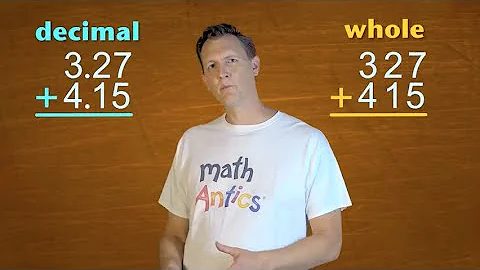
Math Antics Decimal Arithmetic 12:15

Math Antics Decimal Arithmetic

mathantics

6.4M مشاهدة · 10 years ago

Learn Everything About Decimals in 30 Minutes Add Subtract Multiply and Divide Decimals 28:37

Learn Everything About Decimals in 30 Minutes Add Subtract Multiply and Divide Decimals

Grammar Hero

55K مشاهدة · 5 years ago

DECIMAL REVIEW Add Subtract Multiply Divide Decimals Year 7 Maths lesson 7:20

DECIMAL REVIEW Add Subtract Multiply Divide Decimals Year 7 Maths lesson

The Maths Guy!

1K مشاهدة · 9 months ago

Decimals review adding subtracting multiplying and Dividing Decimals 2:00

Decimals review adding subtracting multiplying and Dividing Decimals

Teach Like A Bean

169 مشاهدة · 5 years ago

All About Decimals add subtract multiply and divide 5:24

All About Decimals add subtract multiply and divide

Joel Tutors Math

9.4K مشاهدة · 17 years ago

Decimal Multiplication Division 5:01

Decimal Multiplication Division

Martin Chavez Jr.

1.4M مشاهدة · 6 years ago

Grade 7 review add subtract multiply and divide decimals 13:17

Grade 7 review add subtract multiply and divide decimals

Sir Mathigo

2.3K مشاهدة · 5 years ago

Multiplying Decimals and Dividing Decimals The Easy Way 18:47

Multiplying Decimals and Dividing Decimals The Easy Way

The Organic Chemistry Tutor

740.8K مشاهدة · 9 years ago

Decimal Basics Add Subtract Multiply and Divide Decimals 29:22

Decimal Basics Add Subtract Multiply and Divide Decimals

Your 24-7 Math Tutor

226 مشاهدة · 3 years ago

Adding Subtracting Multiplying and Dividing Decimals 11:04

Adding Subtracting Multiplying and Dividing Decimals

SULearning Support

245 مشاهدة · 4 years ago

Add Subtract Multiply Divide Decimal Numbers 4:03

Add Subtract Multiply Divide Decimal Numbers

larryschmidt

477 مشاهدة · 14 years ago

Addition Trick Butterfly Method for addition fraction Fraction Trick 0:23

Addition Trick Butterfly Method for addition fraction Fraction Trick

Poonam study centre

18M مشاهدة · 4 years ago

Add Subtract Multiply and Divide Decimals 3:58

Add Subtract Multiply and Divide Decimals

Natalie Uy

361 مشاهدة · 11 years ago

Decimals Review add subtract multiply 4:21

Decimals Review add subtract multiply

Emily Strong

19 مشاهدة · 4 years ago

Decimal Operations Explained Add Subtract Multiply Divide Decimals 5:02

Decimal Operations Explained Add Subtract Multiply Divide Decimals

LearningHubX

13 مشاهدة · 2 months ago

Adding and Subtracting Decimals How to Math with Mr J 6:07

Adding and Subtracting Decimals How to Math with Mr J

Math with Mr. J

1.1M مشاهدة · 6 years ago