hello and welcome to German lessons with Mr Ferguson this grammar lesson Heist demonstrative por demonstrative pronouns before we start before please remember to like this video better click and to subscribe to my channel so that can keep helping you with your German if you're enjoying my videos please consider buying me coffee by clicking the banner now all contribution are gratefully received and allow me to continue to bring you new and exciting German content whilst keeping it free to access on YouTube thank you to those of you who have already contributed it's very much appreciated feel and in this lesson we'll be looking at type of word in German called demonstrative pronoun these are soall because they demonstrate which thing you're referring to let's have look at some English examples don't like this book but love that one I've been looking for jumper but hate this one this is the same man spoke to earlier he's the one who bought me coffee the demonstrative pronouns in the above examples are this that one this one the same and the one to use demonstrative pronouns in German it's important that you have an understanding of the definite articles and the corresponding adjective endings in German and so if you don't know what these are or how they work you can watch the defin articles section of my adjective endings in German video by clicking the banner now the definite articles in German are in the nominative case de Das in the accusative case de de de plus an on the noun in the dative case and Dez plus an on the noun dear Dez plus and de in the genitive case in German there are lots of different types of demonstrative pronoun and will list the ones we'll be looking at here before going into more detail about each of them using an article to replace noun when context is established putting stress on an article to show that you're talking about specific thing using to replace whole concept or sentence placing an article with the words this when an object is near to you or that when an object is further away saying the one or the ones who when giving more information in relative Clause if you aren't sure what relative Clause is I'd recommend going back to learn what those are by clicking the banner now saying the same one or the same ones if two nouns are the same so let's look at using an article de Das Etc to replace noun the boots please me or like the boots this is standard sentence in which we're talking about some specific boots if you're in shop looking at different boots you can simply say deal Mia which would translate as these ones please me or like these ones as the context of boots has been made clear by the situation you wouldn't need to sayif here there is slight change in the table that you've learned here and it's as follows the de plus in the dative plural box becomes Den as is the case with relative clauses similarly Dez plus in the masculine and new genitive boxes become and in the feminine genitive line becomes the plural of the genitive line becomes de or we'll come back to this shortly the genitive demonstrative pronoun Des for masculine and Ne and de for feminine are rare in this context and they are much more commonly used to form relative Clause an example of how Den is used could be I've given it to those who have absolutely nothing one way you might see desen as demonstrative pronoun is as follows was not aware of that as mentioned the plural genitive demonstrative pronoun can either be or and this depends on whether it refers to something ahead or whether it refers back to something that's already been said for example use de when the demonstrative pronoun comes after the noun it describes as you would for relative Clause this essentially translates as who's when the noun is plural for example there are lots of people whose houses are big the refers to lots of people which was mentioned before use if you want to translate of those followed by relative Clause with more information for example is the number of those who also have an expensive car is high de relates to the who also have an expensive car and it therefore refers to the further information given after its use another way in which desen for masculine and Ne and de for feminine are used is to determine who an object belongs to it's not really demonstrative pronoun but it seems sensible to mention it here for example Anna and Clara are spending time with their parents and their friends in this example it's not clear whether the friends are Anna and Clara's friends or whether the friends are friends of Anna and Clara's parents if you stick to this version it implies the former that the parents and the friends belong to Anna and Clara if you write Anna it clarifies the friends belong to the parents the last noun mentioned before here is similar example using Jurgen is in the park with his father and his girlfriend again it's unclear whether it's jurgen's girlfriend or whether it's juran's Father's girlfriend and if we stick with this version it implies that yuran is with his father and with his own IE jurgen's girlfriend if we say jur is finding in park this new version clarifies that Jurgen is in the park with his father and his father's girlfriend deson refers back to the last noun used before it which was fat before we move on to other words used as demonstrative pronouns it's worth pointing out that you can simply emphasize an article to convey the meaning of this the these or that if we take the previous example of boot shopping and you spot pair of boots that you particularly like you can say these boots please me or Like These Boots another example might be do you like this blouse yeah yes find this one good in what seems like slightly unusual way to English speakers you can also use de and and their declensions to denote person sometimes people might introduce themselves with de or in front of their names there is German TV show which demonstrates this which used to be called schlag which translates as beat and that was when media personality stefanb hosted the show it's now called schlag hen as it's hosted by famous chef Stefan Hensler the TV show is based around member of the public beating the host at number of different and sometimes bizarre activities but schlagen is to beat and we use Dean here because the hosts both male are the direct object which means we use the accusative case so when context is established you can simply replace the person's name with correct article for example Hast have you seen today no him haven't seen as is also probably quite clear you can use the word to replace full sentence of information for example we have to do the homework yes know or yes know that James Bond filmo there's new James Bond film in the Cinema that's is full cool that's really cool as in the fact that there is new James Bond film in the cinema is cool the next two demonstrative pronouns are the ways of saying this when something is close by in either time or in terms of its location and that when something is further away the word this in the masculine nominative form is the great news about the word is that it exactly mirrors the definite article look at the two tables together plus an on the noun plus an on the noun plus an on the noun and as I'm sure you can see instead of the of this has essentially been replaced with for example nominative masculine this hat does not suit me accusative masculine don't like this hat dative feminine spoke with this woman Gena the color of this car pleases me or like the color of this car the word that is and follows the exact same patterns plus on the noun plus on the noun plus on the noun and you use this pronoun if the thing you're talking about is further away and you can combine it with the phrase meaning over there or Hinton meaning back there t-shir that t-shirt over there is very expensive do you inal singular see that man back there in day-to-day life you will rarely hear and its declensions and you will much more commonly simply hear the definite article combined with duin or Hinton for example t-shirt Ruben isya that t-shirt over there is very expensive in Mand Hinton do you in formal singular see that man back there the next demonstrative pronoun to talk about is De and its declensions which can be translated as the one or the ones this demonstrative pronoun is always combined with relative Clause let's look at some examples in English and then translate them into German he's the one who sold me the computer she's the one want to spend time with there are lots of people here and want to speak to the ones know your children are the ones being loud as you can probably see the word de yiga is one word but it's made up of what looks like the definite article dare and what can be thought of as an adjective yig this isn't usable adjective in German but it helps to demonstrate how the endings of these demonstrative pronouns decline with the definite articles the adjective endings depend on their location either within or outside of what call the frying pan articles inside the frying pan are used with the adjective ending and articles outside the frying pan are used with the adjective ending and the same happens with de the table therefore looks like this de so let's translate the previous sentences use the nominative with the verb as we treat it like an equal sign and the subject is which is masculine pronoun we therefore need the masculine nominative version of which is just again we use nominative with sign but the subject here is feminine pronoun we therefore use the nominative feminine version of which is as we've used MIT and are referring to people lighter which is plural noun we need to use the dative plural version of which is once more we use the nominative with sign and is plural noun so we use the nominative plural of which is again the last demonstrative pronoun is De meaning the same or the same ones similarly to will reflect the changes in the article and the accompanying adjective ending but it's used as one word it table is as follows plus an on the noun plus on the noun plus on the noun here are some examples my sister and have the same interests my dog always plays with the same toys and so those are the most commonly used types of demonstrative pronoun in German as well as some examples of how to use them they generally behave the same way as the definite article including when used with the adjectives and so it's really crucial that you understand how to form those in the different genders and cases it's good idea to pause the video now to recap the different types of demonstrative pronoun and the situations in which they should be used if you're you're native German speaker and think I've forgotten any useful information about demonstrative pronouns or can think of any examples using the more difficult ones such as or please do let me know by writing comment comment also please remember to click subscribe to receive all of my German lesson videos language learning tips and updates you can also follow me on Instagram with username ha Ferguson and on Twitter under her Ferguson otherwise from me it's Dan on Aid
6:37
A 1 Level German Lesson 26 demonstrative pronouns German for beginners Learn German free
Dream Germany
625 مشاهدة · 9 months ago
10:06
A 1 Lesson 54 Demonstrativartikel dies Demonstrative article dies Learn German
Learn German
266.5K مشاهدة · 7 years ago
10:46
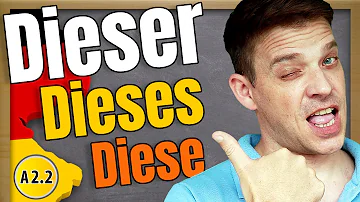
Dieser dieses oder diese Learn when you have to use which Demonstrativpronomen
YourGermanTeacher
126.9K مشاهدة · 5 years ago
10:52
German Demonstrative Pronouns Deutsch lernen
Learn German with Herr Antrim
5K مشاهدة · 13 years ago
5:17
Master German Demonstrative Pronouns – Dieser Diese Dieses Explained
Fast German
134 مشاهدة · 11 months ago
15:53
Der Die Das German Genders Explained Tips Tricks and Hacks
YourGermanTeacher
1.8M مشاهدة · 6 years ago
0:58
Day 10 – learn German in 1 Minute – Demonstrativartikel
Learn German with Monica
4.6K مشاهدة · 3 years ago
11:33
Learn German der die das Rules for articles Hints on how to guess the german articles A 1
Learn German
1.1M مشاهدة · 9 years ago
9:36
Demonstrative Pronouns in German Demonstrativpronomen im Deutschen
The Multi-Language Place
129 مشاهدة · 3 years ago
0:42
A 1 Level German Demonstrative pronouns in German German for beginners Learn German Free
Dream Germany
758 مشاهدة · 9 months ago
2:51
The 4 German cases Explained in a flash
YourGermanTeacher
211.8K مشاهدة · 1 year ago
0:23
Learn German PRONOUNS in 30 Seconds
Quickspeak German
256.5K مشاهدة · 10 months ago
21:30
The Only German Grammar Video You Need to Learn German
Deutsch mit Lari
339.6K مشاهدة · 10 months ago
6:05
Demonstrative Pronouns German 2 WS Explanation Deutsch lernen
Learn German with Herr Antrim
15.5K مشاهدة · 11 years ago
12:11
Master the German Grammar Deutsch lernen Learn German
The German Mentor
366 مشاهدة · 1 year ago
0:13
German Pronouns
Learn German Daily
6.1K مشاهدة · 1 year ago
0:59
Useful German Da Words and their meanings
YourGermanTeacher
363.1K مشاهدة · 2 years ago
25:02
Learn German A 1 in 25 Minutes Step by Step Crash Course For Beginners

 6:37
6:37
 10:06
10:06
 10:46
10:46
 10:52
10:52
 5:17
5:17
 15:53
15:53
 0:58
0:58
 11:33
11:33
 9:36
9:36
 0:42
0:42
 2:51
2:51
 0:23
0:23
 21:30
21:30
 6:05
6:05
 12:11
12:11
 0:13
0:13
 0:59
0:59
 25:02
25:02


